Thoughts on the military and military activities of a diverse nature. Free-ranging and eclectic.

Saturday, June 16, 2007

Searchlights.

This is coolbert:

Searchlights.

The use of searchlights in warfare has been made anachronistic by modern night vision devices [NOD]? Prior to the advent of NOD, searchlights were valuable!?

One of Hobart's Funnies was the Canal Defence Light [CDL]. A "secret weapon" deliberately mis-named to confuse.

"Canal Defence Light (CDL) was a British 'secret weapon' of the Second World War [WW2]."

"It was based upon the use of a powerful carbon-arc searchlight to dazzle and confuse enemy troops. A demonstration had shown that the use of a vehicle mounted searchlight both disoriented the units facing it and masked activities behind the searchlight"

"Canal Defence Light This was a powerful carbon-arc searchlight carried . . . inside a modified turret. The name of the device was deliberately inaccurate in order to help keep it secret - its true purpose was to blind the defenders during a night attack and so help obscure attacking forces. An ingenious optical design allowed the light to flood out of a comparatively small slit in the armour, minimising the chance of damage by enemy fire."

The concept of using searchlights en masse' to dazzle and confuse the defenders during an attack was also used by the Soviet during the latter days of WW2. Used at Seelowe Heights in an effort to blind the German defender. WAS NOT effective. A hindrance rather. The Soviet preparatory bombardment had kicked up too much dust for the searchlights to be useful.

"At 5:30 AM, three Soviet armies moved forward from the Soviet bridgehead into the churned-up German front lines. Their way was in principle illuminated by 143 searchlights on the east bank of the Oder, which Zhukov had arranged to help blind the Germans and give his people an advantage. In fact, in all the smoke and dust the searchlights simply confused the troops, and most of the soldiers halted to wait for daylight."

"Searchlights were occasionally used tactically in ground battles. One famous occasion was the Soviet's use of searchlights during the Battle of Berlin in April 1945. 143 searchlights, aimed to blind Nazi General Henrici's defense force across the Neisse River, failed as the morning fog diffused the light and made silhouettes of the attacking Soviet [soldiers]"

The CDL did play a role in the war for which it was not intended? That role being to provide artificial moonlight for illumination during combat operations!

"artificial moonlight

(NATO) Illumination of an intensity between that of starlight and that of a full moon on a clear night . . . "

"Searchlights were first used in World War I to create "artificial moonlight" to enhance opportunities for night attacks, a practice which continued in World War II. Artificial moonlight was invented by historian and tank warfare theorist, Gen. J.F.C. Fuller."

The idea was to "bounce" the intense light of a searchlight off the BOTTOM of a cloud. Light reflected downward would provide a degree of light allowing for continued combat operations. A NUMBER of searchlights operating simultaneously could illuminate a wide area and do so continuously.

"was used during the attack on the Geilenkirchen salient to create indirect artificial daylight"

"Dash to the Rhine"

"That night we experienced something strange, new and different. A detachment of troops equipped with huge searchlights pulled into the area and began to bounce light off the bottoms of the clouds that covered the sky. An eerie sort of light filled the area."

"Artificial moonlight! One could certainly see more with it than without it. It was not like daytime, but it was light!"

Searchlights at war! Gone forever!?

coolbert.

Labels:

Thursday, June 14, 2007

Dieppe.


This is coolbert:

Did some reading to refresh my memory on the Dieppe landings [1942].

The Dieppe “raid” has always been referred to as a success even though it was a failure?! A pretty marked failure too. Most of the assault force either being killed or captured, NONE of the objectives being gained. An unnecessary slaughter from WHICH A LOT WAS LEARNED??!!

[success even though it was a failure?! That is the type of double-speak higher commanders and political leaders engage in when they have stepped on it big time?! “We lost, but we learned a lot from the loss”]

Tanks [armor] were an integral part of the Dieppe landing force. Taken into consideration by the planners and included in the operation. About a battalion of tanks DID go ashore to provide fire support for the infantry.

Tanks landing at Dieppe seem to have encountered two major problems, neither having been anticipated and for which they [armor] had no counter.

1. Many tanks threw off their tracks while just attempting to get OFF THE BEACH!!

"Despite the damage and the difficulties 27 of the 29 tanks got ashore but only 15 managed to struggle up the smooth, grapefruit-sized pebbles of the beach, slipping and sliding, to get on to the esplanade."

2. Movement of those tanks that had been able to GET OFF the beach, WAS further impeded by an anti-tank wall that STOPPED ALL additional forward advance.

"the Germans had built tank traps for just such an occasion to keep any invading tanks from getting into the town."

"they had to deal with anti-tank walls more than six feet high and four feet thick protecting the exits from the esplanade."

[not, as I have said, what I thought to be a sea-wall. This was a formidable and unbreachable anti-tank wall!!]

That German division defending Dieppe was rated [by the German themselves] as a second-rate force, with scrounged and antiquated weapons. Did have a first-rate commander [Haase], who seems to have known his stuff!! A second-rate German division was able to obliterate a first-rate Canadian unit, and do so almost at their leisure!! DEFENSE IS THE STRONGER FORM OF COMBAT! Dieppe is yet further additional proof that this is so.

[one German regiment of the 302nd Division opposed the landing. Haase was in general command as that regiment was subordinate to him. He had also devised the plan of defense?

Allied commanders and staffs DID learn a lot from the abortive Dieppe “raid”. And from a surprising source. Haase himself [presumably his staff also]. Hasse authored an after-action report detailing how and why the German was successful in repelling the Canadians at Dieppe. A report captured in 1943 by the Soviets and passed on to the British. A report the British paid exceptional interest to.

"Over a year before [before June 6], the Red Army had mauled Germany's 320th Infantry Division [author calls it mistakenly the 320th, not the 302nd!], capturing its codes and classified documents . . . After bloodily beating off the landing force [at Dieppe] . . . the 320th's officers prepared a critique of all the mistakes the Allies had made, a virtual how-not-to-manual . . . An Army G-2 officer described the critique of Dieppe as 'probably the most important document exploited in preparation for D-Day'."

Analysis of the German after-action report allowed those persons planning the Normandy invasion to adopt measures and develop equipment [Hobart’s Funnies] that facilitated the successful attack on the Sixth of June!

coolbert.

Labels:

Wednesday, June 06, 2007

D-Day.

This is coolbert:

June 6 1944.

The invasion of Normandy. The allied assault on Festung Europa. The return of allied forces to France and the beginning of the march across Europe that would result in the demise of Hitler and his regime.

Sixty three years ago today. Always a day of remembrance. I hope it always will be.

Let us put some figures in perspective regarding the landings at Normandy.

More than three thousand American military personnel have been killed during the four years of warfare that has raged in Iraq.

During that first day at Normandy, allied losses were over five thousand killed ON THE FIRST DAY ALONE!!

"About 2,500 GI's died on the beaches and 2,600 paratroopers died."

[this would include NOT only American, would be total allied dead!!]

EVEN BEFORE THE INVASION, IN PREPARATION, DURING REHEARSALS, CATASTROPHIC LOSSES WERE SUFFERED BY ALLIED MILITARY UNITS.

This was Exercise Tiger.

It was all supposed to go so smoothly.

"a full-scale rehearsal for the D-Day invasion of Normandy

"Exercise Tiger was one of the larger exercises that would take place in April and May 1944."

Troops, destined to be landed at Utah beach in Normandy on 6 June, embarked on a TRAINING EXERCISE in the English channel. Aboard a flotilla of Landing Ship Troops [LST]. Were to be landed on ENGLISH beaches that greatly resembled the actual landing sites in Normandy.

Were attacked by German "schnell boots" [fast boats]. Called E-boats by the allies.


A German naval attack that was successful:

"One transport caught fire and was abandoned, a second sunk shortly after being torpedoed, a third was set on fire but eventually made it back to shore."

"There is little information about how exactly individual soldiers and sailors died."

NO!! Some troops drowned. Some burned to death. Some died of smoke inhalation.

Losses were heavy. And recall, this WAS A TRAINING EXERCISE!! Varying figures exist for the number of casualties.

"led to the deaths of almost one thousand American troops"

"The attack caused over 600 casualties . . . 638 servicemen were killed - 441 US Army and 197 US Navy personnel."

"746 men were killed --"

"749 U.S. soldiers and sailors were killed when German torpedo boats surprised one of these landing exercises, Exercise Tiger."

Dig this now:

"compared to only about 200 in the Utah Beach invasion."

"more then four times the losses suffered at Utah on D-DAY."

CONSIDERABLY MORE TROOPS DIED DURING THE DRESS REHEARSAL THAN WERE ACTUALLY KILLED ON UTAH BEACH ITSELF!!

It gets even worse:

"Ten missing officers involved in the exercise had Bigot-level clearance for D-Day, meaning that they knew the invasion plans and could have compromised the invasion should they have been captured alive. As a result, the invasion was nearly called off until the bodies of all ten victims were found."

[Bigot clearance meant you were privy to the Normandy invasion plans!!]

"'BIGOT' was a D-Day codeword, defining ultra top-secret clearance required to know details of the landing plans. Those with this knowledge were called 'BIGOTed'."

And even worse yet:

"Many servicemen drowned in the cold sea waters whilst waiting to be rescued. Soldiers unused to being at sea panicked and put on their lifebelts wrongly. In some cases this meant that when they jumped into the water, the weight of their combat packs flipped them onto their backs, pushing their heads underwater and drowning them."

[I would have to assume here that those combat packs weighed as much as eighty pounds each. That was the load the first wave infantryman at Normandy had to go ashore with! Excessive and unneeded weight!!??]

For many years later, this "incident", Exercise Tiger, was not talked about. NO WONDER WHY!!

coolbert.

Labels:

Friday, November 10, 2006

Smith.


This is coolbert:

Don Wade and Roma, on WLS 890 Chicago talk radio this morning are talking to Marine General Ron Christmas about the dedication of the U.S. Marine Corps museum. Dedicated today by President Bush in Quantico, VA.

It was announced at the dedication that a Marine is being awarded the Medal of Honor for heroism in Iraq. It is a posthumous award. This is quite often the case with the Medal of Honor.

Hunter, the son of the Don and Roma, is a currently serving Marine officer who has done tour[s] in Iraq. So anything regarding the U.S. Marines is of keen interest to this pair of talk show hosts.

Don asks the General about the Clint Eastwood directed move, "Flags Of Our Fathers". Don questions General Christmas if he, the general, feels that the movie is an accurate depiction of events. And the general says he feels it is so.

Don Wade then goes on to say that just as there is controversy with the policies, strategies, and tactics being used in present day Iraq, there was AT THE TIME, controversy regarding Iwo Jima too. Once suggestion made AT THE TIME was that too few troops were used for the landing at Iwo.

And this has been, ever since 1945, been a criticism of the strategy followed by the senior Marine commanders.

It is true that the Marines had three divisions of troops present at Iwo. ONLY two of those divisions were sent ashore. One of course being held in reserve. Criticism suggests that ALL THREE DIVISIONS should have been sent into the Iwo inferno.

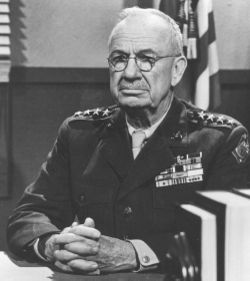
General Holland M. Smith ["Howlin' Mad], overall American commander at Iwo, DID make the conscious decision to retain one fresh division of Marines in reserve.


That the one fresh division present aboard ships was NOT committed has been a grave error in the eyes of some. Especially as the resistance on Iwo Jima was beyond pre-invasion expectations.

But, as even General Christmas said, hindsight is always 20/20.

H.M. Smith had future considerations in mind when he decided NOT to send that reserve division ashore.

This consideration centered around "Downfall". The invasion of Japan that would have commenced in the fall of 1945.

Smith was NOT privy to the atomic bomb secret. Indeed, at the time of the Iwo landings, the first atomic detonation had not even been accomplished. Smith had the invasion of Japan in mind when he DID NOT commit that fresh division.

"many proud regiments suffered devastating losses. With these same units already designated as key components of the landing force against the Japanese home islands, such losses had serious potential implications. These factors may well have influenced General Holland Smith's unpopular decision to withhold the 3d Marines from the battle. From the perspective of an exhausted company commander on Iwo Jima, Smith's decision seemed inexcusable, then and now; from the wider perspective of the commanding general, Fleet Marine Forces, Pacific, the decision makes more sense."

Sending another division into the bloodbath of Iwo would have been, from a manpower standpoint, with an eye to the future, a big mistake.

It is important to remember, that all throughout the Pacific campaign, those island landings on Jap held islands usually resulted in very heavy casualties for the American forces. Battlefield casualties were accompanied by a LOT of non-combat casualties, mental and disease both. Entire units had to be withdrawn to a rear area for refitting and recuperation after battles such as occurred on Guadalcanal and Tarawa.

Rather than debilitate through combat ANOTHER whole division on Iwo Jima, Smith decided to proceed with the plan as originally conceived [two divisions ashore/one in reserve].

It may also be the case that trying to put ashore three divisions of Marines at once on such a small island as Iwo Jima would not have been feasible. NOT enough terrain and land space period to deploy three divisions simultaneously and have them work harmoniously. Unit frontages and boundaries would have been too congested to apply tactics and doctrine as practiced in training with effectiveness.

coolbert.

Labels:

Thursday, November 02, 2006

Cursed?


This is coolbert:

"And I will bless those who bless you, And the one who curses you I will curse." - - Genesis 12; 1-3:


It is generally accepted that during World War Two [WW2], the German nation DID have very good engineers. Had some very radical and innovative designs for WAR MACHINES. Tanks [Tiger], aircraft [jets], submarines [hydrogen-peroxide], etc. State-of-the-art equipment that was ahead of their opponents sometimes in a very marked manner.

The German nation is also accepted to have been DEFICIENT in some very essential and critical areas as well. Areas that were to play a very crucial role in the war. These areas included:

* The entire field of intelligence.

* Physics. [I am thinking development of the atomic bomb here.]

* Mathematics. [crucial to the field of cryptology.]

Cryptology, the making and breaking of codes and ciphers, WAS a weak spot throughout the war for the Germans.

WERE NOT able to penetrate and "read" the high-level codes and ciphers of the allies or the Soviets.

WERE ALSO NOT able to construct their OWN cryptographic systems that were SECURE. HERE I am of course referring here to the entire German debacle with the ENIGMA system.

The ability of the allies to read ENIGMA encrypted messages all throughout the war with IMPUNITY has been touched upon by many authorities.

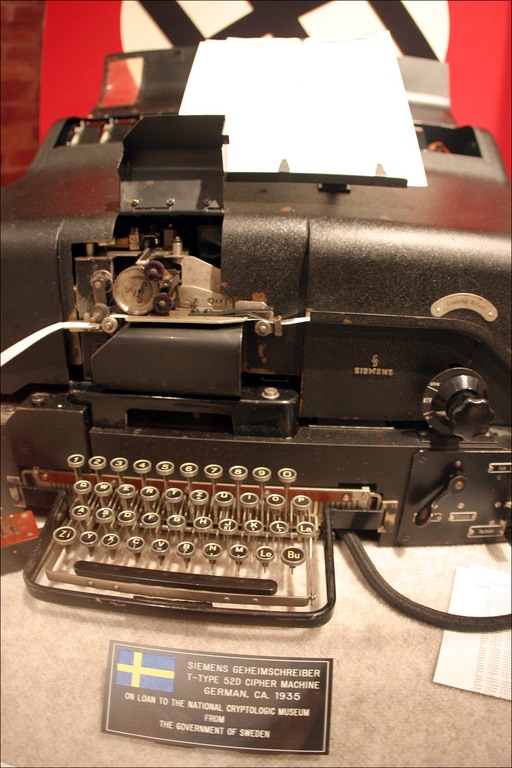
It also seems that another German machine cryptographic system was vulnerable during the war. NOT as well known as ENIGMA. A system that was designed to be MORE secure than ENIGMA. Supposed to be an advancement of a magnitude beyond the ENIGMA. Thought to be so by the German. But was not. This was the geheimschreiber [secret writer]. An on-line cryptographic machine used to secure land-line teletype communications. Long-haul, bread and butter type of communications used for strategic communications of the highest level authorities of the Reich.

The Swedes in particular were responsible for the "breaking" of the geheimschreiber. Remarkably so for a nation usually considered to be a minor-league player on the world stage.

All the result of a Swedish mathematician named Arne Beurling. A man who arrived at a general solution to the geheimschreiber cryptographic machine in TWO DAYS!!!

Read about this astounding feat of Mr. Arne here in this excellent web article.

[the British were ALSO able to "read" this German cryptographic system. To what extent the same as the Swedes is unclear. It is clear the Mr. Arne devised a general solution different from the British, but still effective. Maybe more so!!??]

[that the Swedes could "read" this German secure traffic was a secret for a long time. At least as long [30 years] as the successful effort to conceal knowledge of the ENIGMA secret from the general public. That again of itself is amazing.]

NOW, back to "bless me, I bless you, curse me, I curse you".

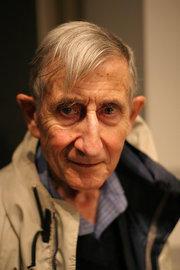
According to the world renowned physicist Freeman Dyson, the Germans during the period of WW2 DID have good engineers, but did not have enough world class physicists and mathematicians. Both were vital to war effort. Mathematicians in particular being need to develop SECURE cryptographic systems that would be relatively invulnerable to enemy snooping.

In the decade prior to the outbreak of WW2, the TOP physicists and mathematicians in Germany WERE JEWISH. Persons that fled the country as a result of Nazi repression. Leaving behind a vacuum that could not be filled. Especially in those two fields where their skills were so needed. As with devising SECURE crypto systems.

Such as WAS NOT the case with the geheimschreiber!!

"Bless me, I bless you, curse me, I curse you". YOU decide!!

coolbert.

Labels:

Sunday, July 23, 2006

Sideshow?


This is coolbert:

In his book "Military Intelligence Blunders", the British retired officer Colonel John Hughes-Wilson makes a startling assertion.

An assertion that the casual reader would not probably appreciate.

The assertion is that the attack [on Pearl Harbor] by the Japanese that brought America into World War Two [WW2] was a mere sideshow to further operations by Japanese forces in "southern waters".

A sideshow??!!

How could this be so??!!

After all, the Japanese DID assemble an enormous fleet for the Pearl Harbor operation. A assemblage of aircraft carriers hitherto never seen or ever even contemplated.

A striking force of great power, that was used ruthlessly and without hesitation.

[this was the kido butai!!]

Even the good Colonel questions his own assertion!

"This fact comes as a slightly shocking revelation to many observers. After all, was it not Pearl Harbor that dragged the USA into the Second World War and turned an essentially European quarrel into a global conflict?"

And yet, Hughes-Wilson seems to be right on the money.

[Well, he is a retired military intelligence officer of ability!]

Pearl Harbor was politically important, but militarily NOT as important as those further military operations of the Japanese directed against Malaya, the Philippines, and the Dutch East Indies.

"Hard though it is to accept, Pearl Harbor was NOT the main Japanese target on 7 December 1941. The merest glance at the balance of Japanese forces deployed in the Pacific during the first week of December 1941 shows that only a fraction of Japanese power was dedicated to neutralizing the US fleet."

The main goal of Japanese forces in the days just after the attack on Pearl harbor was the capture and occupation of territories in "southern waters", mainly Malaya and the Dutch East Indies, for the exploitation of natural resources. Those resources such as rubber, tin, and OIL.

Attacks against the Philippines would be for the purpose of eliminating American forces in the area that had the potentiality to interfere with Japanese efforts in "southern waters". The American garrisons in the Philippines too had to be defeated as a part of successful conquest, occupation, and exploitation.

This emphasis by the Japanese on the "southern operations" was FULLY RECOGNIZED BY ALLIED MILITARY LEADERS IN THE DAYS PRIOR TO PEARL HARBOR!!

[this would include the Americans, British, and Dutch.]

Allied intelligence experts did recognize this threat.

"This was inevitably reflected in the number of messages [radio] intercepted by the American and British [and Dutch too]. The greater part of the traffic [radio] was taken up with events in the South-West Pacific, and Asia, and staff interest in the US fleet at anchorage appeared to be minimal or non-existent.]

"The salient fact about the intelligence disaster at Pearl Harbor is that most of the evidence was hidden by a blizzard of other information at the time. This masking of vital indicator in an overall level of other signals is called "noise" by professional intelligence officers. Quite simply, the clamor of other voices drowned out the Pearl Harbor material."

Furthermore, according to Colonel Hughes-Wilson, and this is germane to 9/11 and WTC too:

"After any surprise attack it is relatively easy to go back over the evidence and pick out he crucial indicators".

Yes!! All that second-guessing done after 9/11 was done by folks that could easily pick out the indications of the attack as they already knew what to look for and what was the significance of what they were looking for.

I recommend this book by Hughes-Wilson highly. Each and every time you read and re-read passages, you pick up on something you had not realized before. Such as what I have just described!

[let me conclude by saying that a lot of folks feel it was a major mistake on the part of the Japanese naval commander Nagumo NOT to have had follow-up attacks on Pearl Harbor. Further attacks would have weakened the U.S. fleet even MORE. Perhaps part of the thinking on the part of Nagumo is that he did not want the kido butai endangered in any manner as it could possibly be needed for more VITAL operations in "southern waters" at a future time. My speculation!]

coolbert.

Labels:

Wednesday, July 12, 2006

Pearl Harbor.

This is coolbert:

"The time has come," the Walrus said,
"To talk of many things:
Of shoes--and ships--and sealing-wax--
Of cabbages--and kings--
And why the sea is boiling hot--
And whether pigs have wings."


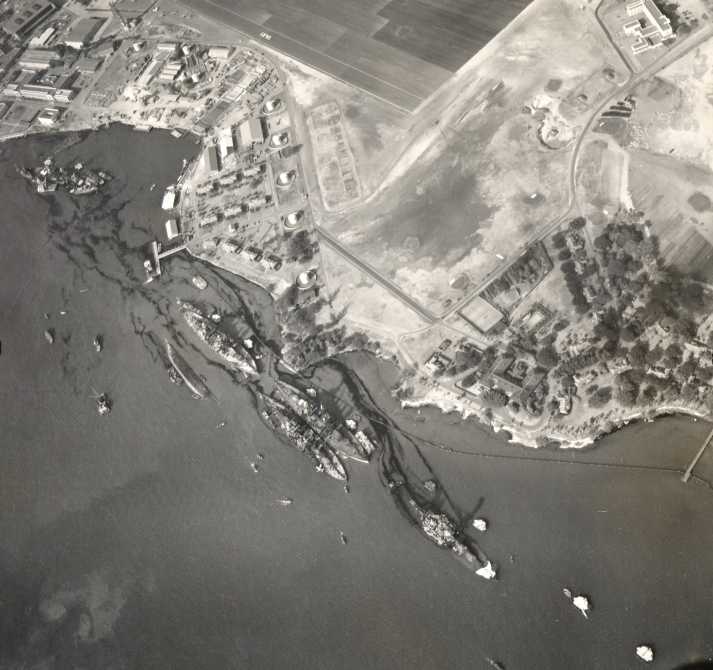
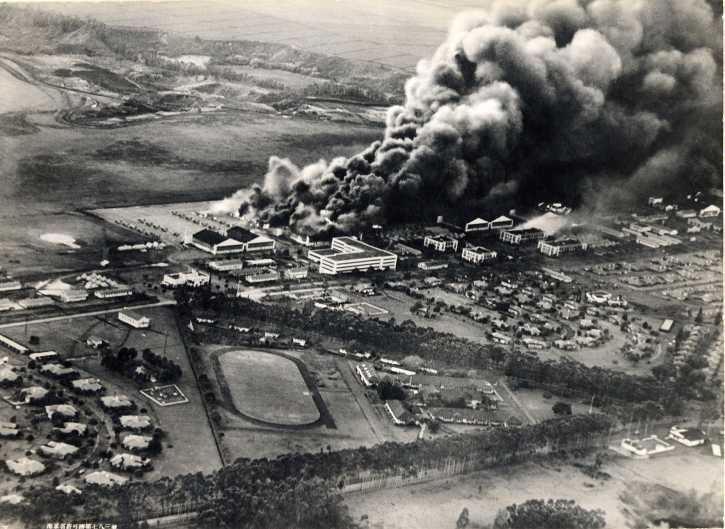
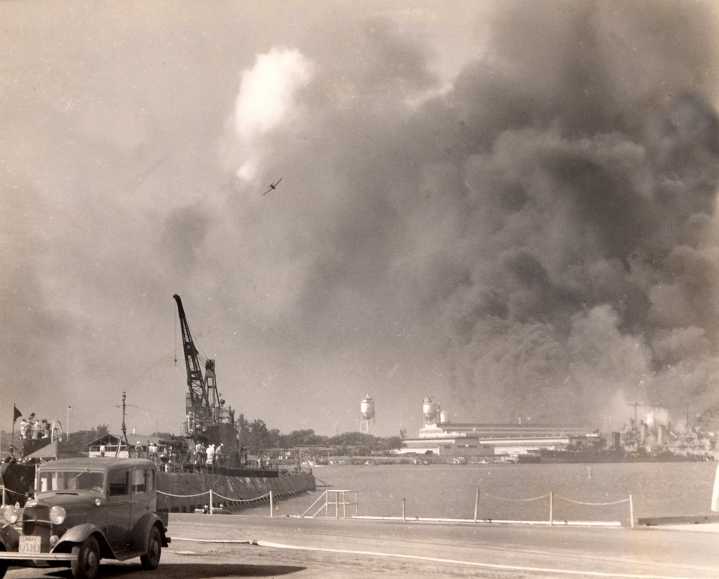
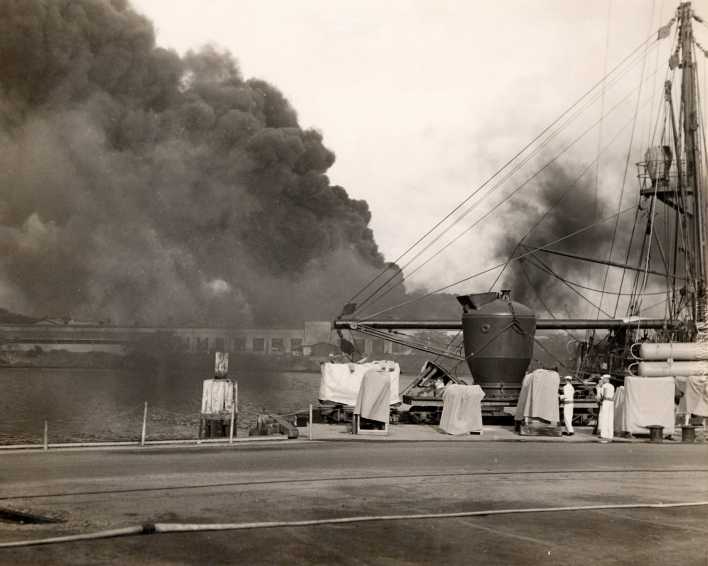
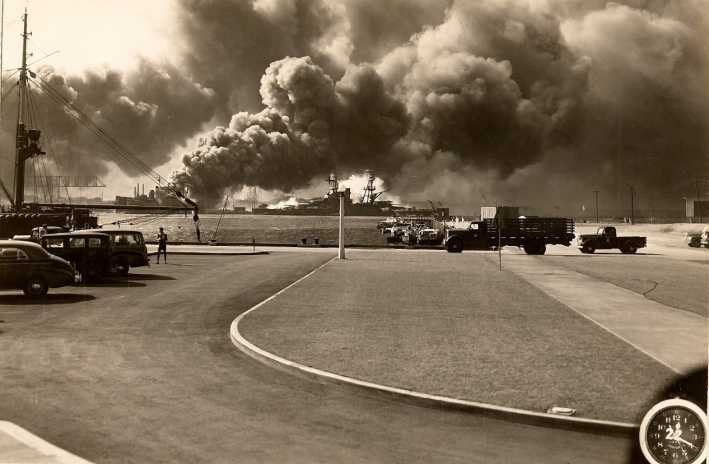
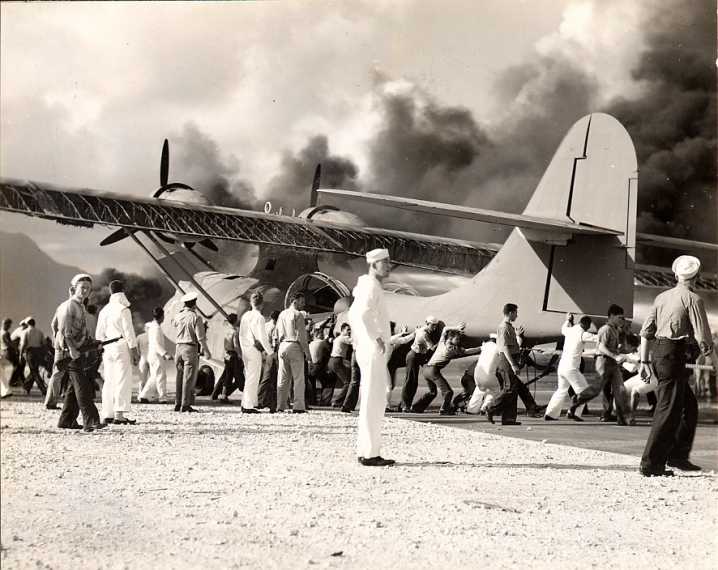
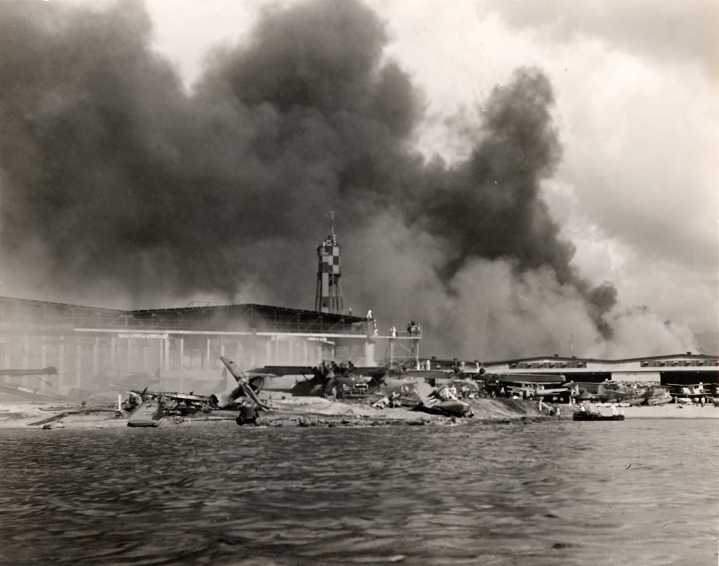
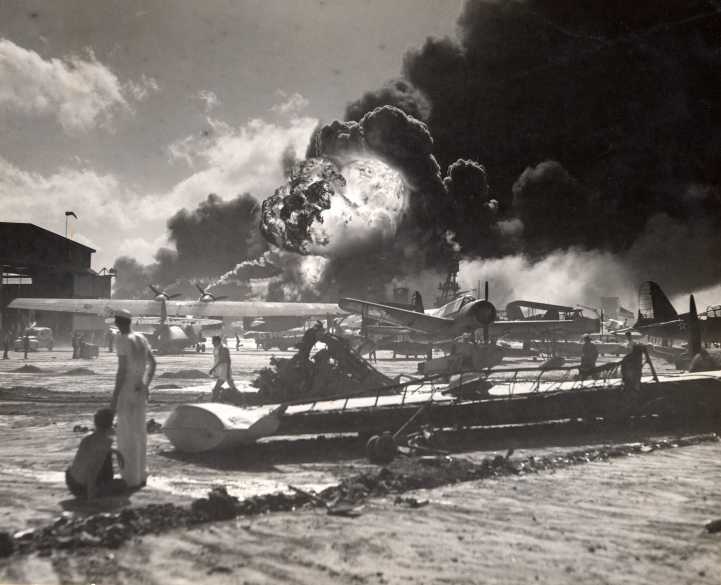
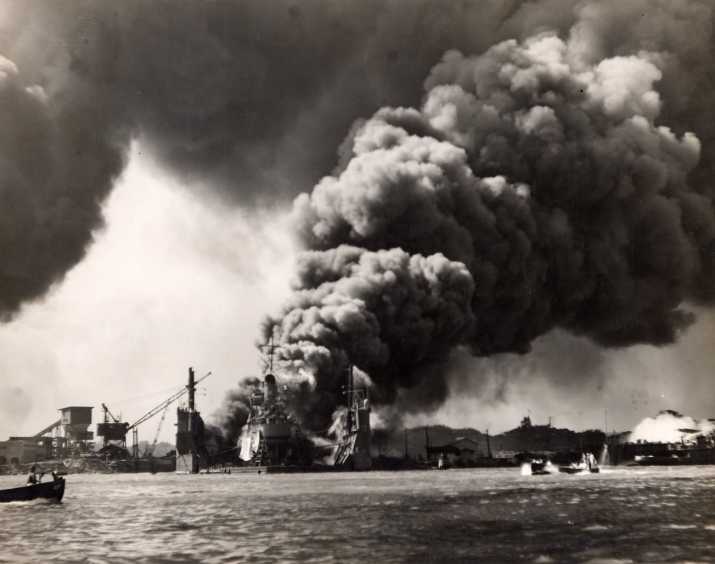
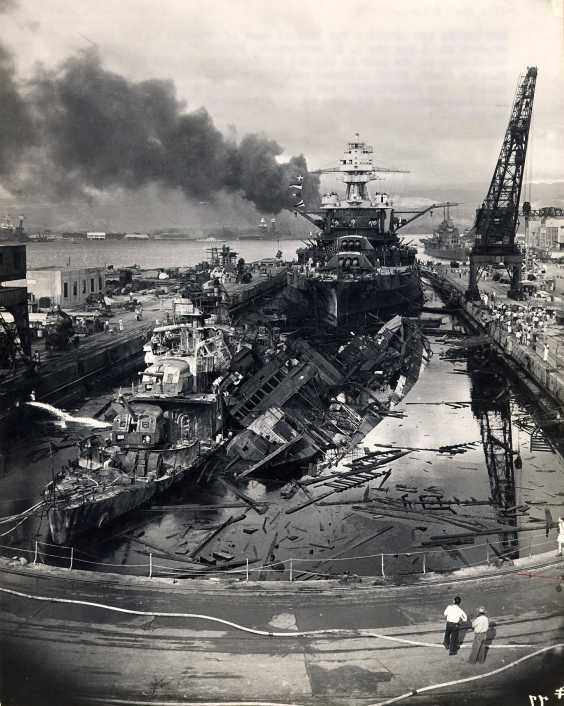
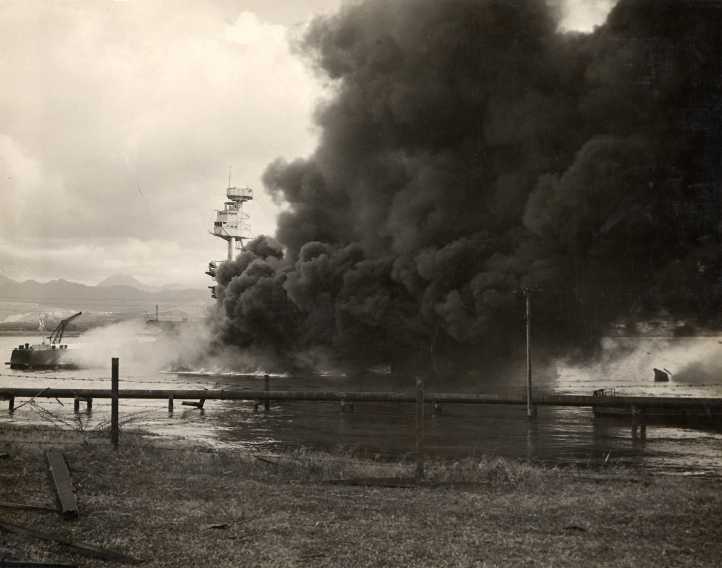
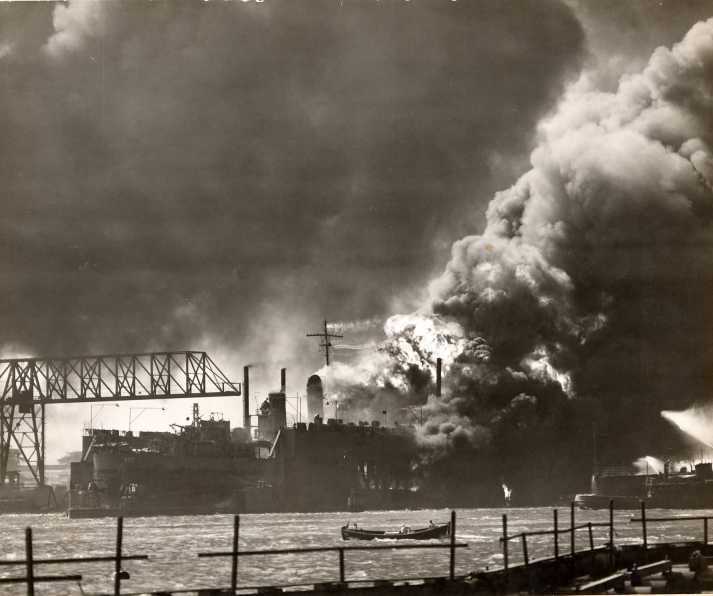
Here are the most amazingly high quality photos I have ever seen of the attack on Pearl harbor. December 7, 1941, a day that will live in infamy.

An attack by a vicious and implacable enemy upon the American fleet berthed at Pearl Harbor. Who is NOT familiar with this??

December 7 had the same effect upon the psyche of my parents generation that 9/11 had upon my generation. A realization that we were NOW at war. With again, a vicious, implacable enemy. An enemy that HAD to be defeated.

My parents generation responded accordingly. With an implacable will of their own. To defeat that enemy, regardless of the cost. Defeat or even anything less than total victory was NOT an option.

With this current enemy and war, after 9/11, the same resolve should be present. Sadly, I get a bad feeling such resolve is missing. We should understand what our current enemy has in mind for US. I do not perceive that folks generally DO understand this. Total victory must not be compromised in this case either.

NO more words, to the photos:


"Pearl Harbor

On Sunday, December 7th, 1941 the Japanese launched a surprise attack against the U.S. Forces stationed at Pearl Harbor, Hawaii. By planning his attack on a Sunday, the Japanese commander Admiral Nagumo, hoped to catch the entire fleet in port. As luck would have it, the aircraft carriers and one of the battleships were not in port. (The USS Enterprise was returning from Wake Island, where it had just delivered some aircraft. (The USS Lexington was ferrying aircraft to Midway, and the USS Saratoga and USS Colorado were undergoing repairs in the United States.)

In spite of the latest intelligence reports about the missing aircraft carriers (his most important targets), Admiral Nagumo decided to continue the attack with his force of six carriers and 423 aircraft. At a range of 230 miles north of Oahu, he launched the first wave of a two-wave attack. Beginning at 0600 hours his first wave consisted of 183 fighters and torpedo bombers which struck at the fleet in Pearl Harbor and the airfields in Hickam, Kaneohe and Ewa. The second strike, launched at 0715 hours, consisted of 167 aircraft, which again struck at the same targets.

At 0753 hours the first wave consisting of 40 Nakajima B5N2 "Kate" torpedo bombers, 51 Aichi D3A1 "Val" dive bombers, 50 high altitude bombers and 43 Zeros struck airfields and Pearl Harbor. Within the next hour, the second wave arrived and continued the attack.

When it was over, the U.S. losses were:

Casualties
USA: 218 KIA, 364 WIA.
USN: 2,008 KIA, 710 WIA.
USMC: 109 KIA, 69 WIA.
Civilians: 68 KIA, 35 WIA.
TOTAL: 2,403 KIA, 1,178 WIA.

[casualties are approximately equal to what was incurred at WTC, 9/11!!]

Battleships
USS Arizona (BB-39) - total loss when a bomb hit her magazine.
USS Oklahoma (BB-37) - Total loss when she capsized and sank in the harbor.
USS California (BB-44) - Sunk at her berth. Later raised and repaired.
USS West Virginia (BB-48) - Sunk at her berth. Later raised and repaired.
USS Nevada - (BB-36) Beached to prevent sinking. Later repaired.
USS Pennsylvania (BB-38) - Light damage.
USS Maryland (BB-46) - Light damage.
USS Tennessee (BB-43) Light damage.
USS Utah (AG-16) - (former battleship used as a target) - Sunk.
Cruisers
USS New Orleans (CA-32) - Light Damage.
USS San Francisco (CA38) - Light Damage.
USS Detroit (CL-8) - Light Damage.
USS Raleigh (CL-7) - Heavily damaged but repaired.
USS Helena (CL-50) - Light Damage.
USS Honolulu (CL-48) - Light Damage.
Destroyers
USS Downes (DD-375) - Destroyed. Parts salvaged.
USS Cassin - (DD-372) Destroyed. Parts salvaged.
USS Shaw (DD-373) - Very heavy damage.
USS Helm (DD-388) - Light Damage.
Minelayer
USS Ogala (CM-4) - Sunk but later raised and repaired.
Seaplane Tender
USS Curtiss (AV-4) - Severely damaged but later repaired.
Repair Ship
USS Vestal (AR-4) - Severely damaged but later repaired.
Harbor Tug
USS Sotoyomo (YT-9) - Sunk but later raised and repaired.
Aircraft
188 Aircraft destroyed (92 USN and 92 U.S. Army Air Corps.)"

coolbert.

Labels:

Tuesday, August 09, 2005

Hoax!

This is coolbert:

Ever since the end of World War Two [WW2], it seems that an endless stream of books have been written regarding the sneak attack of the Japanese at Pearl Harbor [7 December 1941]. The attack that brought the U.S. into the war.

It has long troubled many that the Japanese WERE ABLE to attack without warning and do so successfully in a manner that was at the time astounding to the average citizen. What went wrong?? Why was our fleet not on alert?? What happened or did not happen that allowed this attack to occur??

This is the type of questioning that has been asked over and over. And asked and purportedly answered by a host of eminent and respected historians of the highest caliber.

Perhaps the most contentious accusation made regarding the Japanese attack is that President Franklin Roosevelt HAD to have known that an attack was going to take place. That he did NOTHING and WANTED the attack to take place AND succeed. So as to have a strong pretext to enter the war on the side of England and fight Hitler, who Roosevelt felt was the main enemy.

Partisans of Roosevelt, and there are many, call this sort of accusation mean-spirited politics and unfair character assassination of the lowest order.

Those highly respected and eminent historians have looked at this angle [Roosevelt knew the attack was going to occur] for some time now. And I think the general consensus of opinion runs along these lines:

"well, the belief of Roosevelt and his advisors was that in the days just prior to December 7th, SOMETHING was going to happen. The Japanese WERE going to make an attack. BUT, NOT on Pearl Harbor. The Japanese attack would occur southward, towards Malaya, the isthmus of Kra, the Philippines, and the Dutch Indies. Pearl Harbor WAS NOT a target for the Japanese. Furthermore, in the wake of the attack on Pearl, in hindsight, the fault for American failure was NOT Roosevelt's."


Blame rather:


His subordinates for lack of vision.

The ineptness of Admiral Kimmel and General Short [American commanders in Hawaii].

Poor, faulty, and undisseminated intelligence, not coordinated.

"BUT, DON'T blame Roosevelt. He WAS above the fray."

This, again, seems to be the consensus opinion of the "experts".

IS this consensus correct?

IS something being overlooked?

I leave this for the reader to decide for themselves, based upon the following.

A transcript of an intercepted [by the Germans], supposedly "secure" radio telephone conversation between Roosevelt and Churchill in the ten days prior to 7 December.

[You will recall my blog that mentioned how the Germans were able to read this supposedly "secure" radio telephone traffic].

This material I came across quite by accident. I was handed used copies of a magazine called KTB. This is the publication of an international organization called "Sharkhunters International". A group of enthusiasts dedicated to writing an honest history of the German U-Bootwaffe [U-Boat force]. KTB # 144 [Volume 18 January 2000 Number 1] contains an article that if true [I am attempting to verify the veracity of the article], DOES answer once and for all the question of what Roosevelt knew in advance of the Japanese attack on Pearl Harbor and when he know it. Suggests, NO, does not suggest, SAYS that President Roosevelt knew unequivocally, without any question, with great precision, the time and place of the big Japanese move in the pacific [Pearl Harbor, 7 December].

The following is extracted from the KTB magazine article:

--------------------------------------------------------------------------

Secret State Matter

Nr: 321/41
Time: 26.11/41
Hour: 13.15

Conversation participants: Franklin Roosevelt [FDR] & Winston Churchill [WC].

In this conversation, Winston Churchill explains to Franklin Roosevelt about the Japanese action planned against America.

WC - I am frightfully sorry to disturb you at this hour Franklin, but matters of a most vital import have transpired and I feel that I must convey them to you immediately.

FDR - That's perfectly all right Winston. I'm sure you wouldn't trouble me at this hour for trivial concerns.

WC - Let me preface my information with an explanation addressing the reason I have not alluded to these facts earlier. In the first place, until today, the information was not firm. On matters of such gravity, I do not like to indulge in idle chatter. Now, I have my hands, reports from our agents in Japan as well as the most specific intelligence in the form of the highest level Japanese naval coded messages
(conversation briefly broken) for some time now.

FDR - I felt that this what you were about How serious is it?

WC - it could not be worse. A powerful Japanese task force comprising six of their carriers, two battleships and a number of other units to include tankers and cruisers, has sailed yesterday from a secret base in the northern Japanese islands.

NOTE - this was Hittokappu Bay in the Kuriles.

FDR - We both knew this was coming. There are also reports in my hands about a force of some size making up in China and obviously intended to go south.

WC - Yes, we have all of that (unintelligible) as are far more advanced than you in our reading of the Jap naval operations coded. But even without that, their moves are evident. And they will indeed move south but the force I spoke of is not headed south Franklin, it is headed east.

FDR - Surely you must be . . . will you repeat that please?

WC - I said east. This force is sailing to the east, towards you.

FDR - Perhaps they set an easterly course to fool any observers and then plan to swing south to support he landings in the southern areas. I have . . .

WC - No, at this moment, their forces are moving across the northern Pacific and I can assure you that their goal is the (break in conversation) fleet in Hawaii. At Perl Harbor.

FDR - This is monstrous. Can you tell me the nature of your intelligence without compromising your sources?

WC - Yes, I will have to be careful. Our agents in Japan have been reporting on the gradual (conversation broken) units. And these have disappeared from Japanese home waters. We also have highly reliable sources in the Japanese foreign service and even in the military.

FDR - How reliable?

WC - one of the sources is the individual who supplied us the material on the diplomatic codes that (conversation broken) and a naval officer who our service has compromised. You must trust me, Franklin and I can not be more specific.

FDR - I can accept this.

WC - We cannot compromise our code breaking. You understand this. Only myself & a few (conversation broken) not even Hopkins. It will go straight to Moscow and I am not sure we want that.

FDR - I am still attempting to . . . the obvious implication is that the Japs are going to do a Port Arthur on us at Pearl Harbor. Do you concur?

WC - I do indeed. Unless they add an attack on the Panama Canal to this vile business. I can hardly envision the canal as a primary goal, especially with your fleet lying athwart their lines of communications with Japan. No, if they do strike the canal, they will have to first neutralize your fleet.


According to this, the American president knew about the coming attack on Pearl Harbor ten days before it happened.


FDR - The worst form of treachery. We can prepare our defenses in the islands and give them a warm welcome when they come. It certainly would put some iron up Congress' ass.

WC - on the other hand, if they did launch a bombing raid, given that the aircraft would only be of the carrier borne types, how much actual damage could they inflict? And on what targets?

FDR - I think torpedoes would be ruled out at the outset. Pearl is far too shallow to permit a successful torpedo attack. Probably they would drop medium bombs of the on the ships and then shoot (conversation broken) damage a number of ships and no doubt the Japs would attack our airfields. I could see some damage there but I don't think either an airfield or a battleship could sink very far. What do your people give you as the actual date of the attack?

WC - The actual date given is the eighth of December. That's a Monday.


NOTE - Apparently both Churchill and Roosevelt forgot that Japan was a full day ahead of the Hawaiian Islands due to the International Date Line.


FDR - The fleet is in harbor over the weekend. They often sortie during the week.

WC - the Japs are asking (conversation broken) exact dispositions of your ships on a regular basis.

FDR - But Monday seems odd. Are you certain?

WC - It is in the calendar. Monday is the eighth.

FDR - Then I will have to consider the entire problem. A Japanese attack on us, which would result in war between us . . . and certainly you as well . . . would certainly fulfill two of the most important requirements of our policy. Harry (Hopkins) has told me repeatedly and I have more faith in him than I do in the Soviet ambassador, that Stalin is desperate at this point. The Nazis are at the gates of Moscow, his armies are melting away . . . the government has evacuated and although Harry and Marshall feel that Stalin can hang on and eventually defeat Hitler, there sis no saying what could transpire if the Japs suddenly fell on Stalin's rear. In spite of all the agreements between them and the Japs dropping Matsuoka, there is strong anti-Russian sentiment in high Japanese military circles. I think we have to decide what is more important . . . keeping Russian in the war to bleed the Nazis dry to their own eventual destruction (conversation broken) supply Stalin with weapons but do not forget in fact, he is your ally, not mine. There are strong isolationist feelings here and there are quite a number of anti-Communists.

WC - Fascists.

FDR - Yes, but they would do all they could to block any attempt ton my part to more than give some monetary assistance to Stalin.

WC - but we too have our major desperations, Franklin. Our shipping upon which our nation depends is being sunk by the huns faster than we could ever replace (conversation broken) the Japs attack both of us in the Pacific? We could lose Malaya which is our primary source for rubber and tin. And if the Japs get Java and the oil, they could press south to Australia & I've told you repeatedly, we cannot hold (conversation broken]) them much but in truth I cannot deliver. We need every man and every ship to fight Hitler in Europe. India too. If the Japs get into Malaya, they can press on virtually unopposed into Burma and then India. Need I tell you of the resultant destruction of our Empire? We cannot survive on this small island Franklin (conversation broken) allow the nips to attack, you can get your war declaration through your Congress after all.

FDR - . . . not as capable as you are at translating their messages and the Army and Navy are very jealous of each other. There is so much coming that everyone is confused. We have no agents in place in Japan and every day dozens of messages (conversation broken) that contradict each other or are not well translated. I have see three translations of the same message with three entirely different meanings (conversation broken) addresses your concern for British holdings in the Pacific. If the Japs do attack both of us, eventually we'll be able to crush them and regain all lost territories. As for myself, I will be damned glad to be rid of the Philippines.

WC - I see this as a gamble (conversation broken) what would your decision be? We cannot procrastinate over this for too long. Eleven or twelve days are all we have. Can we not agree in Principle now? I should mention that several advisors have counseled against informing you of this and allowing it to happen. You see by notifying you where my loyalty lies. Certainly to one who is hear and soul with us against Hitler.

FDR - I do appreciate your loyalty Winston. What on the other hand, will happen here if one of intelligence people is able intercept, decipher and deliver to me the same information you just gave me? I cannot ignore it - all my intelligence people will know about it then. I could not ignore it.

WC - But if it were just a vague message then?

FDR - No, a specific message. I could not just sweep it under the rug like that (conversation broken).

WC - Of course not. I think we should let matters develop as they will.

FDR - I think that perhaps I can find a reason to absent myself from Washington while this crisis develops. What I don't know can't hurt me and I too can misunderstand messages, especially at a distance (conversation broken) **

WC - completely My best to you all there.

FDR - thanks for the call.

------------------------------------------------------------------------------

End of transcript.

Is this transcript true?? I am attempting to determine the source. Who knows?? This is the source material that historians will figuratively kill for. Smoking gun they call it. More on this later. With my comments.


coolbert.

Labels:

Friday, May 06, 2005

Italy.

This is coolbert:

There are many disagreements among the "experts" regarding the events of the Second World War [WW2]. For as many questions asked, there are as many answers as there are "experts".

There is one question regarding WW2 for which, I believe, the "experts" would give a unanimous answer. That question would be:

"The armed forces of which country gave the poorest performance in WW2???"

Without question, the answer the "experts" would give, loudly and unanimously, would be, ITALY!!

That this would be so came as somewhat of a surprise during the war years!!

In the years prior to the outbreak of WW2, the Italians DID impress militarily in a number of areas.

The Italians DID have a modern airforce [Regina Aeronautica].

The Italians DID have a modern navy [Supermarina] with considerable abilities.

The Italians did have combat experience from their "conquest" of Ethiopia and from a successful counter-insurgency in Libya.

The Italian military was able to carry out military operations away from their home base. Italian leadership DID display a casual brutality by using saturation bombing and poison gas against spear-carrying Ethiopians. This display of casual brutality is indicative of an aggressive nature, NOT passivity.

[One might argue that fighting camel-riding Senussi tribesmen in Libya or spear-carrying Ethiopians had the opposite effect from creating a combat ready force. When you fight weak opponents, you tend to become weak, when you fight strong opponents, you tend to become stronger.]

[Suvorov states that contrary to popular belief, the Italians DID have good equipment during the war. Italian weapons designers were respected by Red Army intelligence [GRU] as being innovative and imaginative weapons designers.]

However, during the war, the Italian effort, for whatever reason or combination of reasons was downright poor, even shameful to very shameful almost across the board!!

Time after time during the war, the Italians were administered defeats. Sometimes defeats inflicted by numerically inferior foes.

Among these defeats were:

Albania. Italian forces invading were administered a sound beating by the Greek army.

Taranto. The Italian navy had it's major vessels put out of action or damaged IN PORT by eleven British torpedo carrying bi-planes. [A Pearl Harbor type attack.]

Cape Mattapan. The Italian navy suffered a humiliating defeat.

[Defeat at Mattapan was administered by the British navy. The British in particular had extreme contempt for the Italians. British newsreel announcer voices dripped with sarcasm when describing Italian military efforts. Churchill described Mussolini as acting "jackal like".]

The North African desert. Repeated Italian defeats against British opponents that were often numerically inferior.

Malta. An inability of the Italian air force [Regina Aeronautica], bolstered by Luftwaffe units, to reduce the garrison.

Sicily. An unwillingness and inability to defend from allied invasion. Italian forces had to be supplanted by German units.

Final capitulation. Italian forces throw in the towel. German reaction was reinforcement and continuation of the war in Italy, Italian army or no Italian army.

Why the poor performance of the Italian military in WW2. Poor morale? Poor leadership? Poor quality of personnel??

I just cannot say.

But are the experts right? Absolutely.

coolbert.

Labels:

Wednesday, October 13, 2004

Port Blair.


This is coolbert:

All throughout the Second World War, [WW2], and even before that, the Japanese Army engaged in the type of atrocities one only associates normally with the Nazis and the Soviets.

Some of these atrocities are well known and remembered. Such as the Rape of Nanking [China], and the Bataan Death March [Philippines]. And yet, most of the atrocities committed by the Japanese are not well known.

And there seems to be a very big contradiction here. In their home islands, the Japanese are noted for their law abiding nature and politeness. Saint Francis Xavier is reputed to have said about the Japanese, "among the heathen we shall find no people that exceed the Japanese in manners". And yet, when outside the home islands, especially during WW2, the Japanese, for some reason, behaved in many instances as brutes and savages. The politeness was not only gone, it was replaced by a lack of any norms of civilized behavior. A Jekyll and Hyde mannerism that is hard to explain.

A perfect example of a little know but nonetheless horrendous Japanese atrocity occurred on the Andaman Islands. Islands located between the Dutch East Indies and Indian in the Bay of Bengal. both in 1942 and 1945 the Japanese perpetrated atrocity that is hard to understand:

"THE PORT BLAIR MASSACRES

(March 23, 1942) Japanese forces occupied the British controlled Andaman Islands.

They met no resistance from the local population but within hours the 'Sons of Heaven' started an orgy of looting, raping and murder.

Unbelievable orgies were perpetrated in the towns and villages with women and young girls forcibly raped and young boys sodomized [in their own land, such behavior was totally unthinkable].

In Port Blair, eight high-ranking Indian officials were tortured then buried up to their chests in pits they were forced to dig. Their chests, heads and eyes were then prodded with bayonets after which the pit was sprayed with bullets until the helpless victims were all dead.

The Director of Health and President of the Indian Independence League [a group that favored independence of India from Britain, a group that was favorable to the Japanese!], Diwan Singh, was arrested and nearly 2,000 of his Peace Committee associates incarcerated in the local jail and subjected to the water treatment, electric shocks and other unspeakable forms of torture for eighty two days.

Those left alive were then taken out to the country and shot and buried.

After the massacre the Japanese resorted to a reign of terror, women were abducted and taken to the officers club to be raped by the officer elite [this sort of behavior by senior officers speaks of a total breakdown of discipline and order].

A shipload of Korean girls was brought in to participate in this 'sport'.

During the three and a half years of Japanese occupation, out of the 40,000 population of Port Blair around 30,000 were brutally murdered.

The small islands of the Andamans were left a scene of utter devastation.

This was Japan's way of helping India get her freedom from the British."

Further:

"MASSACRE ON ANDAMAN
( August 14, 1945 )

Situated midway between the Bay of Bengal and the Indian Ocean, lie the tranquil Andaman Islands. As the food shortage became acute during the last month of the war, the Japanese occupiers decided to exterminate all those who were no longer useful or employable. All were deprived of their personal possessions and household goods before being embarked on three boats. About two kilometers from the shore of the uninhabited Havelock Island they were forced to jump into the sea and swim to the beach. Most of them, around a hundred, drowned on the way and those who made it were abandoned to die of starvation. Of the original 300 who landed only eleven were alive six weeks later. The next day, 800 Indian civilians were rounded up and transported to another uninhabited island, Tarmugli. Transferred to the island in small boats, they wandered aimlessly on the beach waiting for further orders. Soon, a detachment of 19 Japanese troops arrived and what followed was one of the most heinous crimes in the annals of the Pacific war. It took the detachment just over an hour to slaughter all but two of the 800 victims by shooting and bayoneting. Next day, August 15, 1945, the day of the Japanese surrender, a burial detail of troops arrived to remove all traces of the massacre. Within twenty-four hours all 798 bodies were collected and burned in funeral pyres until only fragmented bones and ashes remained. The ashes were then buried in deep pits dug on the beach. In a gross miscarriage of justice, the Japanese officer responsible was sentenced to only two years in prison by a British Military Court."

There is something very strange about these "incidents".

It seems that many of the persons murdered on the Andamans were followers of Chandra Bose, an Indian agitator and Axis collaborator who hoped for Axis victory in WW2 as a means of gaining Indian independence from Britain. THE PEOPLE THE ATROCITIES WERE PERPETRATED AGAINST WERE FOR THE MOST PART PERSONS WHO WELCOMED AND HOPED FOR JAPANESE VICTORY. PERSONS WHO WANTED A JAPANESE INVASION OF THE ANDAMANS IN THE FIRST PLACE!!!!!

In addition, please note the date of August 14 and August 15, 1945. This is the day before and the day of the Japanese surrender. You would have reasonably have thought that at least by this time the Japanese would have seen the handwriting on the wall and realized that further uncivilized and beastly behavior was NOT in the THEIR interests. But NO!! What was the mentality behind this, I just cannot say?

It should also be kept in mind that at the time of the Japanese surrender there were still about 300,000 allied internees and POW's in the hands of the Japanese. If not for the speedy end of the war in the Pacific brought about by the use of atomic weaponry, many of those 300,000 persons at the hands of the Japanese would have undoubtedly suffered the same fate as the people of the Andaman Islands!!!

"British/Indian troops landed on the Islands after the Japanese surrender,in October 1945."

Damn!!!!!

coolbert.

Labels:

Wednesday, August 04, 2004

Scientists.

This is coolbert:

I think it can be safely said that World War One [WW1] can be categorized as a war of industrialization and mechanization. Man's significant inventions of the twentieth century, flight, the internal combustion engine, etc., and the harnessing of the mass industrial output of a nation for the war effort, these are all characteristics of WW1.

It is also safe to say that World War Two [WW2] was a science war. Man's science was harnessed in the war effort to construct newer and more devastating weaponry, culminating in the atomic bomb. Scientists on both sides of the conflict, Allied and Axis, played a continuous game of ones-up-man-ship in an effort to stay ahead of the opposition.

Many great scientists, mostly physicists, but not entirely confined to that discipline, played significant parts in the war effort. In the years after the war, many of these scientists became famous in their own right for important discoveries and accomplishments.

One such scientist is Gordon Welchman.

While working at Bletchley Park, Welchman was instrumental in developing the first techniques that allowed for British cryptologists to "break" German secret messages sent via the now famous Enigma cipher machine. These first "breaks" led to an understanding of how to read intercepted Enigma messages on a real time basis, rendering invaluable support to the Allied war effort.

Welchman was in the years subsequent to the war instrumental as well in developing packet technology. Without packet technology, the internet and computer technology as we know it would not be possible, period.

"(pak´it) (n.) A piece of a message transmitted over a packet-switching network. See under packet switching. One of the key features of a packet is that it contains the destination address in addition to the data. In IP networks, packets are often called datagrams."

Richard Feynman is another scientists who did yeoman's duty during war, and came to great repute after the war.


As a member of the staff for the Manhattan Project, Feynman, at the age of twenty one [21] !?!? was in charge of the human computers that did the calculations for the a-bomb project, all calculations having to be done by hand or with the assistance of electro-mechanical calculators [computers as we know them now were not in existence at the time].

In the years following the war, Feynman was awarded two Nobel Prizes for his discoveries in physics!!

Yet another physicist who contributed significantly to the war effort was William Shockley.


While working as an operational research analyst [you may remember that in a previous blog entry I have mentioned that the Germans were the first to apply operational research analysis in a military sense] for the U.S. Navy, Shockley, through a process of inspired questioning and analysis of statistics, was able to correctly advise the Navy as to what depth to set depth charges at when attacking German submarines during the Battle of the Atlantic. Shockley's correct advice proved to be an important part of the whole in winning the Battle of the Atlantic.

After the war, in 1947, Shockley, with two other colleagues, is credited with the discovery of the solid-state transistor, a discovery for which they were awarded the Nobel Prize. As the computer as we know it today [the modern PC] is considered to be the greatest invention of the Twentieth Century, Shockley can therefore be said have been the hand that got the ball rolling, solid-state technology being absolutely instrumental to the modern PC! Indeed, the entire phenomenon of Silicon Valley can be credited to the myriad of spin-off companies from the original commercial venture of Shockley's, Fairchild Semiconductor!

In the 1970's, the reputation of Bill Shockley fell into disrepute as a result of his controversial and probably ill-conceived observations regarding eugenics. It was claimed that Shockley, a physicist, not a biologist or geneticist, had no business intruding into an area where he had not education or experience. Shockley responded that his experience as an operational research analyst made him eminently qualified to make the pronouncements that he had made [whites were inherently intellectually superior to blacks].

Finally, the British physicist Freeman Dyson made significant contributions to the war effort as an advisor and analyst for British Bomber Command.


The strategic aerial campaign of the allied air forces over Germany during WW2 was very intense combat wise and also technology wise. Both sides employed all the latest scientific apparatus and electronic measures at their disposal to gain the upper hand. This was technology, counter-technology, and counter-counter-technolgy warfare. Dyson did analysis on the effectiveness of these measures and made recommendations based upon statistical analysis, perhaps based upon the same methods used by Shockley. The quotes of Dyson on German resistance to the strategic bombing offensive are very telling:

"In the closing stages of the war, the fighters earned the admiration, even of some their enemies, like scientist Freeman Dyson.

DYSON:

"The night fighters and their supporting organization put up an astonishing performance, continuing to fight and cause us serious losses until their last airfield was overrun and Hitler's Germany ceased to exist."

"They ended the war morally undefeated. They had the advantage of knowing what they were fighting for, not in those last weeks of the war, for Hitler, but for the preservation of what was left of their homes and families, their cities and their people. We had given them, at the end of the war, the one thing they lacked at the beginning, a clean cause to fight for."

Following WW2, Dyson's career as a physics professor branched into many areas of research and study, such as:

"In the years following the war, Dyson was responsible for demonstrating the equivalence of the two formulations of quantum electrodynamics which existed at the time -"

"From 1957 to 1961 he worked on the Orion project, which demonstrated the possibility of space-flight using nuclear propulsion:"

"In one of his scientific papers, Dyson theorized that a technologically advanced society could completely surround its native star in order to maximize the capture of the star's available energy."

"Dyson has also proposed the creation of a Dyson tree, a genetically-engineered plant capable of growing on a comet."

Dyson continues to this day as a most profound, learned and imaginative scholar!!

coolbert.

Labels:

Tuesday, July 27, 2004

Bodyguard.

This is coolbert:


"the truth is so precious that it must be surrounded by a bodyguard of lies."


Now, this famous quote of Winston Churchill is bandied about by a lot of "experts" and conspiracy theorists and offered as proof that governments around the world generally are constantly lying to us and deceiving us about the truth of things.

Now, what was Churchill actually talking about in the context of this quote?

He was talking about BODYGUARD. A deception plan, one of two deception plans, that was used to deceive the Germans as to the true place of the landing by the Allied forces in France. The other plan was code named FORTITUDE. Both of these plans were designed to deceive the Germans, and both worked famously.

"The most important reason was the development of an extensive deception plan, which was named Bodyguard. It had two major objectives; 1) to confuse the Germans about when and where the invasion was to take place, and 2) to cripple the Germans once the invasion began. [4] It was the most complicated deception plan of the entire war, if not of all time."

The main idea of these deceptions was to confuse the Germans as to the true place intended for the main landings of the Allied forces in France. From Norway down to the border between France and Spain were all possible landing points. And the Germans, being the defenders, had to spread their defenses out. The Allied forces, between the attackers, had the initiative, and this allowed them to achieve superiority at the time and place of their choosing. The approximate time could be surmised by the Germans with some accuracy. After the bad weather in the North Sea from winter of 1943-44 had subsided, and the summer was not too advanced. That would be the months of May, June, or July. The place for the landings was more of the mystery.

And it was here that the deception plans totally fooled the German defenders.

The deception plans led the Germans to believe that a whole lot of Allied armies existed that actually did not. One imaginary [notional] army was poised to invade Norway. Another notional army was poised to invade the Pas de Calais area [the shortest route across the English channel]. Another part of the deception was intended to lead the Germans to believe that the allies would land in the low countries [Belgium, Holland]. The Bay of Biscay as a possible landing area was also located included in the deception plan.

"The centerpiece of the deception plan was to convince the Germans that the invasion would occur in the Pas de Calais area. This proved to be relatively easy. As early as October 1943, Field Marshal Gerd von Rundstedt (the Commander of the German Armies in France) became convinced that the Allies would invade there, an opinion he sent via Enigma to OKW (the German military headquarters). [7]"

"To keep the Germans preoccupied with Pas de Calais, the Allies created the mythical 1st United States Army Group (FUSAG). It was "placed" opposite the Germans in Dover, and "commanded" by US General George C. Patton. [8] From October until the end of July 1944, when this deception was finally dropped, it remained a primary focus of Bodyguard. At all times, it was imperative to keep the Germans convinced that the invasion site was Pas de Calais."

The allies had an additional and huge advantage in that they knew what was the course of action Hitler believed they [the allies] would take. That was a major landing in the Pas de Calais area. Hitler believed this was where the allies would strike, the allies knew it, and the allies took full advantage of this. A lot of the deceptions were designed to reinforce this idea in the mind of Hitler. And Hitler continued to believe the deception even after the allies landed in Normandy!! Hitler believed the Normandy invasion was just a diversion!? Knowing what your foe believes allows you to take advantage of their belief if you are skilled enough!

And best of all, the allies had a feedback mechanism to tell them how well their deception was working. This was done through Enigma decrypts. German encrypted messages were intercepted by the allies and decrypted. These messages told them that they were successful in deceiving the Germans. Success was reinforced and the plans worked.

"Luckily for the Allies, a significant amount of Ultra was being deciphered by the Allies in 1943 and 1944. This made it easy to measure the plan's effectiveness as it was being carried out. During the spring of 1944, Ultra was thorough enough to offer a nearly complete picture of the enemy."

"All war is based upon deception", - - Sun Tzu. How many times have I mentioned this quote? So appropo here, isn't it?!

coolbert.

Labels:

Sunday, July 25, 2004

Husband.


This is coolbert:

In light of the findings of the 9/11 commission, it would be worthwhile to remember another catastrophic attack the U.S. suffered, that at Pearl Harbor in December 1941. The 9/11 WTC attack is said to have had the same shock effect upon the American public that Pearl Harbor did. But sixty years later, of course.

At the time of the attack on Pearl Harbor, the American public was said to be incredulous that such a thing could have happened. "Were not he authorities aware of such a possibility?", was the refrain!

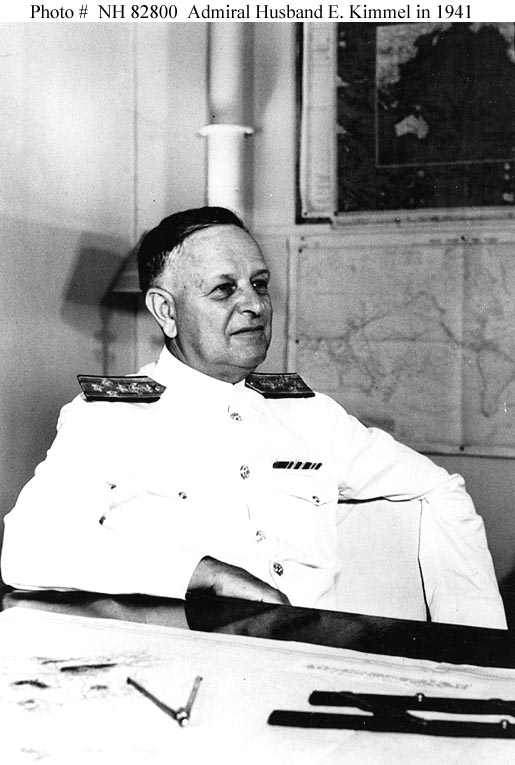
How aware at the time was the U.S. Navy that the fleet at Pearl harbor was vulnerable to attack? Very aware if the words of Husband Kimmel, naval commander at Pearl are to be believed.

Kimmel was well aware that while affording an excellent harbor for the U.S. Navy Pacific Fleet, the harbor at Pearl also had a glaring weakness. It had a narrow mouth that allowed for only one major ship at a time to enter/exit. If just one major warship was sunk in the mouth of the harbor, whatever ships were in the harbor at the time would be bottled up for months at a time. Not able to exit because of the blockage.

Kimmel was also aware of the possibility of a Japanese naval aviation sneak attack against the massed docked fleet. This was on his mind!!

Kimmel was aware of the successful attack by British naval aviation the previous year on the Italian docked fleet at Taranto.

Taranto was a port that had the same characteristics as did the port at Pearl.

The British making a night attack on the docked Italian fleet at Taranto with antiquated, wood and canvas bi-planes carrying torpedoes.

This night attack succeeded beyond the wildest dreams of the British, the major warships of the Italians being torpedoed and put out of action, not to be available for naval action for quite a subsequent time. This was a major coup on the part of the British. And was accomplished by just FIFTEEN torpedo carrying bi-planes. The Italian ships were not sunk, but were damaged to the point where they could not sail and therefore useless to further war effort. Click here to see a very interesting site about the attack at Taranto.

And, strangely enough, the U.S. Navy itself had in 1934 successfully wargamed the carrying out of a sneak attack by naval aviation on the massed fleet at Pearl Harbor!?

Naval contrarians in the U.S. Navy had long advocated the fast striking power of naval aviation against battleships. And this advice was long ignored by the battleship admirals as being unfeasible. This specific war game in 1934 involved one fleet defending Pearl Harbor and a second fleet [aggresssor] sailing from Panama to simulate an attack upon Pearl. This second fleet had as a constituent part the aircraft carrier Lexington. It should be noted that the major part of this second "aggressor" fleet sailing from Panama was battleships [the aircraft carrier was at the time considered to be an adjunct]. It was foreseen that the naval battle would go like this:

* The aggressor fleet would sail from Panama.

* This aggressor fleet would be tracked by reconnaissance of the defenders, i.e., submarines, patrol planes, patrol surface vessels, radio intercepts, etc.

* The defending fleet at Pearl would wait for the proper moment to sail, all the while being "protected" at the "safe" anchorage of Pearl Harbor.

* Once the aggressor fleet was within a certain range of Pearl, the defending fleet would sail and both fleets would maneuver for position and advantage.

* At some point, the two fleets would meet in a climactic, battleship suface action, with all other vessels being adjuncts to the massed guns of both fleets.

* The defenders would of course win and the battleship admirals would be vindicated in their beliefs.

This is what did not happen!!

What did occur is a successful, without warning, sneak attack [war game, not lethal of course] by the naval aviation of the Lexington upon the moored and defenseless battleships of the U.S. Pacific fleet at Pearl.

The Lexington, steaming very fast, left behind the slow-poke battleship aggressor fleet of which she was a part, and on her own, maintaining radio silence, sailed around the Hawaiian islands and approached Pearl from the north, just as the Japanese did seven years later.

The officer in charge of leading the attack decided that seven o'clock, Sunday morning would be the most opportune time to attack the moored fleet [it is often felt by some that this time was the most opportune as a reaction by the moored fleet would be impossible due to so many sailors being incapacitated by drinking binges from the previous night!!].

Launching aircraft early in the morning, the planes of the Lexington, following and hiding in a storm squall, emerged over Pearl Harbor fully armed and ready to attack. The umpires of the war game ruled this to be a legal and possible maneuver. And that all the ships at anchor at Pearl were deemed to have been sunk or damaged by the attacking planes of the Lexington!

And what happened seven years later? Japanese planes, attacking from the north, using the mountains [not a storm squall in this case] for cover, at seven o'clock on Sunday morning, caught the U.S. Pacific fleet at anchor and destroyed it!!

Now, someone might say, did the Japanese know of this war game and know what possibilities this manner of attack offered?

I am not sure.

But it is a good bet that by careful radio monitoring of U.S. naval exercises, the Japanese probably had a good idea of U.S. naval tactics, to include this simulated attack upon Pearl. [U.S. Navy radio monitors all throughout the 1930's maintained a very large number of intercept stations throughout the Pacific. These radio monitors were very good at monitoring Japanese fleet activities and observing from afar Japanese tactics and strategies. It is not beyond possibility the Japanese did the same to the U.S. Navy in the years leading up to WW2].

So, Admiral Husband Kimmel was aware of the great danger posed to the U.S. Pacific Fleet by a sneak attack upon Pearl Harbor. And Kimmel was aware that Japan was going to take some military action in the Pacific in the days prior to the attack upon Pearl Harbor. And yet, knowing all this, the fleet was still caught at anchorage and destroyed! Go figure!

coolbert.

Labels:

Sunday, June 20, 2004

Help?

This is coolbert: In the international Jewish community [sometimes referred to as World Jewry] there has been a long standing grudge against the allied militaries and the leaders of same from World War Two [WW2].

The argument is made by the Jews that nothing was done to save the condemned Jews being sent to the death chambers and crematoria of Auschwitz. The feeling among world Jewry is that the Allies did not care, could have done more, but did not. And perhaps one reason, according to world Jewry, is that this slaughter of the Jews was not all unpleasant in the eyes of the allies. That somehow by their inaction they gave tacit approval to what the Germans were doing.

One suggestion that world Jewry has made is that the railroad tracks leading to Auschwitz could have been bombed. Impeding the process of the trains taking tens of thousands to death. The failure of the allies to bomb the tracks is cited as proof that the allies just did not care.

Is this argument plausible?

Not very! If the decision had been made to bomb the railroad tracks leading to Auschwitz, it would have had to have been during the daytime by a mass of bombers. Precision bombing just did not exist except in rare cases during World War Two. This mass of bombers could have all dropped their bomb loads at once on a stretch of track, but probably with less than satisfying results.

These types of bombing missions during the war almost without exception met with limited and less than satisfactory results. And the Germans were very good at repairing this sort of damage, and quickly too. The trains would be rolling again in no time. The Germans had put a high priority on sending trainloads of Jews to Auschwitz for extermination and this would not have deterred them. And what is worse is that the losses to the allied aircraft would have been prohibitive.

There would have only a few months out of the year to do this sort of mission [considerations of daylight], because of the length of the mission [pushing the bombers to the furthest of their range], and flying through the most densest part of the German air defenses to do so too [without escort].

Once when going to the target the bombers would be subject to fighter interceptor attack, and once again when returning to base they would have been hit a second time.

The losses would have been unacceptable for the gain.

As cruel as it may sound, the military gain would be nil, and actually impeded the furtherance of damage to the German war machine [defeating the German military was the paramount goal of the war].

An alternative approach would have been to destroy the crematoria at Auschwitz. This would have stopped the burning of the dead bodies and left the Germans with no recourse but to stop the executions of the Jews.

Not being able to burn the bodies would have created a monumental disposal problem that could not be solved.

Could this have been done?

Yes!

One of the pilots from the famous "Dam Busters Squadron" was asked how the bombing could have been done. He suggested flying a four engine Lancaster to the target and dive bombing the crematoria with a huge bomb that would destroy the target. This would have been the only way.

Again, units such as the Dam Busters had more important agendas and target during the war. Sad to say, this would have not been a useful mission for such an elite unit.

Now, there is another alternative bombing that could have been done that may have had an even great effect on saving the condemned Jews.

In the nine hour documentary "Shoah", an interview was made with an American professor who had been an officer in the Polish Home Army [the underground guerilla force left over after the conquest and occupation of Poland by the Germans] during the World War. This officer, a Christian, toured a Jewish ghetto just prior to leaving for a mission to England. The Jews wanted this man to see for himself what was happening to them. And this officer recounts a conversation he had with two leading members of the surviving Jewish community. He asked the two men what could be done to save the Jews. Here is the response:

"First, the allies must announce to the German people what is happening to the Jews, using all the means at their disposal. Perhaps the German population does not know. Tell the Germans to stop or there will be consequences. Give them one month for the slaughter to stop."

"Then [secondly] if it [the killing] does not stop, the allies must mass their air force and on one specific day, they must then obliterate a German city from the face of the earth. Again, then announce to the German people what has happened and why. And tell them to stop. And once again, give them one month. And if the slaughter does not stop, once again, mass the allied air force and obliterate another city. And continue to do so until the slaughter stops".

This officer did relay his intelligence and personal observations to the authorities in London. But what was proposed did not happen.

Would it have stopped the Germans from slaughtering the Jews?

I bet it would not have. By that time the Germans were hell bent on their policy of slaughter and would have just continued without blinking an eye. Persons of the ilk that would carry out such a slaughter in the first place are not phased by threats.

Here is something further to consider with regard to bombing the railroad tracks leading to and the crematoria at Auschwitz.

There was a book published some decades ago now called "Poland, SOE, and the Allies". Recounts the various attempts of the British SOE [Special Operations Executive] to air drop supplies to the Polish Home Army.

All throughout the war this was a priority for the British. And yet, these air drops were almost uniformly unsuccessful.

And the reasons were very similar from what was previously described as being reasons for not bombing the railroad tracks leading to Auschwitz.

Long range bombers would have to be used, flying through the worst part of the German air defenses both ways, in day time so the drops would be on target, unacceptable losses for the gain, etc.

Even during the Battle of Warsaw in 1944 were the allies for the most part unable to air drop supplies to the Home Army troops. Long range bombers several times tried to drop supplies to the embattled Poles. The only successful drop was by the South African air force, and that was only once done successfully. If the allies could not help by air their fellow Christians, how could anyone assume they could have done better by air operations to help the Jews?

coolbert.

Labels:

Thursday, February 12, 2004

Unconditional!

This is coolbert:

One thing about an invasion of Japan and the dropping of the a-bomb that is only appreciated in a minor way.

Japan was trying to surrender.

But under their terms.

* NO occupation.
* NO disarming of the military.
* NO concessions about overseas territories [Formosa, Korea, etc.].

The Japanese wanted a negotiated settlement that would not be too unfavorable to them.

This was totally against what the Allies and the Soviets had fought for during the war.

It was decided early that because of the nature of the enemy being fought in WW2, unconditional surrender was the only course to be taken by the allies.

And this was the course taken with regard to Italy and Germany.

Why would Japan have been such an exception?

It would not have been!

Without an cessation of hostilities the war would have continued in the manner that it was already taking until Japan surrendered unconditionally or the place was more or less obliterated.

The Soviets had already entered the war and annihilated the Kwangtung Army of Manchuria.

Further warfare would have probably seen the Soviets invade Hokkaido and probably further south too. I am not sure the Soviet capability in this area, but it may have been more than would have been anticipated.

coolbert.

Labels: ,