Thoughts on the military and military activities of a diverse nature. Free-ranging and eclectic.

Saturday, March 15, 2008

Wuhan.

This is coolbert:

While surfing the Internet looking for info on the use of poison gas by the Japanese military, of course came across the Battle of Wuhan.

NOT even a footnote to history now?

A battle of the most momentous proportions. An epic fight on the scale of a Stalingrad?? NOW, forgotten?

"The Battle of Wuhan . . . was a large-scale battle of the Second Sino-Japanese War. More than one million National Revolutionary Army [the Nationalists] troops were gathered, with Chiang Kai-shek himself in command, to defend Wuhan from the Imperial Japanese Army . . . It lasted four and half months, and was the longest, largest and one of the most significant battles of the entire Second Sino-Japanese War.

Staggering statistics as to the number of combatants involved:

Chinese - - 1,100,000 troops (120 divisions).

Japanese - - 350,000 troops.

Casualties and losses - - 400,000 Chinese

"including a small band of Soviet Air Force volunteers [100 casualties total]."

[Soviet pilots at the same time were also fighting in the skies over Spain. I think it comes as a surprise to many that the Soviets would supply aid and assistance to the Chinese Nationalists!?]

The Battle of Wuhan was a Japanese victory [facilitated in measure by the use of poison gas?]! But what is called a pyrrhic victory!!??

"pyrrhic - - adjective - - 3. of or relating to or resembling Pyrrhus or his exploits (especially his sustaining staggering losses in order to defeat the Romans); 'a Pyrrhic victory'"

"The Japanese's pre-war hopes for a final showdown in Wuhan, to annihilate the main force of Chinese Army and forcing them to yield were unsuccessful . . . the China theatre now entered the stage of stalemate"

The Chinese Nationalists under Chiang Kai-shek were often seen and portrayed in the U.S. media as being corrupt, inefficient, lackadaisical, more concerned with fighting and defeating the communists under Mao than fighting the Japanese.

That is all baloney? The U.S. media and historians have fed us garbage. The Battle of Wuhan is an indication this is so [being fed garbage]! Persons willing to commit resources, fight as long and as hard as the Chinese did at Wuhan [even in defeat] is NOT indicative of laziness, corruption, a lackadaisical attitude, etc.!!

coolbert.

Labels: ,

Thursday, March 13, 2008

My Japan!

This is coolbert:

Here is the type of thing Bert likes to read.

A wiki entry on the World War Two [WW2] "propaganda" movie, "My Japan"

"My Japan"

"My Japan is an American anti-Japanese propaganda film produced in 1945 to spur sale of American war bonds. The film takes the form of a mock travelogue of Japan, presented by an impersonated Japanese narrator."


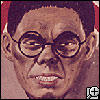
Well - impersonated - sort of! Man appears to be a Nisei. Japanese-American doing his bit for the war effort. Dig the ever-smiling face, the Ming-the-merciless haircut, the flower arrangement.

This particular wiki entry tries to make some hay of the fact that this is a "propaganda" film. Uses statistics that are incorrect. NOT factual or accurate.

From the narration:

"Guadalcanal, Tarawa, Saipan, Iwo Jima - you boast of them as major victories; to you they are. To us they are minor defeats - the loss of island outposts. You Americans are fond of saying 'look at the score.' Very well, look at it. You sent your finest troops against these outposts. They died by the thousands. Here they are massacred, slaughtered. But you took the islands, you say. Yes, we expected you to. That is why we garrisoned them with second-rate troops. The best of your lives for the worst of ours. WE TOO, know a thing or two about bargains. You have not yet faced the best of our armies. You have faced only ten percent of our worst!"

That the statistics are incorrect is not germane!! The narration would BE CORRECT FROM A JAPANESE STANDPOINT!! Even up to the final surrender, the Japanese public did believe the war was going just swimmingly and that the American forces were being annihilated right and left. Superior Japanese fighting spirit would always triumph over materially rich but spiritually weak American forces. The film IS CORRECT IN PORTRAYING THINGS AS THE JAPANESE SAW THEM!!

[In 1944, the Japanese for two weeks celebrated in a delirious manner the sinking of an entire American aircraft carrier task force in a naval battle near Formosa [Taiwan]!! A naval battle THAT DID NOT EVEN OCCUR!! Such was the mental state of the Japanese even at the end of the war!!]

coolbert.

Labels:

Sunday, November 11, 2007

The Rising Sun??

This is coolbert:

Here is the latest intelligence from KTB "Sharkhunters" [http://www.sharkhunters.com]

"A destroyer? One of Japan's newest acquisitions for the Japanese Maritime Self Defense Force. Incorporates a AEGIS radar suite. Though it describes a full length flight deck, I would assume it has vertical missile tubes before and aft of superstructure. Offensive or defensive.....depends on your point of view, doesn't it since other paperwork says it has hangar space for 16 helicopters and once the VSTOL F-35 is operational, all the other Asian countries may start rumblings about Japanese militarism - something that has never left their minds since WW II."

Combat systems to include:

* AEGIS radar suite.

[remember, a "suite" is the radar plus all the electronics and computer systems that goes with it!! An ENTIRE system!]

* Full length flight deck. [with (an offset superstructure)]

* Vertical missile tubes? "VLS tubes - her MK 41 VLS not only gives her the capability to launch standard air defense missiles, but also TOMAHAWK cruise missiles"

* Can accommodate sixteen helicoptes.

* Appropriate for STOVL F-35?

Described as a Japanese destroyer-helicopter ship. But MUCH more than that!!??

Banzai!!

coolbert.

Labels:

Friday, August 24, 2007

Shinto.


This is coolbert:

“This will get their attention!!”

Again, from the Chicago Tribune today:

“Japan”

“Mailing of finger spurs arrest”

“TOKYO - - Police arrested an extremist Thursday for sending his severed finger to the ruling part to protest the prime minister’s [of Japan] absence from the Yasukuni Shrine honoring Japan’s 2.5 million war dead on the anniversary of the end of World War II, according to reports.”

NEVER SAY THE JAPANESE DO NOT TAKE THINGS SERIOUSLY.

The Yasukuni Shrine is dedicated to Japanese war dead. It is almost an obligatory ritual for Japanese prime ministers to visit the shrine and pay their respects.

There is, however, a controversial aspect to the Yasukuni Shrine. Incorporated into the names of the war dead are those persons executed by American authorities as war criminals in the aftermath of World War Two. Persons such as Hideki Tojo.

"The shrine is a source of considerable controversy. Included in the Book of Souls are 1,068 people convicted of war crimes by a post World War II court. A total of 12 convicted and 2 suspected Class A war criminals ('crime against peace') are enshrined at Yasukuni."

I can recall first reading of this “incorporation” many years ago now. Created only a slight stir at the time. Names added IN SECRET, HOPING TO AVOID NOTICE!!

David Yeagley at his web site does have some interesting comments regarding the ritual-like visit of the Japanese Prime Minister to the Yasukuni Shrine.

"BadEagle has pointed out before, the Shinto religion does not honor the life, deeds, or character of the dead. It honors the departed spirits, the kami (gods) which depart without moral definition. This is ancient animism. Koizumi [the Japanese Prime Minister at the time] is not honoring war criminals. That is a superimposition of Western abstract political ideology."

[there is a whole group of folks out there who consider David Yeagley to be an American Indian imposter, a poseur’, a fraud, a fake, an all-around bad man and a white supremacist to boot!! From what I read, this is NOT so!! David sounds authentic to me!!]

"poseur'

a person who habitually pretends to be something he is not"

Also, cutting off your own finger is indicative of behavior normally associated with the Yakuza [Japanese mafia]. A sign of atonement or guilt freely accepted . There is a close link between the Yakuza and Japanese “right-wing” elements.

coolbert.

Labels:

Thursday, April 26, 2007

Comfort?

This is coolbert:

"Hey GI, got gum??"


Here is a headline from today's Chicago Tribune:

"U.S. let Japanese coerce 'comfort women' for GIs"

This is really bound to raise some hackles!!

The entire issue of "comfort women" being used by the Japanese Army in World War Two [WW2] to satisfy the sexual desires of the Japanese soldier has been highly documented for some time now. A very sensitive issue throughout Japan and indeed the entire Orient. Young women, usually Koreans, but also Chinese were IMPRESSED into what was tantamount to slave labor, "servicing" the Japanese soldier.

This is an issue that never seems to go away. The present Japanese Prime Minister Abe just recently made some comments on the subject that were considered to be "controversial".

And now this.

"TOKYO -- Japan's abhorrent practice of enslaving women to provide sex for its troops in World War II has a little-known sequel: After its surrender -- with tacit approval from U.S. occupation authorities -- Japan set up a similar "comfort women" system for American GIs."

A similar system - - was set up - - in Japan - - after the war - - to satisfy the sexual lust of the occupying American soldiers!!??

The first question I have is, does any of this surprise anyone?? I would think not.

Extracts from the Tribune article with my comments [in bold].

"The strategy was, through the special work of experienced women, to create a breakwater to protect regular women and girls."

I guess the impression of the Japanese was that the American troops would behave as the Japanese troops did all throughout the Pacific theatre, raping and molesting with abandon the local women!!

"there were a great deal of apprehensions at first. But they were paid highly and they gradually came to accept their work peacefully."

They were paid highly!! Those women the Japanese raped in Nanking were not paid highly, they were first raped, and then executed. My understanding is that most of the comfort women serving the Japanese Army, in bondage as they were, RECEIVED NO PAY!!

"On Aug. 28, 1945, an advance wave of occupation troops arrived in Atsugi, just south of Tokyo. By nightfall, the troops found the RAA's first brothel."

These guys [Americans] were "randy" and ready to go, were they not!!!???

"Police officials and Tokyo businessmen established a network of brothels"

When they say "Tokyo businessman", read correctly THE YAKUZA!!! Japanese organized crime [mafia].

"I rushed there [to the brothel] was surprised to see 500 or 600 soldiers standing in line on the street"

Well, who was guarding the hen house at the time!!??

"the charge for a short session with a prostitute was 15 yen, or about a dollar, roughly the cost of half a pack of cigarettes."

At the time, in Japan, if you HAD half a pack of cigarettes, you could probably buy or barter for just about anything you wanted.

"By the end of 1945, about 350,000 U.S. troops were occupying Japan."

This figure of occupation troops seems way too high??!!

"Amid complaints from military chaplains and concerns that the brothels would embarrass the occupation forces when disclosed back in the U.S., on March 25, 1946, MacArthur placed all brothels, comfort stations and other places of prostitution off limits."

I bet those chaplains were NOT TOO WELL LIKED after that!!

Was this sexual slavery on the same level as the Japanese exploitation of the "comfort women"??!!

I say NO!! BUT, it will be portrayed as being so!!

This almost sounds as if it is an effort on the part of some to say to the world, "well, we [the Japanese Army] had sexual slaves, yes, we did, but so did the Americans!!"

coolbert.

Labels:

Monday, March 26, 2007

Purple.

This is coolbert:

“Seek and ye’ shall find!!” - - Matthew 7:7.


While looking over the wiki entry for the Japanese Purple cryptographic machine, came across something that partially answers a question I had posed in a previous blog entry:

The Japanese Army cipher machine, analogous to the Enigma, but more secure [??] was not decrypted by Allied intelligence until 1943!! Now it can be understood WHY! Japanese army cryptologic theoreticians had looked at the Purple machine and found it to be wanting??!!

"Just before the end of the war, the Army warned the Navy of a weak point of PURPLE, but the Navy failed to act on this advice."

"The Army developed their own cipher machines on the same principle as Enigma, 92-shiki injiki, 97-shiki injiki and 1-shiki 1-go injiki from 1932 to 1941. The Army judged that these machines had lower security than the Navy did its PURPLE design, so they were less used."

[it is not entirely clear from the wiki article if the Army machines were more secure than Enigma? Confidence in these crypto machines was lacking and they just tended to be used less?]

Rather than use Purple, the Japananese Army devised and used THEIR own cryptographic machines, NOT HAVING the same weakness as Purple!! Machines that were used with less frequency.

There is also confusion here. It seems that the cryptographic success achieved in 1943 was against an enciphered code system used by the Japanese Army, and NOT against a machine cipher??

"It is the first square recovered by Central Bureau and Arlington Hall in April 1943, for the 2468 Japanese army water transport system, the first Japanese army system to be read."

This was an enciphered code system as opposed to a machine cipher.

The Japanese Army had crypto machines, but just used them less and not with confidence?

However, the various Japanese military attaches’ stationed in Europe continued to use Purple for their correspondence [they had diplomatic status!!]. That Purple traffic “read” by the allies [primarily the U.S.] was the proverbial “goldmine”.

NOW we know the rest of the story!?

It seems I am going in a circle with this.

coolbert.

Labels:

Monday, February 05, 2007

Martial Rule.


This is coolbert:

“Among the heathen, we shall find no persons that exceed the Japanese in manners!” - - Francis Xavier.

“Emotion clouds reason!” - - Michael Corleone.


In 1923 there occurred an event that surely demonstrates that “emotion clouds reason” is decidedly so!

In a most surprising place. And with a military dimension to it.

The Great Kanto Tokyo earthquake of 1923. In Japan.

The Japanese of course, are renowned the world over for their extreme politeness, manners, courtesy, etc. Smiling, bowing, respectful toward others. As was witnessed and commented upon by Francis Xavier himself. Such is the NORMAL nature of Japanese society. A very law abiding people. Foreign people visiting or living in Japanese cities remark how safe it is compared to even the safest of western cities.

The Kanto earthquake was an enormous disaster for the Japanese capital. 100,000 persons lost their lives from the earthquake itself. But what happened next was also a disaster. But a man-made disaster, as contrasted to the natural disaster of the earthquake.

Japanese militarists, best described as “Young Turks”, took advantage of the situation and spread a rumor that Korean nationals were looting the bodies and properties of dead Japanese. A pogrom began. A pogrom where Japanese mobs roamed the streets of Tokyo, seeking out Korean nationals, who would be caught and hung on the spot. AS MANY AS 8,000 KOREANS WERE MURDERED IN A FEW DAYS!!

Pogrom - - a government sponsored riot, usually directed at an ethnic minority!! From the Russian word for RIOT!!

"Though the word was not known in Japan at the time, the events have many of the characteristics of a pogrom, targetting Jews and other ethnic and religious groups in various countries."

[statistic seem to vary regarding the total number of Koreans murdered. Some say 8,000, others say 6,000, even a figure as low as 241 is bandied about!! Take your pick! I tend to favor the former rather than the latter.]

You may wonder how the Japanese were able to determine who is Japanese and who is Korean? An American probably could not tell the difference between a Japanese, a Korean, or a Chinese person. But the Japanese, they can tell, believe me:

"Because people with Korean accents pronounced "G" or "J" in the beginning of words differently, (jū-go-en, go-jū-sen) and (gagigugego) were used as shibboleths. Anyone who failed to pronounce them properly was deemed Korean."

"people found a way to distinguish Japanese from Korean or Chinese in order to force a person to pronounce certain phrases which is difficult to pronounce correctly for foreigners."

[this pattern of recognition is found everywhere. The ability of people being able to distinguish between ethnicities is found all over the world. Subtle but to the initiated very visible signs of WHO YOU ARE! Northern Ireland, Israel, India, it does not matter! That someone can differentiate between a Catholic and a Protestant, an Arab and a Jew, a Hindu or a Muslim, it can be done, and is done, as incomprehensible to Americans as it may seem!]

And for what you may ask, did the militarists initiate such behavior? Spreading false rumors of the like that they did! The object in all likelihood was to create, on purpose, an enormous amount of chaos, unlawful and un-Japanese behavior so that martial law would have to be declared. Martial law that would require, "bringing in the troops". A martial law regime would be put in place "for a time" that would end up being forever.

My opinion.

"In short, mob psychology means that the momentary and extreme emotional mental phenomenon which take place in unorganized group . . . People behave audaciously and do incredible things which they never do usually."

Even among the Japanese, emotion can cloud reason. Sure. It can amongst anyone.

coolbert.

Labels:

Tuesday, January 02, 2007

Japanese!


This is coolbert: The Japanese.

"Our men can't beat Japs??!!" - - Australian cabinet minister upon being told of the fall of the British garrison at Singapore.


Banzai!!

During the first six months of World War Two [WW2] in the Pacific theatre, the Japanese did have unqualified success.

To the allied forces this came as a decided and almost overwhelming shock.

This was not expected or anticipated. The Japanese would have been recognized by allied planners [American, British, Dutch] as being good soldiers, sailors, and airmen, but NOT THAT good.

The constant victories and conquests of Japan during that first six months of the war [December 1941 - - June 1942] WERE impressive.

Victories and conquests to include:

* Pearl Harbor.

* Hong Kong.

* Malaya and Singapore. [the worst defeats in the history of the British military.]

* Philippines.

* Dutch East Indies.

* Thailand.

* Burma.

* Wake Island, Guam, and the Andaman Islands.

Allied forces could not ONLY NOT defeat the Japanese anywhere, they could NOT EVEN stop further advance. The situation during that first six months was precarious for the allied forces.

The Japanese even launched surprise attacks into the Indian Ocean as far afield as Colombo, Ceylon [carrier attack] and Madagascar [midget submarines].

To what can we attribute these Japanese military successes?

A combination of factors to include:

* Much more prior combat experience. The Japanese had been fighting a full scale war in China for four years prior to Pearl Harbor. The Japanese KNEW their business.

* The Japanese were offensive minded. The allies were defensive minded. Static defense of the allied forces did not match up against Japanese infiltration [Hutier tactics??] and "herringbone" infantry tactics mastered in China.

"When you defend everything, you defend nothing" - - Frederick the Great.

* The Japanese were fighting a coalition [Americans, British, Dutch]. A coalition that DID NOT have a coordinated plan. Coalitions traditionally do not fight well. Napoleon could credit a lot of his successes to this fact.

* The Japanese employed combined arms in a manner the allies could not. A concerted attack from land-sea-air that could not be matched by allied forces. With the destruction of the allied fleet at Pearl Harbor and the sinkings of the Repulse and the Prince of Wales, reinforcement and support was impossible for the embattled allied garrisons.

* The Japanese Zero in particular was an outstanding aircraft piloted by superior pilots that outperformed ANY allied aircraft in the theatre. When you achieve air superiority and consequently air supremacy, you were more or less guaranteed victory on the WW2 battlefield.

"Air superiority is the dominance in the air power of one side's air forces over the other side's during a military campaign."

"Air supremacy is the most favorable state of control of the air . . . that degree of air superiority wherein the opposing air force is incapable of effective interference."

"In the first six to twelve months of a war with the United States and Great Britain I will run wild and win victory upon victory. But then, if the war continues after that, I have no expectation of success."

- Admiral Isoroku Yamamoto, Commander in Chief of the Japanese Navy (1940)

Until Midway, absolutely true!!

coolbert.

Labels:

Saturday, December 30, 2006

Tsuji!

This is coolbert:

Here is the URL for an interesting web site about the famous/infamous Japanese officer Colonel Tsuji:

Click here.

Also, try this web site for a previous blog entry on the Colonel.

Although the Colonel was obviously prejudiced toward his own Japanese soldiers, his rating of enemy combatants and their fighting capacities is most interesting. In UNDERGROUND ESCAPE, published in 1952, he ranked the fighting qualities of all the armies he had opposed. The Japanese of course were highest, with one Japanese soldier the equivalent of 10 Chinese--the army he rated second, given equivalence in equipment and training. Following in order were 3) Russians, 4) Ghurkas in British service, 5) Americans, 6) Australians, 7) Indians in British service, 8) British, 9) Filipinos, 10) Burmese, 11) Thai, 12) Vietnamese, and 13) French.

Craig [Colonel, USMC] replies:

"He has an interesting viewpoint, since America kicked the Japanese in every battle after the first 6 months of the war. And we of course had more men and equipment and fire support, but they were fighting from prepared positions against amphibious assault."

"Their soldiers were very brave, but to a fault. They took enormous casualities with their famous charges, with very poor results."

coolbert.

Labels:

Sunday, July 23, 2006

Ha-Go.


This is coolbert:

"Fight the enemy with weapons you have, but he does not" - - Alexander Suvorov.

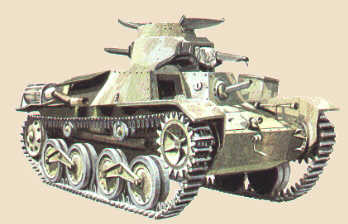
This is the Japanese Type 95 "Ha-Go" tank.

Used by the Japanese widely during their Malayan campaign of 1941-42 with great effectiveness.

During the fighting that led to the capture of Singapore and the greatest defeat in the history of British arms, the Japanese had at their disposal two hundred of these tanks.

Tanks, that even by the standards of the time, were INFERIOR.


At yet, played an important part in the defeat of the British.

British doctrine held that tanks could not be used in the jungle. Because of this, at THEIR disposal, the British had ZERO tanks available to THEM in all of Malaya.

[American officers, as I have said before, were of the belief that Vietnam was NOT an American type of war as tanks could not be used in the jungle.]

The Japanese DID NOT EMPLOY their tanks in the jungle. They used them strictly on the road network of the Malay peninsula. To chase the British troops during the retreat of the latter to Singapore.

The Type 95 possessed a very small and weak main gun, only 37 mm. About the same size as most anti-tank guns of the time. And yet, the tank is an OFFENSIVE weapon. When employed en masse', as a group, they can overpower through sheer numbers anti-tank defenses, as the anti-tank gun is a DEFENSIVE weapon.

From Suvorov again:

The anti-tank rocket [anti-tank gun in the case of Singapore and the Type 95 tank] is a defensive weapon - part of a passive system. The tank, on the other hand, is an offensive weapon. Any defensive system involves the dispersal . . . over a wide territory, leaving them stong in some places and weak in others. And it is where they are weak that the tanks will appear, and in enormous concentrations . . . They [tanks] are an offensive weapon and they have the initiative in battle".

Infantry, such as the British, must have been confounded and in consternation when confronted with Japanese tanks [even an inferior variety] for which they did not have a counter. Confidence must have gone hill fast.

Couple this with the quick, easy, and sustained control of the air over Malaya by Japanese warplanes, and the British were sitting ducks.

coolbert.

Labels:

Thursday, November 03, 2005

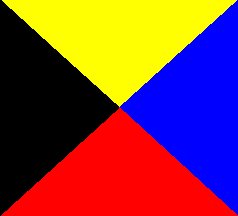
Z Flag.


This is coolbert:

"Hoist the Z flag!!"

It seems the missing Z flag has been found.

The flag flown by the Japanese Admiral Togo during his climactic battle at Tsushima in 1905. The defeat of the Russian fleet by Togo meant an end to the Russo-Japanese War, with victory going to the Japanese.

With that victory, and a decisive victory at that, Japan became a world power to be reckoned with. Prior to 1905, Japan was still considered to be a feudal, backwards Asian country. After 1905, Japan was now in the same league as the U.S. and the various European powers. And ascending rapidly with further development of all types too!!

It had been thought for some time that the Z flag was flown by Admiral Nagumo just prior to the attack on Pearl Harbor in 1941. Evidently this is NOT so!! Perhaps the message was the same, "let every man do his duty", but the flag that Nagumo flew WAS NOT the Z flag of Togo.

It seems the Z flag has been in the keep of the British since the end of the war between Japan And Russia. Was entrusted to the British as a sign of good will by Togo.

And only recently discovered by a Shinto priest who had been on an almost chivalrous quest for the "relic".

NOW it has been found [the flag]. Of course, this flag is just not mere bunting or cloth. Represents the ascendancy of Japan into the category of world power. And demonstrates that the Japanese are not 2nd rate in any manner. Is a powerful symbol. I hope it is not misused!!

Read the whole article about the Z flag discovery by clicking here.

coolbert.

Labels:

Saturday, November 13, 2004

Chang


This is coolbert:

I see that Iris Chang has died.

Wrote an interesting history of the "Rape of Nanking". The Japanese atrocity [among many] perpetrated on the Chinese people during the 1930's era war between China and Japan.

[Upon capturing Nanking, the Nationalist capital, the Japanese troops embarked on a thirty day episode of mass rape, murder, and general mayhem. This is one of the most sordid and depraved incidents of the entire war between China and Japan.]

Iris also wrote several other histories and her death at the age of thirty six will be counted as a tragic loss.

It seems that a dramatic incident in Iris's life changed her perspective on World War Two [WW2], the atomic bombing of the Japanese cities that ended the war in the Pacific, and the whole nature of the relationship between China, Japan, and other Asian countries in the period before, during, and after WW2. This change in perspective provided a marked stimulus that resulted in the history on the "Rape of Nanking".

A number of years ago, Iris and several of her relatives fell into a discussion about the American atomic attacks on Hiroshima and Nagasaki. And the opinion of Iris was that the atomic bombings were while perhaps necessary, were excessive. Suddenly, Iris's Chinese aunt, born and raised in China, and who has been listening quietly all the time, blurts out something that Iris had not expected. According to what Iris remembered, the aunt says to the effect that:

"My older aunt, my dah ahiee (big aunt), is actually very small. Her wrists are the size of napkin rings, as delicate as rice paper--and the clothes we pass around in our family do not fit her slight frame. She is shy, especially in English. And during one heated family discussion on the American bombings of Hiroshima and Nagasaki in a mid-peninsula Sizzler, she kept quiet. I had pointed out to her rather talkative husband that the U.S. government was still the only government that had dropped the atomic bomb on human beings. Hiroshima, I could maybe see, but Nagasaki too? At this point, my petite aunt spoke up. "I think they should have bombed the whole country!" she bellowed, and then lapsed back into silence."

THIS IS INDEED HEAVY STUFF!!

"It was the first time I realized how profoundly the Chinese were affected by World War II. Even then, I was not familiar with what had happened in the country of my mother's birth during the war"

After this outburst, the aunt then clammed up and was silent on the topic after that.

And this is all true. Undeniably, the Japanese DID in WW2, as been mentioned in previous blog entries, behaved as sadistic beasts and crazed rapists. Carrying the act of rape as a weapon of war to an unprecedented level. This of course was not just sex-crazed soldiers lusting after Chinese women. This was an act of power. The Japanese are saying [whether they realize it or not], "we dominate you and can abuse you and do with you as we please."

WHAT IS MOST SURPRISING IS THAT IRIS SEEMED TO HAVE ONLY BEEN VAGUELY AWARE OF THIS. THAT THE CHINESE WOMEN WERE SUBJECTED TO BARBARIC ABUSE WAS SOMETHING SHE KNEW ABOUT, BUT AS TO WHAT EXTENT IS JUST NOT CLEAR!!!!!

After doing much research, Iris, probably ashamed at her lack of knowledge, devoted an entire book to the "Rape of Nanking". Iris's entire perspective on the war and Japan's role in same was changed totally about face based upon a single statement of fact by her aunt.

[to discuss even with family such shameful incidents as mass rape is probably a taboo in Chinese society. People know this stuff happened, but are hesitant to talk about it, for fear of shame. My appraisal. That Iris's aunt responded as she did was due to being provoked by her family members for perhaps being so ignorant and seemingly sympathetic toward the Japanese].

coolbert.

Labels: ,

Thursday, October 14, 2004

Masonobu!


This is coolbert:

This particular blog entry is devoted to Colonel Masonobu Tsuji. The famous/infamous Japanese military officer whose life before, during, and after World War Two [WW2] could easily be the history of Japan during the same period. Tsuji has been mentioned in previous blog entries. Where ever Japan WAS at this period in time WAS also the place where Tsuji WAS. China, Manchuria, Mongolia, Malaya, Philippines, South Pacific, Burma, Indo-China, Japan, and back to Indo-China.

[My comments in bold]

Tsuji was a man of promise from an early age??

"Tsuji was born in Ishikawa Prefecture on October 11, 1900,

Attached to Army General Staff May 1921. Graduated War College (more advanced level evidently than Military Academy) November 1924."

"About 1930 he attended the War University as a lieutenant, where he quarreled, he said, with his instructors on matters of military tactics. Studied Chinese, though indifferently, and at some time studied Russian to about the same degree of enthusiasm."

This is a very unusual pattern of advancement, at least by western standards. The normal sequence progression for an officer would be for service as first a platoon leader, then a company executive officer, and then a company commander. And then, if the officer was considered to be promising, would attend Staff School and then be given staff positions. Tsuji seems to have short-circuited the whole process, being a staff officer at the age of 21??!! Perhaps the Japanese had a different approach??!!

Tsuji was a man with contacts at the highest level of Japanese society.

"Perhaps it was here that he was, as he later claimed, a classmate of Prince Chichibu, the Emperor's younger brother."

"he was an aide to the Emperor's younger brother, Prince Misaka"

"He recruited friends and acolytes in China"

"he had mysterious sources of power and probably direct access to Tojo;"

Once again, that a man of such junior rank would have such high level contacts is somewhat unusual. It seems that Tsuji from the get-go was an aspiring officer and made these contacts and friendships with an eye to the future.

Tsuji was a man who engaged in intrigue against his brother officers.

"The Kodo group believed that the entire affair had been devised as a trap by Tsuji. In any event, he stored up influence where it mattered: with such future commanders as Tojo, Renya Mutaguchi, and Tomioka Yamashita."

"He had also turned one staff officer over to the kempeitai for "corruption," as a result of which the officer committed suicide."

"Kawaguchi realized that Tsuji had never told the commander about the change in plans. Kawaguchi responded that he would have one battalion in position, whereupon he was replaced--Tsuji's intention, apparently. Tsuji called 17th Army Hq and told his colleague Col Konuma that "Kawaguchi refused to advance, and the division commander relieved him of his command."

"Kawaguchi thought that Tsuji agreed and that the change in plans would be passed up to General Murayama, but there was some mixup and Murayama wasn't informed. When Murayama found that Kawaguchi wasn't where he was supposed to be, sacked him on the spot. Kawaguchi believed Tsuji had deliberately betrayed him and never forgave him."

"He [Kawaguchi] nursed more hatred for his countryman Tsuji than for the enemy."

"he carried out the functions of a government spy."

"Not unexpectedly he was detested throughout the entire Japanese Army;"

And yet again, that an officer would behave in such a manner toward his brother officers is very unusual. A man behaving in such a manner usually becomes a pariah.

Tsuji also intrigued at the international and Japanese governmental level.

"One a "gangland-style assault in Tokyo," the other a railroad bombing as with Marshal Chang. "The latter plan was devised by a lieutenant colonel named Masanobu Tsuji, already an idol of the most radical young officers. A chauvinist of the first water, he was determined to thwart a summit meeting that was destined to end in a disgraceful peace."

"Identified as one of the "officers responsible for provoking the disastrous Nomonhan incident in 1939."

Tsuji was apparently heavily involved with "nationalist" elements that wanted a militaristic regime in Japan. They got what they wanted. Nomonhan [Khalkin Gol] was the clash between Soviet forces and the Japanese.

Tsuji was a man whose appearance epitomized the "yellow peril".

"wears the round-lensed Oriental spectacles that were so savagely caricatured in American propaganda cartoons during the Pacific War."

"his spectacles reflect the light and magnify his Oriental eyefolds, giving him a cruel aspect that would have satisfied Americans devotees of "Yellow Peril" books, movies, and comics."

Click here to see a picture of Tsuji.

Click also here to see another picture of Tsuji.

The caricature was the big buck teeth, and the slitted slanty eyes showing from behind thick glasses. Tsuji does not seem to resemble this.

Tsuji was a hard-core military man, forsaking familial responsibilities.

"By his own account, when in his thirties "I . . . divorced my wife and left my (two) children to participate in the movement for national reformation,"

"Despite his occasional visits to Japan, he evidently never saw his family. During the war, his wife had to go to work in a garment factory and send his eldest son to work in a bakery shop, while two younger children were put in an orphanage."

Tsuji divorced his family only in a figurative sense, not a literal. He wanted to devote himself entirely to his military career without any distraction of family!!

Tsuji was an operational planner of extraordinary ability.

"He was often at the front giving advice and devising fresh plans"

"Tsuji became a staff officer in charge of operations and planning under Lt-General Tomoyuki Yamashita. He applied himself diligently and concluded that Singapore could not be defended from the rear, that British fighter strength was much weaker than announced, that British land and sea forces had only been reinforced and only half the 80,000 or so forces were 'Europeans'"

"Tsuji persuaded his superiors in Tokyo to send him to Rabaul as an observer. As usual, he soon became a go-between, arguing the army's need for a full-scale relief expedition to Admiral Yamamoto aboard the flagship Yamato.

The Japanese assault force consisted of 5,600 infantry plus support troops, with Tsuji personally directing operations."

"but where the business of fighting was concerned, he was invariably right."

"Tsuji was one of the most extraordinary men in the entire Japanese army. . . . Tsuji was a man of extraordinary ingenuity and courage;"

Tsuji was the chief of operations for the Malayan campaign that defeated the British.


Tsuji was a war criminal.


"In Singapore, "five thousand Chinese had been murdered largely at his instigation for 'supporting' British colonialism."

"Tsuji believed that all prisoners should be executed, the Americans because they were colonialists and the Filipinos because they had betrayed their fellow Asians."

"But other officers, whose names for good reason have vanished from the record, carried out Tsuji's oral instructions, which were reinforced by the press."

"But Imperial Headquarters was so insistence about the execution of Santos." Kawaguchi: "Whom do you mean by Imperial Headquarters?" Hayashi: "It was Tsuji."

"The decree, as the Chinese soon discovered, was part of Operation Clean-up (called Sook-Ching). It had been planned by Lieutenant-Colonel Tsuji, officer in charge of planning and action. The 25th Army intended to move to Sumatra. Only the Defense Force would be left behind to hold Singapore. Tsuji argued that before they went the 25th Army should clean up all anti-Japanese elements including the Chinese volunteers who fought so tenaciously against the Japanese, all members of the China Relief Fund, and other anti-Japanese organizations. The most brutal massacre for weeding out and exterminating anti-Japanese elements began in Singapore."

"As a result, many thousands of Chinese men lost their lives during the ruthless Operation Clean-up. But today the official figure said only several thousands died while many sources indicate the death toll may be as high as 50,000. At the War Crime Trial in 1947, the Japanese defendants admitted to killing only 5,000 Chinese civilians.
A.D. 1942 - Singapore (Operation Sook Ching)
70,699 Chinese tortured and/or killed by Japanese
Kempeitai in Colonel Tsuji Masanobu's "Sook Ching" or
Purification/Ethnic Cleansing in reprisals for overseas
Chinese support of mainland China against the Japanese
invasion."

"This is extraordinary, as the massacre in Singapore ranks third to those at Nanking and Manila."

"Intelligence Marred by Cruelty

Mamoru Shinozaki, who is remembered for saving many Chinese lives in Singapore during a Chinese purge, names Tsuji as "the one who made plans for the Chinese massacre." Sook Ching or Shuku Sei (purge through purification) operation was planned by the Operation Staff of the 25th Army which Tsuji headed and carried out under an order issued in the name of General Yamashita. The directive was transmitted from Yamashita through the Chief of Staff Major General Kawamura Saburo, Commander of Syonan-To garrison, who delegated the task to the Kempetai. Chinese males between the ages of 18 and 50 were to report to mass-screening centres. Some were taken away and never seen again. About 6,000 Chinese were killed in the large-scale purge (the Chinese version puts the figure at 50,000)."

"The 1946-1963 file of Colonel Tsuji Masanobu, who eluded capture and trial for alleged crimes against the Chinese at Singapore, and for mistreatment of Allied POWs. After returning to Japan, allegedly in disguise in 1948, but not identified until 1950"

"he was cruel and barbarous;"

Cruel and barbarous. That is an apt description. Atrocities carried out without a qualm and at the behest of Tsuji that met his criteria for proper treatment of "enemies" of the Empire. The ethnic Chinese of Malaya DID aid and assist the British, whereas the ethnic Malay did not. This group of ethnic Chinese in Malaya had a strong antipathy for the Japanese and this greatly provoked persons such as Tsuji. And Tsuji did escape war crimes prosecution totally. In 1947 Hirohito gave blanket amnesty to all Japanese that had committed war crimes. And in the 1950, SCAP [Supreme Command Allied Powers], the occupying power in Japan, ended all war crimes trials of Japanese as part of a bargain for Japanese support during the Korean War??!!

Tsuji was a courageous military man.

"My body carries the bullets of five countries--Russian from Nomonhan, American from Guadalcanal, Chinese from Shanghai, British from Burma, and Austrian [sic] from the Philippines." He boasted that no enemy bullet could kill him, and that his lines of communication went back to General Tojo and perhaps even to the Deity."

"By his own account, Tsuji was badly wounded in the Burma campaign, and this may have been the occasion for the medal."

"wounded seven times and carried "more than 30 odd pieces of shrapnel, both large and small" in his body."

"he declared himself immune to death by enemy action,"

Tsuji was undeniably a brave man. Exposed himself to fire and was wounded on a number of occasions. He DID NOT just stay in headquarters and make plans that others carried out.

Tsuji was a homosexual??

"(Wherever Tsuji traveled, he seemed to find a "pure- hearted" youngster who wept upon parting from him. Whether this was a literary cliche or a reference to homosexual liaisons, I can't decide.)"

"even obtains "a fine lovable young soldier" as his orderly."

"Met another Japanese, "a pure hearted youth" deciphering Chinese communist codes."

"bade goodbye to his orderly, who of course wept bitter tears,"

This is just not proven. Raises eyebrows, much as it did for T.E. Lawrence and the rumors that existed in the same fashion. Perhaps this is a lot of get-up by the many enemies of Tsuji to defame the man?

Tsuji was a man who eschewed and hated the fleshpots.

"These headquarters officers are all rotten. They are only working for their medals. Every night they go to parties and play with geishas. Since the China Incident, all the military have gone bad. They hate me because I know all this and speak out."

"As the story was told, he had once burned down a geisha house with his fellow officers inside. Either through loyalty to his wife and children, or out of a more generalized misogyny or perhaps homosexuality, had nothing to do with women when he was campaigning."

"He was offended by the sight of "comfort women," there and at the nightly parties. In his puritan fashion, he set about to clean them up."

Since Tsuji was a man that had "divorced" his family for the duration of the war at least, he saw no need for others NOT to do the same. Devote all your energies for the war effort and the Emperor is how Tsuji saw things. He expected and was high disappointed when others did not reciprocate his views.

Tsuji was a cannibal.

"Tsuji and some other staff officers had eaten the liver of an enemy pilot.

Instead, Parker was killed while they were at dinner, "while trying to escape." It was then and there, in this version, that the pilot's liver was brought in.

"The more we consume," Tsuji proclaimed, "the more we shall be inspired by a hostile spirit towards the enemy." Some officers merely toyed with their portions, some ate a bit and spit it out. Tsuji called them cowards and ate until his own portion was finished."

"especially Major Abe and Colonel Tsuji. A Captain Lily of the U.S. Army Military Police turned up to investigate the incident of cannibalism in China, and the two officers feared that they would be charged with Lieutenant Parker's murder."

The eating of the liver of your enemy is said to imbue the diner with the courage and virtues of the vanquished. I do not think this is something that is native to Japanese culture. Tsuji may have picked this up while on sojorn in the South Pacific. Natives there are confirmed cannibals who engage in eating their enemies. It seems that Parker, the American, was a pilot whose plane was shot down. Parker was captured, executed, prepared and eaten!!

Tsuji was a spy master.

"After Malaya, Tsuji was in Burma. When Japan surrendered, he was asked by the Japanese authorities to "disappear". He wandered around Southeast Asia in disguise"

"Brilliant Intelligence Officer

One of the officers assigned to the Japanese army research unit in Taiwan to plan the invasion of Malaya and Singapore. He was tasked with collecting in six months all data on tropical warfare, from organizing army corps, equipment, campaign direction, military strategy, tactics and geography. Japanese nationals traveling and living in Malaya and Singapore provided useful information."

"As long as the Chinese Nationalists felt that a man was useful to them, they detained and used him."

Refers to his outfit as Third Research Group, aka The Bamboo Shelter. It was, he says, "a miserable intelligence unit."

"Our treatment was equivalent to detention."

"He is put to work for the National Defense Department Section [intelligence] Comprehensive Study Group. On Aug 4 moved to former Japanese Supreme Hq!"

"Tsuji's position now "midway between that of a prisoner and a guest." Despite this setback, he goes to work at the Military Control Bureau's propaganda department"

"Says a band of seven young "special attack" (kamikaze) officers were in Thailand, disguised as priests while spying for the Japanese authorities; they "insisted on joining me."

"I'd like you to go underground in China and open up a new way for the future of Asia."

"He decides to go underground in China."

"On 22 Oct Tsuji decided to make his own reconnaissance of Malaya"

As has been mentioned previously, Tsuji was the operational planner for the Malayan campaign. Not only was he the operations planner, but he had also been the intelligence officer in charge of gathering all available intelligence regarding the Malay peninsula and the British forces defending same. It does appear that at the end of the war, Tsuji and other selected officers went undercover to pose as Buddhist monks in China and throughout all of Southeast Asia. The purpose was to set up espionage rings for the FUTURE. For a losing power to do so is not unheard of. Gehlen the German intelligence officer, volunteered his espionage network in eastern Europe to the CIA at the end of WW2. From what is described, it seems a lot of Tsuji's work was done for the Nationalist Chinese fighting the communist forces under Mao, with an eye to a future conflict with the Soviet Union!!

Tsuji was a politician.

"subsequently went into politics."

"Elected to Diet 1952 "and twice thereafter"; wrote numerous books & articles."

In Japan, there is a small party of avid nationalists. A political party that advocates a return to the rule of the military and an adherence to the ancient samurai traditions. This party also has strong ties to the Yakuza [Japanese Mafia]. I would not be one bit surprised if Tsuji was a representative of this party.


Tsuji was a man of strong opinions.

"No respecter of persons he would advise his superiors without hesitation; often he would give orders in their name without the slightest authority."

"Col. Tsuji also wrote an article in the 1950's recommending Japan acquire
nuclear weapons!"

"he ranked the fighting qualities of all the armies he had opposed. The Japanese of course were highest, with one Japanese soldier the equivalent of 10 Chinese--the army he rated second, given equivalence in equipment and training. Following in order were 3) Russians, 4) Ghurkas in British service, 5) Americans, 6) Australians, 7) Indians in British service, 8) British, 9) Filipinos, 10) Burmese, 11) Thai, 12) Vietnamese, and 13) French."

"Colonel Tsuji Masanobu, later explained that "our candid ideas at the time were that the Americans, being merchants, would not continue for long with an unprofitable war."[6]"

This rating scheme of Tsuji's must have made based upon observations made during th earliest days of the war. At the end of the war, De Puy rates that one American soldier was equal to four Japanese, at brigade and higher echelon. One American soldier was able to accomplish as much as four Japanese, due to a variety of factors. This was not the case at the start of the war! Placing the Chinese second only to the Japanese is also a surprise. The fighting reputation for the Chinese army during WW2 was not that great. Pretty good, sometimes, on the defense, but not good on the offense. Often time preferring to advance on a Japanese position and then dig in and defend, waiting for a Japanese attack. Tsuji does give a pretty good rating for American troops, at least we can give him that.

Tsuji was a prolific author.

"The convoys sailed on 4 Dec, each man religiously studying the pamphlet Tsuji had written,"

"Wrote another report on likelihood of WWIII, a manual on cold- weather operations, a basic training manual, a manual on "strategic uses of topography," and lectured on WWIII to Defense Dept officers. Spent six months translating Japanese manual of 1924 about fighting Soviet Union in Siberia."

"wrote numerous books & articles."

"a 32-page manual entitled "Read This Alone -- And The War Can Be Won." This manual was distributed by the Japanese Imperial Army Headquarters to all troops heading for the combat zones in southeast Asia. The detailed instructions on how to treat the civilians as well as the American, British, and Dutch colonialists give chilling insights to the history of the war"

"He then wrote a number of books on the Japanese war campaign in Malaya and Singapore, including "Japan's Greatest Victory, Britain's Worst Defeat: The Capture of Singapore, 1942." He stopped at the fall of Singapore, conveniently excluding the purges he had taken masterminded."

"Tsuji published best selling accounts of his wartime exploits and assumed leadership of the East Asia League."

"In Oct 1947 began work translating a multi-volume Japanese manual on Soviet war potential. Submitted resignation Feb 1948 and in April granted two months' leave."

Tsuji seems to have been a man who had a very high opinion of himself and did not hesitate to make that fact known to others.

Tsuji was a man whose career inspired others [is this good or bad??!!].

"Tsuji was a close friend of Kitta, and several post war nationalist leaders, notably Park Chung Hee [South Korea] and Sukarno [Indonesia], claimed inspiration from him."

This is most interesting. Years ago now, Park Chung Hee was the strongman ruler of South Korea. Had been a general officer in the South Korean army before assuming role of President of ROK. And also a member of the collaborationist Korean forces that served with the Japanese during WW2 [many brutal guards on the infamous Burma railroad were Korean nationals.] At the time, all the Korean Generals familiar to American officers stationed in South Korea were known to the Americans by a nickname, each and every Korean general having their own peculiar nickname. All except one. Park. He was a man no one, and I mean no one, ever took lightly. A man who the greatest possible respect was shown to. Having Tsuji as an inspiration seems to explain a lot, doesn't it??

Tsuji was a CIA operative??

"Bergamini (1046) also confirms Masanobu's disappearance. He speculates he
may have still been alive (this, in 1971) and a CIA agent in Hanoi, after his disappearance Laos. However, given his inside knowledge about Dulles during the new JFK admin., a real potential blackmail threat that Dulles didn't need--and given his continued contact with CIA, I now suspect that Dulles had him killed there in Laos in 1961."

It may be very well that Tsuji offered the services of his agents to the CIA in return for something that he valued. What that would be I just cannot say. Having established a spy ring in SE Asia at the end of the war, Tsuji could offer something to the CIA that they desperately needed at the time, ready-made agents in an area of the world that suddenly became of the greatest importance to American interests. Tsuji, appearing in Saigon in 1961 and then suddenly disappearing could be related to this.

Tsuji was a Viet Cong/NVA commander??

"serving as an Operations Staff officer under Vo Nguyen Giap. When one considers the ruthless and brilliance of the North Vietnamese operations, the hand of Masanobu Tsuji can be seen clearly."

[I posed the question of Japanese advisors to the Vietnamese to a Vietnamese professor at Harvard. She was very skeptical, given the hatreds left over from the Japanese occupation.]"

Could it be that Tsuji offered his services to General Giap and this offer was accepted? Sounds bizarre and far-fetched. But what is it? Fact is stranger than fiction!

Tsuji was a man who disappeared under mysterious circumstances.

"Tsuji mysteriously disappeared while traveling through Southeast Asia. This time, his disappearance in Vietnam in 1961 was real"

"Even after he returned to public life in Japan, writing several books about the war, "he still lived mysteriously, traveling on secret missions, and in April, 1961, he went to Vietnam,"

It may here that he did disappear, as part of the activation under his control of a spy ring in SE Asia. Not for anyone to know about, disappearing and not emerging in the same persona. Perhaps led the rest of his life as one who has adopted a new guise and life.

coolbert.

Labels:

Wednesday, September 15, 2004

Ink.

This is coolbert:

A personal note on blogging. It is really amazing when you are doing research how you come across items of interest that you were not searching for in the first place. Items you may have perused before, but did not originally strike you as being something that could be or would be blogged about. But this does happen.

Yesterday, while searching through a book looking to corroborate an idea that I had and DID want to blog about, I read a passage in the book that I must have overlooked previously. Only upon re-reading did this tidbit become of interest to me. I DID NOT find the corroboration that I originally was searching for, but did find something that now is of interest, and surprisingly so.

It seems that the Japanese, perhaps prior to and surely during the Second World War [WW2] were using radioactive secret ink.

Some sort of system allowing for communication with secret agents.

What this does indicate, is that the Japanese once again, perhaps prior to the war, and surely during the war, were engaged in nuclear research.

Research that had fruition at least in the use of radioactive secret ink. Albeit a minor research product, it does bear witness to the fact that the Japanese DID have nuclear research going on. Research that in years subsequent to the war has been denied or pooh-poohed as being only minor.

Some of you may remember my previous blog entry regarding the book "Japan's Secret War", which maintains that perhaps, and only perhaps, the Japanese did detonate a "device" that was nuclear in nature in the days just prior to the end of WW2.

Can the fact that the Japanese DID engage in the production of radioactive secret ink be placed in the category of "where there is smoke, there is fire" category?? That this indicates only a small part of a much larger nuclear research capacity? A capacity that resulted in the detonation of a nuclear "device"?? I think not!

Here is how I think the radioactive secret ink worked.

The secret agent would have been supplied with a bottle of fluid [ink] that has been rendered radioactive in some way [radium perhaps].

To write a message using the radioactive secret ink, the secret agent takes a plate of glass and lays it flat on a table. Using a pen, the secret agent then dips the nib of the pen in the "ink" and writes his message on the glass.
Before the liquid can dry, the agent then takes a blank sheet of paper and using that paper as a blotter, carefully blots the liquid onto the paper.

The characters written in the liquid secret radioactive ink will be blotted onto the blank sheet of paper.

Allowing for the liquid to dry, the agent then writes a normal letter using normal ink on the presumably blank sheet of paper, and forwards that letter, containing the secret message, to a contact or cut-out.

This contact or cut-out in turn will forward the secret message to the Japanese agent runner. A sheet of ordinary photographic paper can then be exposed for a period of time to the "normal letter", the radioactivity of the secret ink blotted onto the "letter" creating a latent image on the photo paper.

The latent image containing the secret message is then exposed using normal photo developing techniques. Pretty smart!

coolbert.

Labels:

Saturday, August 07, 2004

Z Factor.

This is coolbert:

About a decade or so now, there was a book that came out with the title of "The Z Factor". This book dealt with the relationship between Japan and the U.S.

And the gist of the book was that Japan was now the ascendant world power and the U.S. was now on the decline. Japan was now the world's economic powerhouse and in the near future was going to surpass the U.S. in all areas of economic development. Japan was becoming the largest creditor nation on the planet and the U.S. the largest debtor nation. Etc.

And what the author wanted to emphasize was that Japan no longer had to be subservient to the U.S. and be the "yes" man. Japan could steer and follow it's own course in the world, to it's advantage, and not having to take American interests or wishes into consideration when making decisions.

There was another book that had the same message, and was published approximately the same time as was the "Z" book. This book was called, "The Japan That Can Say No". Had the same basic ideas and concepts that did the "Z" book.

In addition, there was a "secret" study that was commissioned by the Chairman of Sony, Morita. This study was an analysis of American society, culture, politics, foreign affairs, etc. [read this study for yourself by clicking here]. Done by Japanese scholars for Morita. And was designed to be circulated among Japanese movers and shakers as a guide to them as to how they should make business decisions regarding America. And the study was not too flattering at all to the U.S. On the contrary. The study basically said that the U.S. was a sick society on the way out and was not a good prospect for Japanese investment in the future. Somehow, this "secret" study was leaked to the outside world, and Morita ended up with big egg on his face.

This type of thinking seems to have been pretty common in Japan at the time.

Now, what most intrigues me is that the choice of the title for the first book I
mentioned, "The Z Factor". I believe the choice of this title was very well thought out and provocative, at least to the Japanese audience. The significance would be lost on non-Japanese audiences, with intention.

The letter "Z", when taken in the proper context, has a strong significance for initiated Japanese audiences.

Prior to the great naval battle of Tsushima [1905] [read about Tsushima by clicking here], the Japanese Admiral Togo raised an oversized Japanese flag prior to battle. Togo's flagship led his armada into battle flying this flag [click here to see what this flag actually looks like]. Closing on the Russian fleet, Togo raised this flag, the meaning being:

"13:55 The range was 12,000m, the MIKASA steered to W, and hoisted "Z" flag, which meant:
"The rise or fall of Imperial Japan hangs on this battle. Everyone shall be stirred up harder and do your best." [similar to what Nelson said at Trafalgar, Togo being a great admirer of Nelson].

The battle that resulted in a stupendous victory for the Japanese over the Russians. A victory that cemented Japan's place in the powers of the world. Japan, from this point on, was a world power of the first magnitude, in a league with the European powers and the U.S. This flag that was flown by Togo became known, for whatever reason, as the "Z" flag. And it became a powerful symbol in Japan. A symbol to the Japanese of their ascendancy and greatness.

Move forward to 1941. The Japanese fleet is approaching the Hawaiian Islands to launch aircraft for the attack on Pearl Harbor. The attack aircraft are lined up on the carrier decks awaiting take off. And it is just at sunrise. And Admiral Nagumo, on his flag ship, to the surprise of everyone, raises an oversized flag. But not just any flag. It is the same "Z" flag flown by Togo 36 years earlier. [Some authorities say this was not the same flag, was a flag called the "DG" flag].

"Vice Adm. Nagumo, commander of the task force steaming toward Oahu, Hawaii, hoisted the "DG" signal flag on the mast of his flagship, which he had let it be known among his fleet meant exactly the same as Admiral Togo's "Z" signal, flown from the Mikasa's mast 36 years earlier: "The fate of the Empire depends on this battle. Let every man do his utmost."

This symbol was not lost on the Japanese pilots. It told them the significance of this event, the attack on Pearl Harbor. It was an attack the Japanese hoped would have results for them similar to that of Tsushima, destruction of the fleet of an opposing world power, and further advancing the status of Japan as a world power. Japan, after winning a war with America, it was hoped, would not be just a power among powers, it would be a world power ranking with perhaps only Germany, while exceeding all others!! This gesture of Nagumo's had the desired motivational impact, and the attack was successful

Again, move ahead, this time say forty five years into the future from 1941. And, as I have said before, you now have the book with the title, "The Z Factor". Was it a coincidence that the title was chosen as it was? I think not! This title was deliberately chosen for the consumption of Japanese audiences to bring attention to the gist of the book. Japan was no longer going to be a power among powers, Japan was now going to be "the" world power. And "Z" is the symbol of that power, a symbol created by war.

coolbert.

Labels:

Sunday, July 11, 2004

Sword & Pen.


This is coolbert: As the Sikh guru Gobind Singh was at the same time a warrior and a philosopher both, and not having a contradiction in this regard, in feudal [1600-1865?] Japan, a similar situation existed among the samurai warrior class.

With the ascendancy to the position of Shogun of Tokugawa [circa 1600], a period about two hundred and fifty years of peace existed in Japan. And during this time, a large number of highly trained samurai warriors existed, all the while training for a war that never came. Samurai as a class were required to hone and maintain their martial skills to a high degree, and this they did, receiving a stipend all the time from the government. Without war, however, the samurai did find themselves with a lot of free time on their hands. And in many instances, especially among the higher ranking samurai, but also among the lower levels of the samurai, a patronage of the fine arts of Japan began. This patronage led to a flourishing of existing fine arts, and the creation of new art forms that are popular to this day.

And many of these fine arts have a tradition and ambiance that seems to go against what we in the west regard as the character of the military man.

What fine arts am I talking about here? Well, flower arranging, brush painting, calligraphy, tea ceremony, poetry reading. All these fine arts were highly appreciated by the leading samurai and encouraged by the patronage of same. These are not activities military men in the west would be expected to participate in. In Japan, however, this sort of thing is in keeping with the samurai motto, "sword and pen in harmony". To the Japanese, none of this to them presented a contradiction.


New art forms
that were highly appreciated by the samurai also became the rage during this feudal period. I am thinking of the Kabuki theatre and Noh plays. Many of the themes and plays in this area revolve around samurai tradition and ethic and show the samurai as the archetype of the Japanese spirit [yamato].

Japanese Zen Buddhism has both greatly influenced and been influenced by the samurai. The samurai greatly appreciated the meditative aspect of Zen. Such meditative discipline allows for great concentration. Concentration that allows a swordsman to become more adept and proficient. It is not an accident that many of the Zen monasteries had resident martial artists as monks, and regular martial arts training was part of the regimen at such a monastery. Indeed, the entire philosophy of Zen Buddhism highly appealed to the samurai. The philosophy that impermanence is a normal factor of life. And that by looking at nature, such things as the cherry blossom, a blossom that falls to the ground at the height of it's beauty, were translated to mean for the samurai that his lot in life was death, and to face death unflinchingly and acceptingly was a way of life that found consonance with Zen. Read a really interesting web site that describes in detail the correlation between zen and the warrior philosophy of the samurai by clicking here.

The samurai writers Musashi Miyamoto [read about Musashi by clicking here] and Hagakure [click here to read more about the philosophies of Hagakure] wrote distilled versions of the samurai ethic and philosophy. Musashi, along with writing his work, "Book of the Five Rings", was also an accomplished brush painter. A condensed version of the teachings of Musashi can be found by clicking here. More samurai sayings that illustrate the philosophy behind the samurai spirit can be found by clicking here.

These forms of art and disciplines of martial arts training are still around and going strong in modern Japan. The various unarmed martial arts forms so popular in the world today, such as judo, aikido, karate, all have a genesis in feudal Japan. Other martial arts forms such as kendo [swordfighting], and archery are also practiced widely. The latter, archery, is mainly taught as a Zen discipline, with strong philosophical overtones present. To read an intersting article about kendo, click here. Click here to read an interesing web site that deals with the spiritual aspects of Japanese archery.

coolbert.

Labels:

Thursday, February 12, 2004

Unconditional!

This is coolbert:

One thing about an invasion of Japan and the dropping of the a-bomb that is only appreciated in a minor way.

Japan was trying to surrender.

But under their terms.

* NO occupation.
* NO disarming of the military.
* NO concessions about overseas territories [Formosa, Korea, etc.].

The Japanese wanted a negotiated settlement that would not be too unfavorable to them.

This was totally against what the Allies and the Soviets had fought for during the war.

It was decided early that because of the nature of the enemy being fought in WW2, unconditional surrender was the only course to be taken by the allies.

And this was the course taken with regard to Italy and Germany.

Why would Japan have been such an exception?

It would not have been!

Without an cessation of hostilities the war would have continued in the manner that it was already taking until Japan surrendered unconditionally or the place was more or less obliterated.

The Soviets had already entered the war and annihilated the Kwangtung Army of Manchuria.

Further warfare would have probably seen the Soviets invade Hokkaido and probably further south too. I am not sure the Soviet capability in this area, but it may have been more than would have been anticipated.

coolbert.

Labels: ,

Wednesday, February 11, 2004

Downfall.

Top Secret
Operation Downfall


by James Martin Davis
The Story of the Invasion of Japan


Deep in the recesses of the National Archives in Washington, DC, hidden for over four decades, lie thousands of pages of yellowing and dusty documents. These documents, which are now declassified, still bear the stamp, "Top Secret." Contained in these little examined documents are the detailed plans for "Operation Downfall," the code name for the scheduled American invasion of Japan.

Only a few Americans in 1945, and fewer Americans today, are aware of the elaborate plans that had been prepared for the American invasion of the Japanese home islands. Even fewer are aware of how close America actually came to launching that invasion and of what the Japanese had in store for us had the invasion of Japan actually been launched.

"Operation Downfall" was prepared in its final form during the spring and summer of 1945. this plan called for two massive military undertakings to be carried out in succession, and aimed at the very heart of the Japanese Empire.

In the first invasion, in what was code named "Operation Olympic", American combat troops would be landed by amphibious assault during the early morning hours of November 1, 1945, on Japan itself. After an unprecedented naval and aerial bombardment, 14 combat divisions of American soldiers and marines would land on heavily fortified and defended Kyushu, the southernmost of the Japanese home islands.

On March 1, 1946, the second invasion, code named "Operation Coronet", would send at least 22 more American combat divisions against one million Japanese defenders to assault the main island of Honshu and the Tokyo Plain in a final effort to obtain the unconditional surrender of Japan.

With the exception of a part of the British Pacific Fleet, "Operation Downfall" was to be a strictly American operation. It called for the utilization of the entire United States Marine Corps, the employment of the entire United States Navy in the Pacific, and for the efforts of the 7th Air Force, the 8th Air Force recently deployed from Europe, the 20th Air Force, and for the American Far Eastern Air Force. Over 1.5 million combat soldiers, with millions more in support, would be directly involved in these two amphibious assaults. A total of 4.5 million American servicemen, over 40% of all servicemen still in uniform in 1945, were to be a part of "Operation Downfall."

The invasion of Japan was to be no easy military undertaking and casualties were expected to be extremely heavy. Admiral William Leahy estimated that there would be over 250,000 Americans killed or wounded on Kyushu alone. General Charles Willoughby, MacArthur's Chief of Intelligence, estimated that American casualties from the entire operation would be one million men by the fall of 1946. General Willoughby's own intelligence staff considered this to be a conservative estimate.

During the summer of 1945, America had little time to prepare for such a monumental endeavor, but our top military leaders were in almost unanimous agreement that such an invasion was necessary.

While a naval blockade and strategic bombing of Japan was considered to be useful, General Douglas MacArthur considered a naval blockade of Japan ineffective to bring about an unconditional surrender. General George C. Marshall was of the opinion that air power over Japan as it was over German, would not be sufficient to bring an end to the war. While most of our top military minds believed that a continued naval blockade and the strategic bombing campaign would further weaken Japan, few of them believed that the blockade or the bombing would bring about her unconditional surrender. The advocates for invasion agreed that while a naval blockade chokes, it does not kill; and though strategic bombing might destroy cities, it still leaves whole armies intact. Both General Dwight D. Eisenhower and General Ira C. Eaker, the Deputy Commander of the Army Air Force agreed. So on May 25, 1945, the Combined Chiefs of Staff, after extensive deliberation, issued to MacArthur, to Admiral Chester Nimitz, and to Army Air Force General "Hap" Arnold, the Top Secret directive to proceed with the invasion of Kyushu. The target date was set, for obvious reasons after the typhoon season, for November 1, 1945.

On July 24th, President Harry S. Truman approved the report of the Combined Chiefs of Staff, which called for the initiation of Operations "Olympic" and "Coronet." On July 26th, the United Nations issued the Potsdam Proclamation, which called upon Japan to surrender unconditionally or face "total destruction." Three days later, on July 29th, DOMEI, the Japanese governmental news agency, broadcast to the world that Japan would ignore the proclamation of Potsdam and would refuse to surrender.

During this same time period, the intelligence section of the Federal Communications Commission monitored internal Japanese radio broadcasts, which disclosed that Japan had closed all its schools to mobilize its school children---it was arming its civilian population and forming it into national civilian defense units, and that it was turning Japan into a nation of fortified caves and underground defenses in preparation for the expected invasion of their homeland.

"Operation Olympic", the invasion of Kyushu, would come first. Olympic called for a four-pronged assault from the sea on Kyushu. Its purpose was to seize and control the southern one-third of that island and to establish American naval and air bases there in order to effectively intensify the bombings of Japanese industry, to tighten the naval blockade of the home islands, to destroy units of the main Japanese army, and to support "Coronet", the scheduled invasion of the Tokyo Plain, that was to come the following March.

On October 27th, the preliminary invasion would begin with the 40th Infantry Division would land on a series of small islands to the west and southwest of Kyushu. At the same time, the 158th Regimental Combat Team would invade and occupy a small island 28 miles to the south of Kyushu. On these islands, seaplane bases would be established and radar would be set up to provide advance air warning for the invasion fleet, to serve as fighter direction centers for the carrier based aircraft and to provide advance air warning for the invasion fleet, should things not go well on the day of the invasion.

As the invasion grew imminent, the massive power of the United States Navy would approach Japan. The naval forces scheduled to take part in the actual invasion consisted of two awesome fleets---the Third and the Fifth.

The Third Fleet, under Admiral "Bull" Halsey, with its big guns and naval aircraft, would provide strategic support for the operation against Honshu and Hokkaido in order to impede the movement of Japanese reinforcements south to Kyushu. The third Fleet would be composed of a powerful group of battleships, heavy cruisers, destroyers, dozens of support ships, plus three fast carrier task groups. From these fast carriers, hundreds of Navy fighters, dive bombers and torpedo planes would hit targets all over the island of Honshu.

The Fifth Fleet, under Admiral Spruance, would carry our invasion troops. This Fleet would consist of almost 3,000 ships, including fast carriers and escort carrier task forces, a gunfire and covering force for bombardment and fire support, and a joint expeditionary force. This expeditionary force would include thousands of additional landing craft of all types and sizes.

Several days before the invasion, the battleships, heavy cruisers and destroyers would pour thousands of tons of high explosives into the target areas, and they would not cease the bombardment until after the landing forces had been launched.

During the early morning hours of November 1, 1945, the actual invasion would commence. Thousands of American soldiers and marines would pour ashore on beaches all along the eastern, southeastern, southern and western coasts of Kyushu.

The Eastern Assault Force, consisting of the 25th, 33rd and the 41st Infantry Divisions, would land near Miyaski, at beaches called Austin, Buick, Cadillac, Chevrolet, Chrysler, and Cord (?) (Ford?) and move inland to attempt to capture this city and it's nearby airfield.

The Southern Force, consisting of the 1st Cavalry Division, the 43rd Division and Americal Division would land inside Ariake Bay at beaches labeled DeSoto, Dusenberg, Essex, Ford and Franklin and attempt to capture Shibushi and to capture, further inland, the city of Kanoya and its surround airfield.

On the western shore of Kyushu, at beaches Pontiac, Reo, Rolls Royce, Saxon, Star, Studebaker, Stutz, Winton and Zephyr, the V Amphibious Corps would land the 2nd, 3rd and 5th Marine Divisions, sending half of its force inland to Send and the other half to the port city of Kagoshima.

On November 4th, the reserve force, consisting of the 81st and 98th Infantry Division, and the 11th Airborne Division, after feigning an attack off the island of Shikoku would be landed, if not needed elsewhere, near Kaimondake, near the southern most tip of Kagoshima Bay, at beaches designated Locomobile, Lincoln, LaSalle, Hupmobile, Moon, Mercedes, Maxwell, Overland, Oldsmobile, Packard and Plymouth.

The objective of "Olympic" was to seize and control the island of Kyushu in order to use it for the launching platform for "Coronet", which was hoped to be a final knockout blow aimed at Tokyo and the Kanto Plain. "Olympic" was not just a plan for invasion, but for conquest and occupation as well. It was expected to take four months to achieve its objective, with three fresh American Divisions per month to be landed in support of that operation if needed. These additional troops were to be taken from the units scheduled for "Coronet."

If all went well with "Olympic", on March 1, 1946, "Coronet" would be launched. "Coronet" would be twice the size of "Olympic", with as many as 28 American Divisions to be landed on Honshu, the main Japanese island.

On March 1, 1946, all along the coast east of Tokyo, the American 1st Army would land the 5th, 7th, 27, 44th, 86th and 96th Infantry divisions along with 1st, 4th, and 6th Marine Divisions

At Sagami Bay, just south of Tokyo, the entire 8th and 10th Armies would strike north and east to clear the long western shore of Tokyo Bay, and attempt to go as far as Yokohoma. The assault troops, landing to the south of Tokyo would be the 4th, 6th, 8th, 24th, 31st, 32nd, 37th, 38th, and 87th Infantry Divisions, along with the 13th and 20th Armored Divisions.

Following the initial assault, eight more Divisions---the 2nd, 28th, 35th, 91st, 97th and 104th Infantry Divisions and the 11th Airborne division--- would be landed. If additional troops were needed, as expected, other Divisions re-deployed from Europe and undergoing training in the United States would be shipped to Japan in what was hoped to be the final push.

The key to victory in Japan rested with the success of "Olympic" at Kyushu. Without the success of the Kyushu campaign, "Coronet" might never be launched. The key to victory in Kyushu rested with our firepower, much of which was to be delivered by carrier launched aircraft.

At the outset of the invasion of Kyushu, waves of Helldivers, Dauntless dive Bombers, Avengers, Corairs and Hellcats would take off to bomb, rocket and strafe enemy defenses, gun emplacements and troop concentrations along the beaches. In all, there would be 66 aircraft carriers loaded with 2,649 naval and marine aircraft to be used for close-in air support for the soldiers hitting the beaches.

These planes were also the fleet's primary protection against Japanese attack from the air. Had "Olympic" begun, these planes would be needed to provide an umbrella of protection for the soldiers and sailors of the invasion. Captured Japanese documents and post-war interrogation of Japanese military leaders disclose that our intelligence concerning the number of Japanese planes available for the defense of the home islands was dangerously in error.

In the last months of the war, our military leaders were deathly afraid of the Japanese "kamikaze" and with good cause. During Okinawa alone, Japanese aircraft sank 32 ships and damaged over 400 others. During the summer months, our top brass had concluded that the Japs had spent their air force , since American bombers and fighters flew unmolested over the shores of Japan on a daily basis.

What our military leaders did not know was that by the end of July, 1945, as part of the Japanese overall plan for the defense of their country, they had been saving all aircraft, fuel and pilots in reserve, and had been feverishly building new planes for the decisive battle for their homeland. The Japs had abandoned, for a time, their suicide attacks in order to preserved their pilots and planes to hurl at our invasion fleets.

The plan for the final defense of Japan was called "Ketsu-Go", and a large part of that plan called for the use of the Japanese Naval and Air Forces in defense. Japan had been divided into districts, and in each of these districts hidden airfields were being built and hangers and aircraft were being dispersed and camouflaged in great numbers. Units were being trained, deployed and given final instructions. Still other suicide units were being scattered throughout the islands of Kyushu and elsewhere, and held in reserve; and for the first time in the war, the Army and Navy Air Forces would be operating under one single unified command.

As part of the "Ketsu-Go", the Japanese were building 20 suicide take-off strips in southern Kyushu, with underground hangers for an all-out offensive. In Kyushu alone, the Japanese had 35 camouflaged airfield and 9 seaplane bases. As part of their overall plan, these seaplanes were to be used in suicide missions as well.

On the night before the invasion, 50 seaplane bombers, along with 100 former carrier aircraft and 50 land based army planes were to be launched in a direct suicide attack on the fleet.

The Japanese 5th Naval Air Fleet and the 6th Air Army had 58 more airfields on Korea, Western Honshu and Shikoku, which also were to be used for massive suicide attacks. Allied intelligence had established that the Japanese had no more than 2,500 aircraft of which they guessed only 300 would be deployed in suicide attacks. However, in August of 1945, unknown to our intelligence, the Japanese still had 5,651 Army and 7,074 Navy aircraft, for a total of 12,725 planes of all types. During July alone, 1, 131 new planes were built and almost 100 new underground aircraft plants were in various stages of construction.

Every village had some type of aircraft manufacturing activity. Hidden in mines, railway tunnels, under viaducts and in basements of department stores, work was being done to construct new planes.

Additionally, the Japanese were building newer and more effective models of the "Okka" which was a rocket propelled bomb, much like the German V-1, but piloted to its final destination by a suicide pilot. In March of 1945, the Japanese had ordered 750 of the earlier models of the "Okka" to be produced. These aircraft were to be launched from other aircraft. By the summer of 1945, the Japanese were building the newer models, which were to be catapulted out of caves in Kyushu to be used against the invasion ships which would be only minutes away.

At Okinawa, while almost 10,000 sailors died, as a result of kamikaze attacks, the kamikaze there had been relatively ineffective, primarily because of distance. Okinawa was located 350 miles from Kyushu and even experienced pilots flying from Japan became lost, ran out of fuel or did not have sufficient flying time to pick out a suitable target. Furthermore, early in the Okinawa campaign, the Americans had established a land based fighter command which, together with the carrier aircraft, provided an effective umbrella of protection against kamikaze attacks.

During "Olympic", the situation would be reversed. Kamikaze pilots would have little distance to travel, would have considerable staying time over the invasion fleet, and would have little difficulty picking out suitable targets. Conversely, the American land based aircraft would be able to provide only minimal protection against suicide attacks, since these American aircraft would have little flying time over Japan before they would be forced to return to their bases on Okinawa and elsewhere to refuel.

Also, different from Okinawa would be the Japanese choice of targets. At Okinawa aircraft carriers and destroyers were the principal targets of the kamikaze. the targets for the "Olympic" invasion were to be the transports carrying the American troops who were to participate in the landing. The Japanese concluded they could kill far more Americans by sinking one troop ship than they could by sinking 30 destroyers. their aim was to kill thousands of American troops at sea, thereby removing them from the actual landing. "Ketsu-Go" called for the destruction of 700 to 800 American ships.

When invasion became imminent, "Ketsu-Go" called for a four-fold aerial plan of attack. While American ships were approaching Japan, but still in the open seas, an initial force of 2,000 army and navy fighters were to fight to the death in order to control the skies over Kyusku. A second force of 330 specially trained navy combat pilots were to take off and attack the main body of the task force to keep it from using its fire support and air cover to adequately protect the troops carrying transports. While these two forces were engaged, a third force of 825 suicide planes was to hit the American transports in the open seas.

As the convoys approached their anchorage's, another 2,000 suicide planes were to be detailed in waves of 200 to 300, to be used in hour by hour attacks that would make Okinawa seem tame in comparison.

American troops would be arriving in approximately 180 lightly armed transports and 70 cargo vessels. Given the number of Japanese planes and the short distance to target, certainly a number of the troop carrying transports would have hit.

By mid-morning of the first day of the invasion, most of the American land based aircraft would be forced to return to their bases, leaving the defense against the suicide planes to the carrier pilots and the shipboard gunners. Initially, these pilots and gunners would have met with considerable success, but after the third, fourth and fifth waves of Japanese aircraft, a significant number of kamikaze most certainly would have broken through.

Carrier pilots crippled by fatigue would have to land time and time again to rearm and refuel. Navy fighters would break down from lack of needed maintenance. Guns would malfunction on both aircraft and combat vessels from the heat of continuous firing, and ammunition expended in such abundance would become scarce. Gun crews would be exhausted by nightfall, but still the waves of kamikazes would continue. With our fleet hovering off the beaches, all remaining Japanese aircraft would be committed to nonstop mass suicide attacks, which the Japanese hoped could be sustained for ten days.

The Japanese planned to coordinate their kamikaze and conventional air strikes with attacks from the 40 remaining conventional submarines from the Japanese Imperial Navy, beginning when the invasion fleet was 180 miles off Kyushu. As our invasion armada grew nearer, the rate of submarine attacks would increase. In addition to attacks by the remaining fleet submarines, some of which were to be armed with "Long Lance" torpedoes with a range of 20 mines, the Japanese had more frightening plans for death from the sea.

By the end of the war, the Imperial Japanese Navy still had 23 destroyers and two cruisers which were operational. These ships were to be used to counterattack the American invasion and a number of the destroyers were to be beached along the invasion beaches at the last minute to be used as anti-invasion gun platforms.

As early as 1944, Japan had established a special naval attack unit, which was the counterpart of the special attack units of the air, to be used in the defense of the homeland. These units were to be saved for the invasion and would make widespread use of midget submarines, human torpedoes and exploding motorboats against the Americans.

Once offshore, the invasion fleet would be forced to defend not only against the suicide attacks from the air, but would also be confronted with suicide attacks from the sea.

Attempting to sink our troop carrying transports would be almost 300 Kairyu suicide submarines. these two-man subs carried a 1,320 pound bomb in their nose and were to be used in close-in ramming attacks. By the end of the war, the Japanese had 215 Kairyu available with 207 more under construction.

With a crew of five, the Japanese Koruy suicide submarine, carrying an even larger explosive charge, was also to be used against the American vessels. by August, the Japanese had 115 Koryu completed, with 496 under construction.

Especially feared by our Navy were the Kaitens, which were difficult to detect, and which were to be used against our invasion fleet just off the beaches. These Kaitens were human torpedoes over 60 feet long, each carried a warhead of over 3,500 pounds and each was capable of sinking the largest of American naval vessels. The Japanese had 120 shore-based Kaitens, 78 of which were in the Kyushu area as early as August.

Finally, the Japanese had almost 4,000 Navy Shinyo and Army Liaison motor boats, which were also armed with high explosive warheads, and which were to be used in night time attacks against our troop carrying ships.

The principal goal of the special attack units of the air and of the sea was to shatter the invasion before the landing. By killing the combat troops aboard ships and sinking the attack transports and cargo vessels, the Japanese were convinced the Americans would back off or become so demoralized that they would then accept a less than unconditional surrender and a more honorable and face-saving end for the Japanese.

In addition to destroying as many of the larger American ships as possible, "Ketsu-Go" also called for the annihilation of the smaller offshore landing craft carrying our G.I.'s to the invasion beaches.

The Japanese had devised a network of beach defenses, consisting of electronically detonated mines farthest offshore, three lines of suicide divers, followed by magnetic mines and still other mines planted all over the beaches themselves.

A fanatical part of the last line of maritime defense was the Japanese suicide frogmen, called "Fukuryu." These "crouching dragons", were divers armed with lunge mines, each capable of sinking a landing craft up to 950 tons. There divers, numbering in the thousands, could stay submerged for up to ten hours, and were to thrust their explosive charges into the bottom of landing craft and, in effect, serve as human mines.

As horrible as the defense of Japan would be off the beaches, it would be on Japanese soil that the American armed forces would face the most rugged and fanatical defense that had ever been encountered in any of the theaters during the entire war.

Throughout the island-hopping Pacific campaign, our troops had always outnumbered the Japanese by two and sometimes three to one. In Japan it would be different. by virtue of a combination of cunning , guesswork and brilliant military reasoning, a number of Japan's top military leaders were able to astutely deuce, not only when, but where, the United States would land their first invasion forces. The Japanese positioned their troops accordingly.

Facing the 14 American Divisions landing at Kyushu would be 14 Japanese Divisions, 7 independent mixed brigades, 3 tank brigades and thousands of specially trained Naval Landing forces. On Kyushu the odds would be three to two in favor of the Japanese, with 790,000 enemy defenders against 550,000 Americans. This time the bulk of the Japanese defenders would not be the poorly trained and ill-equipped labor battalions that the Americans had faced in the earlier campaigns. The Japanese defenders would be the hard-core of the Japanese Home Army. These troops were well fed and well equipped and were linked together all over Kyushu by instantaneous communications. They were familiar with the terrain, had stockpiles of arms and ammunition, and had developed an effective system of transportation and re-supply almost invisible from the air. Many of these Japanese troops were the elite of the Japanese army, and they were swollen with a fanatical fighting spirit that convinced them that they could defeat these American invaders that had come to defile their homeland.

Coming ashore, the American Eastern amphibious assault forces at Miyazaki would face the Japanese 154th Division which straddled the city, the Japanese 212th Division on the coast immediately to the north, and the 156th Division on the coast immediately to the south. Also in place and prepared to launch a counter-attack against our Eastern force were the Japanese 25th and 77th Divisions.

Awaiting the Southeastern attack force at Ariake Bay was the entire Japanese 86th Division, and at least one independent mixed infantry brigade.

On the western shores of Kyushu, the Marines would face the most brutal opposition. Along the invasion beaches would be the 146th, 206th and 303rd Japanese Divisions, along with the 6th Tank Brigade, the 125th Mixed Infantry Brigade and the 4th Artillery Command. Additionally, components of the 25th and 77th Divisions would also be poised to launch counterattacks.

If not needed to reinforce the primary landing beaches, the American Reserve Force would be landed at the base of Kagoshima Bay on November 4th, where they would be immediately confronted by two mixed infantry brigades, parts of two infantry divisions and thousands of the naval landing forces who had undergone combat training to support ground troops in defense.

All along the invasion beaches, our troops would face coastal batteries, anti-landing obstacles, and an elaborate network of heavily fortified pillboxes, bunkers, strong points and underground fortresses.

As our soldiers waded ashore, they would do so through intense artillery and mortar fire from pre-registered batteries as they worked their way through tetrahedral and barbed wired entanglements so arranged to funnel them into the muzzle of these Japanese guns.

On the beaches and beyond would be hundreds of Japanese machine gun positions, beach mines, booby traps, trip-wire mines, and sniper units. Suicide units concealed in spider holes would meet the troops as they passed nearby. Just past the beaches and the sea walls would be hundreds of barricades, trail blocks and concealed strong points.

In the heat of battle, Japanese special infiltration units would be sent to reap havoc in the American lines by cutting phone and communication lines, and by indiscriminately firing at our troops attempting to establish a beachhead. some of the troops would be in American uniform to confuse our troops and English speaking Japanese officers were assigned to break in on American radio traffic to call off American artillery fire, to order retreats and to further confuse our troops.

Still other infiltrators with demolition charges strapped on their chests or backs would attempt to blow up American tanks, artillery pieces and ammunition stores as they were unloaded ashore.

Beyond the beaches were large artillery pieces situated at key points to bring down a devastating curtain of fire on the avenues of approach along the beach. Some of these large guns were mounted on railroad tracks running in and out of caves where they were protected by concrete and steel.

The battle for Japan, itself, would be won by what General Simon Bolivar Buckner had called on Okinawa "Prairie Dog Warfare." this type of fighting was almost unknown to the ground troops in Europe and the Mediterranean. It was peculiar only to the American soldiers and marines whose responsibility it had been to fight and destroy the Japanese on islands all over the south and central Pacific. "Prairie Dog Warfare" had been the story of Tarawa, of Saipan, of Iwo Jima and Okinawa. "Prairie Dog Warfare" was a battle for yards, feet and sometimes even inches. It was a brutal, deadly and dangerous form of combat aimed at an underground, heavily fortified, non-retreating enemy. "Prairie Dog Warfare" would be what the invasion of Japan was all about.

In the mountains behind the beaches were elaborate underground networks of caves, bunkers, command posts and hospitals connected by miles of tunnels with dozens of separate entrances and exits. Some of these complexes could hold up to 1,000 enemy troops.

A number of these caves were equipped with large steel doors that slid open to allow artillery fire and then would snap shut again.

The paths leading up to these underground fortresses were honeycombed with defensive positions, and all but a few of the trails would be booby-trapped. along these manned defensive positions would be machine gun nests and aircraft and naval guns converted for anti-invasion fire.

In addition to the use of poison gas and bacteriological warfare (which the Japanese had experimented with), the most frightening of all was the prospect of meeting an entire civilian population that had been mobilized to meet our troops on the beaches.

Had "Olympic" come about, the Japanese civilian population inflamed by a national slogan. "One Hundred Million will die for the Emperor and Nation", was prepared to engage and fight the American invaders to the death.

Twenty-eight million Japanese had become a part of the "National Volunteer Combat Force" and had undergone training in the techniques of beach defense and guerrilla warfare. These civilians were armed with ancient rifles, lunge mines, satchel charges, Molotov cocktails and one-shot black powder mortars. Still others were armed with swords, long bows, axes and bamboo spears.

These special civilian units were to be tactically employed in nighttime attacks, hit and run maneuvers, delaying actions and massive suicide charges at the weaker American positions.

Even without the utilization of Japanese civilians in direct combat, the Japanese and American casualties during the campaign for Kyushu would have been staggering. At the early stage of the invasion, 1,000 Japanese and American soldiers would be dying every hour. The long and difficult task of conquering Kyushu would have made casualties on both sides enormous and one can only guess at how monumental the casualty figures would have been had the Americans had to repeat their invasion a second time when they landed at heavily fortified and defended Tokyo Plain the following March.

The invasion of Japan never became a reality because on August 6, 1945, the entire nature of war changed when the first atomic bomb was exploded over Hiroshima. On August 9, 1945, a second bomb was dropped on Nagasaki, and within days the war with Japan was at a close.

Had these bombs not been dropped and had the invasion been launched as scheduled, it is hard not to speculate as to the cost. Thousands of Japanese suicide sailors and airmen would have died in fiery deaths in the defense of their homeland. Thousands of American sailors and airmen defending against these attacks would also have been killed with many more wounded.

On the Japanese home islands, the combat casualties would have been at a minimum in the tens of thousands. Every foot of Japanese soil would have been paid for, twice over, by both Japanese and American lives.

One can only guess at how many civilians would have committed suicide in their homes or in futile mass military attacks.

In retrospect, the one million American men who were to be the casualties of the invasion, were instead lucky enough to survive the war, safe and unharmed.

Intelligence studies and realistic military estimates made over forty years ago, and not latter day speculation, show quite clearly that the battle for Japan might well have resulted in the biggest blood bath in the history of modern warfare.

At best, the invasion of Japan would have resulted in a long and bloody siege. At worst, it could have been a battle of extermination between two different civilizations.

Far worse would be what might have happened to Japan as a nation and as a culture. When the invasion came, it would have come after several additional months of the continued fire-bombings on all of the remaining Japanese cities and population centers. The cost in human life that resulted from the two atomic blasts would be small in comparison to the total number of Japanese lives that would have been lost by this continued aerial devastation.

If the invasion had come in the fall of 1945, with the American forces locked in combat in the south of Japan, who or what could have prevented the Red Army from marching into the northern half of the Japanese home islands. If "Downfall" had been an operational necessity, the existence of a separate North and South Japan might be a modern-day reality. Japan today could be divided down its middle much like Korea and German. The world was spared the cost of "Downfall" however, because on September 2, 1945, Japan formally surrendered to the United Nations and World War II was finally over.

Almost immediately, American soldiers, sailors, airmen and marines in for the duration were now discharged. The aircraft carriers, cruisers, transport ships and LST's scheduled to carry our invasion troops to Japan, now ferried home American troops in a gigantic troop-lift called "Magic Carpet."

The soldiers and marines who had been committed to invade Japan were now returned home where they were welcomed back to American shores. All over America celebrations were held and families everywhere gathered in thanksgiving to honor these soldiers who had been miraculously spared from further combat and were now safely returning home.

In the fall of 1945, with the war now over, few Americans would ever learn of the elaborate top-secret plans that had been prepared in detail for the invasion of Japan. Those few military leaders who had known the details of "Operation Downfall" were now preoccupied with demobilization and other postwar matters, and were no longer concerned with this invasion that never came.

In the fall of 1945, in the aftermath of the two thermonuclear explosions that triggered the Japanese surrender, and with the war a fading memory, few people concerned themselves with the invasion plans for Japan that had been rendered obsolete by the atomic age. Following the surrender, the classified documents, maps, diagrams and appendices for "Operation Downfall" were packed away in boxes where they began their long circuitous route to the National Archives where they still remain.

But even now more that forty years later, these plans that called for the invasion of Japan paint a vivid description of what might have been one of the most horrible campaigns in the history of modern man. The fact that "Operation downfall", the story of the invasion of Japan, is locked up in our Nations Archives and is not reflected in our history books is something for which all Americans can be thankful.


Post Script


With the capture of Okinawa during the summer of 1945 the Americans in the Pacific had finally obtained what the allies in Europe had enjoyed all along---a large island capable of being used as a launching platform for invasion. Following the cessation of hostilities with German, millions of American soldiers, sailors and airmen were being re-deployed to the Pacific for the anticipated invasion of Japan. The center of this immense military buildup and the primary staging area for the invasion was the island of Okinawa.

American military planners knew that the invasion of Japan would be a difficult military undertaking. Japan had never been successfully invaded in its history.

Six and on-half centuries before, an invasion similar to the planned American invasion had been attempted and failed. That invasion had striking similarities to the one being planned by the Americans that summer of 1945.

In the year 1281 AD two magnificent Chinese fleets set sail for the Empire of Japan. Their purpose was to launch a massive invasion on the Japanese home islands and to conquer Japan in the name of the Great Mongol Emperor, Kublai Khan.

Sailing from China was the main armada, consisting of 3,500 ships and over 100,000 heavily armed troops. Sailing from ports in Korea was a second impressive fleet of 900 ships, containing 42,000 Mongol warriors.

In the summer of that year, the invasion force sailing from Korea arrived off the western shores of the southernmost Japanese island of Kyushu. The Mongols maneuvered their ships into position and methodically launched their assault on the Japanese coast. Like human surf, wave after wave of these oriental soldiers swept ashore at Hagata Bay, where they were met on the beaches by thousands of Japanese defenders who had never had their homeland successfully invaded.

The Mongol invasion force was a modern army, and its arsenal of weapons was far superior to that of the Japanese. Its soldiers were equipped with poisoned arrows, maces, iron swords, metal javelins and even gunpowder. The Japanese were forced to defend themselves with bow and arrows, swords, spears made from bamboo and shields made only of wood.

The battle was fierce with many solders killed or wounded on both sides. It raged on for days, but aided by the fortifications along their beaches of which the Mongols had no advance knowledge; and inspired by the sacred cause of the defense of their homeland, these ancient Japanese warriors pushed the much stronger Mongol invaders off the beaches and back into their ships lying at anchor in the Bay.

This Mongol fleet then set back out to sea, where it rendezvoused with the main body of its army, which was arriving with the second fleet coming from China.

During the summer of 1281, this combined force of foreign invaders maneuvered off shore in preparation for the main assault on the western shores of Kyushu.

All over Japan elaborate Shinto ceremonies were performed at shrines, in the cities, and in the countryside. Hundreds of thousands of Japanese urged on by their Emperor, their warlords, and other officials prayed to their Shinto gods for deliverance from these foreign invaders. A million Japanese voices called upward for divine intervention.

Miraculously, as if in answer to their prayers, from out of the south a savage typhoon sprang up and headed toward Kyushu. Its powerful winds screamed up the coast where they struck the Mongol's invasion fleet with full fury, wreaking havoc on the ships and on the men onboard. The Mongol fleet was devastated. After the typhoon had passed, over 4,000 invasion craft had been lost and the Mongol casualties exceeded 100,000 men.

All over Japan religious services and huge celebrations were held. Everywhere tumultuous crowds gathered in thanksgiving to pay homage to the "divine wind" that had saved their homeland from foreign invasion. At no time thereafter has Japan ever been successfully invaded. The Japanese fervently believed that it was this "divine wind" that would forever protect them.

During the summer of 1945 another powerful armada was being assembled to assault the same western coastline on the island of Kyushu, where six and one-half centuries earlier the Mongols had been repelled.

The American invasion plans for Kyushu, scheduled for November 1, 1945 called for a floating invasion force of 14 army and marine divisions to be transported by ship to hit the western, eastern and southern shoreline of Kyushu. This shipboard invasion forced would consist of 550,000 combat soldiers, tens of thousands of sailors and hundreds of naval aviators.

The assault fleet would consist of thousands of ships of every shape, size and description, ranging from the mammoth battleships and aircraft carriers to the small amphibious craft, and they would be sailing from Okinawa, the Philippines and the Marianas.

Crucial to the success of the invasion were nearly 4,000 army, navy, and marine aircraft that would be packed into the small island of Okinawa to be used for direct air support of our landing forces at the time of this invasion.

By July of 1945, the Japanese knew the Americans were planning to invade their homeland. Throughout the early summer, the Emperor and his government officials exhorted the military and civilian population to make preparations for the invasion.

Japanese radios throughout that summer cried out to the people to "form a wall of human flesh" and when the invasion began, to push the invaders back into the sea, and back onto their ships.

The Japanese people fervently believed that the American invaders would be repelled. They all seemed to share a mystical faith that their country could never be invaded successfully and that they, again, would be saved by the "divine wind".

The American invasion never came, however, because the bombing of Hiroshima and Nagasaki, as if by a miracle, ended the war.

Almost immediately American soldiers, sailors, and airmen, in for the duration, were being discharged and sent home. By the fall of 1945, there remained approximately 200,000 soldiers, sailors and airmen still on Okinawa. Okinawa, which would have been the major launching platform for the invasion of Japan, was now peaceful.

In October, Buckner Bay, on the east coast of the island, was still jammed with vessels of all kinds---from Victory ships to landing craft. On the island itself, 150,000 soldiers lived under miles of canvas, in what were referred to as "Tent Cities." All over the island, hundreds of tons of food, equipment and supplies stacked in immense piles lay out in the open.

During the early part of October, to the southwest of Okinawa just northeast of the Marianas, the seas were growing restless and the winds began to blow. The ocean skies slowly turned black and the large swells that were developing began to turn the Pacific Ocean white with froth. In a matter of only a few days, a gigantic typhoon had somehow, out of season, sprung to life and began sweeping past Saipan and into the Philippine Sea. As the storm grew more violent, it raced northward and kicked up waves 60 feet high.

Navy Meteorologists eventually became aware of the storm, but they expected it to pass well between Formosa and Okinawa, and to disappear into the East China Sea.

Unexplainable, on the evening of October 8th, the storm changed direction and abruptly veered to the east. When it did so, there was insufficient warning to allow the ships in the harbor to get under way in order to escape the typhoon's terrible violence. By late morning on the 9th, rain was coming down in torrents, the seas were rising and visibility was zero. Winds, now over 80 miles per hour blowing from the east and northeast, caused small crafts in Buckner Bay to drag their anchors.

By early afternoon, the wind had risen to over 100 miles per hour, the rain coming in horizontally now was more salt than fresh, and even the larger vessels began dragging anchor under the pounding of 50 foot seas.

As the winds continued to increase and the storm unleashed its fury, the entire Bay became a scene of devastation. Ships dragging their anchors collided with one another; hundreds of vessels were blown ashore. Vessels in groups of two's and three's were washed ashore into masses of wreckage that began to accumulate on the beaches.

Numerous ships had to be abandoned, while their crews were precariously transferred between ships.

By mid-afternoon, the typhoon had reached its raging peak with winds, now coming from the north and the northeast, blowing up to 150 miles per hour. Ships initially grounded by the storm were now blown off the reefs and back across the bay to the south shore, dragging their anchors the entire way. More collisions occurred between wind-blown ships and shattered hulks.

Gigantic waves swamped small vessels and engulfed larger ones. Liberty ships lost their propellers, while men in transports, destroyers and Victory ships were swept off the decks by 60 foot waves that reached the tops of the masts of their vessels.

On shore, the typhoon was devastating the island. Twenty hours of torrential rain washed out roads and ruined the island's stores of rations and supplies. Aircraft was picked up and catapulted off the airfields; huge Quonset huts were sailing into the air, metal hangars were ripped to shreds and the "Tent Cities", housing 150,000 troops on the island, ceased to exist.

Almost the entire food supply on the island was blown away. Americans on the island had nowhere to go, but into the caves, trenches and ditches of the island in order to survive. All over the island there were tents, boards and sections of galvanized iron being hurled through the air at over 100 mph.

The storm raged over the island for hours, and then slowly headed out to sea; then it doubled back, and two days later howled in from the ocean to hit the island again. On the following day, when the typhoon had finally past, dazed men crawled out of holes and caves to count the losses.

Countless aircraft had been destroyed, all power was gone, communications and supplies were nonexistent. B-29's were requisitioned to rush in tons of rations and supplies from the Marianas. General Joseph Stillwell, the 10th Army Commander, asked for immediate plans to evacuate all hospital cases from the island. The harbor facilities were useless.

After the typhoon roared out into the Sea of Japan and started to die its slow death, the bodies began to wash ashore. The toll on ships was staggering. Almost 270 ships were sunk, grounded or damaged beyond repair. Fifty-Three ships in too bad a state to be restored to duty were decommissioned, stripped and abandoned. Out of 90 ships which needed major repair, the Navy decided only 10 were even worthy of complete salvage, and so the remaining 80 were scrapped.

According to Samuel Eliot Morrison, the famous Naval historian, "Typhoon Louise" was the most furious and lethal storm ever encountered by the United States Navy in its entire history. Hundreds of Americans were killed, injured and missing, ships were sunk and the island of Okinawa was in havoc.

News accounts at the time disclose that the press and the public back home paid little attention to this storm that struck the Pacific with such force. The very existence of this storm is still a little-known fact.

Surprisingly, few people then, or even now, have made the connection that an American invasion fleet of thousands of ships, planes and landing craft, and a half million men might well have been in that exact place at that exact time, poised to strike Japan, when this typhoon enveloped Okinawa and its surrounding seas.

In the aftermath of this storm, with the war now history, few people concerned themselves with the obsolete invasion plans for Japan.

However, had there been no bomb dropped or had it been simply delayed for only a matter of months, history might well have repeated itself. In the fall of 1945, in the aftermath of this typhoon, had things been different, all over Japan religious services and huge celebrations would have been held. A million Japanese voices would have been raised upward in thanksgiving. Everywhere tumultuous crowds would have gathered in delirious gratitude to pay homage to a "divine wind" which might have once again protected their country from foreign invaders, a "divine wind" they had names, centuries before, the "Kamikaze."

Labels: