Thoughts on the military and military activities of a diverse nature. Free-ranging and eclectic.

Friday, February 01, 2008

Volga German.


This is coolbert:

"Volga Germans"

"The Volga Germans (German: Wolgadeutsche or Russlanddeutsche) were ethnic Germans living along the Volga River in the region of southern European Russia around Saratov and to the south."

The Volga Germans. Ethnic Germans who have lived in Russian for centuries. Invited first by the Empress Catherine [herself an ethnic German] to settle in regions that were basically unpopulated but potentially fertile. Lands that the ethnic Russian would not or could not develop on their own. For a variety of reasons.

" . . . "Catherine the Great" published manifestos in 1762 and 1763 inviting Europeans to immigrate and farm Russian lands while maintaining their language and culture."

"Germans responded in particularly large numbers due to poor conditions in their home regions."

Land in the southern reaches of the Volga, marginal but considered vital to Imperial Russian rule. Declaring your rule is one thing. Populating a land with your loyal subjects is another.

The Volga Germans were a success story. As with German populations all over the world, hard-working, orderly, neat, clean, industrious, forward-looking, educated, etc. And generally peaceful.

Traits that stood them in good stead, but contrasted with their ethnic Russian neighbors. A degree of resentment directed from the Russian toward the Volga German was present from the get-go!!?? "Why are you successful when I am not?" "Why do you have land when I do not?" "Why are you prosperous and educated and I am not?" That sort of thing I can well imagine! Loyalty was always a question too?

A population always resented to some extent? Became much more so during World War Two [WW2]. Resentment that became subject to the paranoia of Stalin and his henchmen!

Thanks here to Al Nofi [CIC # 149], through StrategyPage.

"On June 22, 1941, Hitler invaded Russia and changed the whole program. Once again, the Volga Germans came under enormous suspicion."

"Alarmed by a few instances of actual subversive activity by some Volga Germans (an infinitesimal percentage of the population), the NKVD decided to 'test' the loyalty of the Volga Germans".

"In August of 1941, even as Hitler’s hordes were shattering the Red Army at the front, some Soviet airborne troops were provided with German uniforms and dropped near German villages. If the local people welcomed the apparently German troops, whole villages were wiped out. On the other hand, villages that resisted the 'German attackers' were considered to be loyal, though not for long."

This is a strange, unusual, and UNHEARD OF USE OF PSEUDO-UNITS. Military units dressed in the uniform of the enemy. Impostors seeking that advantage on the battlefield by use of a ruse that most consider abhorrent. The NKVD did have the responsibility for unconventional warfare. ON SOVIET TERRITORY AGAINST THEIR OWN PEOPLE!!

"When Hitler invaded the Soviet Union, Stalin worried that the Volga Germans might collaborate with them. On August 28, 1941, he dissolved the Volga-German ASSR [Volga German autonomous area] and ordered the immediate relocation of ethnic Germans, both from the Volga and from a number of other traditional areas of settlement. These were stripped of their land and houses, and moved eastwards to Kazakhstan in Soviet Central Asia, Altai Krai in Siberia, and other remote areas . . . In 1942 nearly all the able-bodied German population was conscripted to the labor army. About one third [1/3] did not survive the labor camps"

Stalin was one of the most evil minded persons of all time. I don’t think anyone would dispute that! Whole peoples were subject to his paranoia and rabid mental distortions. And he had at his disposal with the NKVD a group compliant with the “wishes” of the dictator. Those Volga Germans had lived among the Russians for almost two hundred years and were still not trusted. The communists have always been and where ever they are now noted for their guile, deceptions, trickiness, etc. Deceitful persons who revel in their deceit??!! Such as with the tricks done to the Volga Germans. With the fall of communism, those Volga Germans nowadays are finally returning to Germany proper!! Decided finally, after much travail, where their future is much more secure!

Stalin! Evil, evil man!

[today, those Tu-95 bombers currently active fly out of military airfields located in Engels, across the Volga from Saratov.]

coolbert.

Labels:

Thursday, December 27, 2007

SS.


This is coolbert:

The SS Mann - - as intellectual??

In a previous blog entry I mentioned the strange case [?] of SS General Eduard Deisenhofer. A man of obvious high intellect. A PhD, an outstanding scholar, etc. AND a SS mann!! Actually, a pretty high ranking SS mann!

I would think that most persons find a tremendous contradiction here. SS mann and intellectual? That persons with real mental abilities and scholarly backgrounds were attracted to the SS comes as a surprise to most? What goes on here?

[Joseph Goebbels was reputed to have THREE PhD's? I am not sure if a PhD in Europe and the right to claim the title of Herr Doctor has the same connotations it does here in the U.S.?]

Here too is another SS mann who was a Herr Doctor!

Oskar Dirlewanger.

A man of obvious physical courage and ability on the battlefield.

"was an infantry officer in World War I and won both the Iron Cross 2nd Class and the Iron Cross 1st Class."

"He served in the Condor Legion in the Spanish Civil War from 1936 to 1939 and he was wounded three times."

"Dirlewanger was known to lead his soldiers into combat personally which was unusual for someone of his rank; he was wounded many times in combat"

"Dirlewanger was seriously injured in combat for the twelfth time"

"Dirlewanger . . . led many assaults, winning several awards for bravery"

A man also of considerable intellectual talents. [??]

"in the year 1922 he attained a PhD in Political Science."

But, possessed a dark side to his character that was deplorable in the extreme.

"Oskar Dirlewanger was arguably a skillful psychopath"

"psychopath - - n. A person with an antisocial personality disorder, manifested in aggressive, perverted, criminal, or amoral behavior without empathy or remorse."

"Dirlewanger was an alcoholic"

"In 1934 he was convicted of, among other things, the rape of a thirteen-year old BDM girl and molesting other underage girls"

Dirlewanger, a reprobate, cad, bounder, anti-social psychopath, commanded a SS unit of similar like-minded men.

"Dirlewanger could be kept in check only while on military duty, so he [Berger] organised the creation of a military unit which would be used to rehabilitate convicts."

This became known as the Dirlewanger unit. First at battalion strength, then regimental, and finally a division size unit. As a division size unit, NEVER DID, however, actually get beyond the manpower level of a normal infantry brigade.

[from this point on, referred to as the Dirlewanger!!]

This is the very bad idea of trying to "reform" criminal minded persons by placing them under military discipline. "Reform" by induction into the military.

This "concept" [the "Dirty Dozen"] is proven to JUST NOT WORK, period. Is a popular notion, reforming criminals by forcing [inducing them to volunteer?] them to join the military. But only that, a notion, not working, usually backfiring on advocates.

[I am not absolutely correct here? The various Muslim armies [Turks for instance] have been known to employ criminals in bashi bazook units. I have blogged on this before. Irregulars drawn from the ranks of released prison inmates. Being used right now - - as we speak - - by the Sudanese government in the form of the janjaweed!!??]

"convicted criminals (starting with poachers) could be reformed and used as second line units on the eastern front against the partisans. However a lack of poachers meant that the division soon began accepting other criminals . . . and members of the Wehrmacht convicted of felony offenses and eventually all German convicts.

"the Wilddiebkommando Oranienburg (Poacher's Command Oranienburg) was formed. This unit was to be composed of criminals convicted of poaching. It was felt that poachers were in possession of skills which would make them excellent scouts and anti-partisan troops . . . Initially a unit of convicted poachers, it became over time composed of increasing numbers of common criminals . . . the volunteers sent to the Dirlewanger were convicted of major crimes which would be considered criminal in civilian courts. While the theory was that service in the Dirlewanger would rehabilitate the criminals, it in fact provided them with the ability to continue committing criminal acts with no repercussions."

[the primary role of the Dirlewanger was to be in anti-partisan operations. Very dangerous but necessary duty on the Eastern Front during World War Two. Gave the Dirlewanger also good opportunity to commit atrocity against helpless civilians!!]

"provided them with the ability to continue committing criminal acts with no repercussions."

THERE IT IS IN A NUTSHELL. PROVIDES THE OPPORTUNITY TO CONTINUE CRIMINAL ACTS, BUT ON A WORSE BASIS FOR THE MOST PART!! "REFORM" AND REHABILITATION DOES NOT EVEN OCCUR!

IN THE CASE OF THE DIRLEWANGER UNIT, YOU HAVE A MAD-MAN COMMANDING A UNIT OF MAD-MEN!!!

Consider the sordid descriptions of what the Dirlewanger was capable of:

"numerous cases of corruption, rape, indiscriminate slaughter, beating and looting. Desertion was common."

"atrocities were a daily occurrence"

"Dirlewanger's unit . . . gained a reputation for extreme brutality, including mass murder of civilians, rape and other excesses. Even children were often the victims . . . Dirlewanger's unit was used in the suppression of the Warsaw Uprising, where they committed much worse atrocities"

"mass executions of tens of thousands of civilians in the Wola district of the city [Warsaw]"

"During the battle [Battle of Warsaw - - 1944], the Dirlewanger [unit] behaved atrociously, raping, looting and killing citizens of Warsaw"

"the brigade continued its practise of looting, raping and killing,"

"In its final phase, Dirlewanger's men came to include, besides common criminals, increasing numbers of political prisoners (Communist, Socialist, trade unionists, anarchists and so on), patients from psychiatric hospitals and homosexuals, as well as others considered unfit to serve in normal military units."

"the ability to volunteer [get out of prison for free ticket?] for service in the regiment was extended to all criminals, even those convicted of the most heinous crimes."


The "soldier" on the far left front appears to be enjoying himself? Shooting the man kneeling in the front of the photo!

Ordinary and common criminals can become soldiers? NO! More trouble than they are worth. A BAD IDEA! Never has worked, never will work.

coolbert.

Labels:

Thursday, December 13, 2007

Werwolf!!

This is coolbert:

Grrrrr!!!


From the wiki entry on the German Werwolf [German post-WW2 partisans].

A list of purported allied atrocities in reaction to werwolf activity??

"Allied Reaction and Reprisals"

* "At Seedorf UK forces randomly selected and burned 2 cottages on April 21."

* "At the town of Sogel the Canadian first Army evacuated the civilians from the city center whereupon it was systematically demolished."

* "The Canadians behaved in similar fashion in Freysoythe."

* "Unless the citizens of the city of Stuppach within 3 hours produced the German officer that the U.S. forces believed was hiding there they were informed that: all male inhabitants would be shot, women and children expelled to the surrounding wilderness and the city razed."

* "U.S. combat troops destroyed the town of Bruchsal, in retaliation for SS activities."

* "At the city of Constancein the French occupation zone in mid May 400 hostages were taken, two persons who resisted French orders had been shot, part of the city evacuated and threats were made to burn the evacuated part down."

* "French forces expelled more than 25,000 civilians from their homes. Some of them were then forced to clear minefields in Alsace."

* "Killing of hostages by the French took place amongst others in Markdorf and Reutlingen."

* "The city of Lichtental was pillaged and the female population raped by the French [read the goum here??]."

* "Jarmin was demolished by Soviet troops."

* "At the town of Schivelbein all men were shot and all women and girls raped by Soviet troops."

[communist troops within the Soviet Zone of Occupation uniformly behaved in what can only be described as a beastly manner!!]

Colmar von der Goltz would have approved of allied reprisals against the German werwolf!!??

The German military has a strong aversion to the guerrilla fighter? It was not so much reprisals as a German loathing of partisan warfare that contributed to the werwolf NOT materializing as expected?!

coolbert.

Labels:

Friday, July 06, 2007

Modular.

This is coolbert:

"Another significant German weapons advancement of World War Two [WW2] was the Type XXI submarine.

Was a potential war-winning weapon that was not deployed in time or in numbers to be effective."

This must have been one of the instances that Albert Speer had in mind when he wrote in his memoirs that the allied strategic bombing offensive of World War Two [WW2] did hurt Germany badly.

German industry, under the overall direction and command of Speer, did disperse industrial production in an effort to combat the allied bombers.

[dispersal was done across the board. Tanks, airplanes, submarines, etc.]

In the case of tanks, for instance, one plant would build the gun and the engine. A second plant would build the hull and the gun. A third plant would build the engine and the turret. Etc. Parallel modular manufacturing with the final assembly done at several other facilities.

Modular construction such as was used with the Type XXI submarine was successful, but at a cost.

Slower and required greater coordination.

A process that followed this path:

* pre-fabricated sections manufactured in parallel, in distributed works around the country.

* sections to be transported to the shipyard by water (big Type XXI sections).

* final assembly of sections at the shipyard.

"the construction office was housed in a remote location in the Hartz mountains; the boats were built decentralized in modules, which were ferried by barge to a main site only towards the end of construction. Here they were assembled to complete hulls, reducing the period of vulnerability towards air attacks in the shipyard."

According to Speer, German submarine production capacity progressed and was undiminished all throughout the war, BUT WOULD HAVE BEEN MUCH GREATER IF NOT FOR THOSE PESKY ALLIED BOMBERS STRIKING DAY AND NIGHT!!

"Speer repeatedly said (both during and after the war) it caused crucial production problems. A particular example comes from Admiral Karl Dönitz, head of the U-Boat arm, who noted in his memoirs failure to get the revolutionary Type XXI U-boats . . . into service was entirely the result of the bombing."

coolbert.

Labels: ,

Friday, June 29, 2007

Dialog!

This is coolbert:

From the Potsdam Agreement:

"it is not the intention of the Allies to enslave the German people. It is the intention of the Allies that the German people be given the opportunity to prepare for the reconstruction of their life on a democratic and peaceful basis . . . it will be possible for them in due course to take their place among the free and peaceful peoples of the world."

In the aftermath of World War Two [WW2], Germany was in a beaten and very sorry state. An occupied nation without redeeming value in the eyes of many people the world over.

Interrogations by the allied powers of captured German military personnel proceeded in earnest. Including the interrogations of the surviving U-boat commanders.

From the book, "George Blake: Double Agent":

"their Lordships of the Admiralty wanted all the available facts on subjects ranging from the strategy of German pocket-battleships to the psychology of U-boat crews. The German invention of the revolutionary "Schnorkel" breathing system for submarines, the magnetic and pressure mines, ingeniously constructed torpedoes"

AND, along with the interrogations, apparently, POLITICAL DIALOG also. German U-boat commanders were seen as being redeemable, having potential great value for the future. Could form the nucleus of a home-grown German leadership providing inspiration and vision so that Germany could once again become a prosperous and valued member of the western world.

Once again, from E.H. Cookridge, author of "George Blake":

"These German officers [U-boat captains] were not in the same category [as Nazi war criminals] . . . The U-boat captains were hard, but honorable according to their flawed code. If Germany was to have any sort of civilized future, they and officers like them from the German army and Luftwaffe were worth saving from their own political beliefs."

[The Kieigsmarine was by far the least politically indoctrinated of the German armed forces. Hitler himself is quoted as having said "I have a reactionary Army, a National Socialist Air Force and a Christian Navy"]

Such political dialog was SUCCESSFUL??

From the ranks of the top U-boat commanders we find a number of men who were of outstanding leadership ability. Persons who when rehabilitated, WERE able to resume their military careers [from 1955 onward] and did serve honorably in the newly reconstituted German Navy. These EVIDENTLY WERE THE TYPE OF MEN "worth saving" through political dialog that the allies had in mind.

Otto Kretschmer.

"In 1955 joined the Bundesmarine (postwar German navy) . . . He retired in September 1970 with a rank of Flotillenadmiral."

Erich Topp.

"He later served in postwar West Germany’s navy, rising to the rank of Rear Admiral, and worked closely with NATO during the Cold War."

Herbert Schultze.

"In 1956 joined the Bundesmarine and served in several staff positions, including another two years at the now renamed Marineschule Mürwik [Marinekriegsschule Mürwik (naval war college)]. He retired in September 1968 as Kapitän zur See."

Robert Gysae.


"During the postwar period he joined the Bundesmarine (post-war German Navy). There he served for four years as Navy attache in the USA and then spent three years as Flottillenadmiral and Commander of the Marinedivision Nordsee before retiring in March 1970."

Klaus Scholtz.


"After the war he served from 1953 to 1956 in the naval arm of Bundesgrenzschutz (Federal Frontier Guard), then transferred to the Bundesmarine. He was then commander of several naval bases, including Kiel, Cuxhaven and Wilhelmshaven. In 1966 he retired as Kapitän zur See."

Adolf Piening.

"In 1956 the later Kapitän zur See Adolf Piening joined the Bundesmarine, serving for 13 years."

We must not forget Captain Rogge either. Captain of the Atlantis and known for his considerate treatment of prisoners of war. Considerate and gracious almost to a fault? Ended the Second World War with the rank of Admiral. Is in a class by himself? WAS ONE ONLY SEVERAL GERMAN FLAG OFFICERS [General or Admiral] NOT TO BE ARRESTED AT THE END OF WW2 FOR INTERROGATION AND INVESTIGATION!!

"[One exerts leadership] with a Christian respect for the human qualities of others, conviction and trust in oneself. - - Captain Berhard Rogge"

[Rogge was one-quarter JEWISH!!]

Bernhard Rogge.

"eventually became a Konteradmiral (rear-admiral) of the West German Bundesmarine."

"June 1, 1957 -- Enters the post-World War II West German Bundesmarine with the rank of Konteradmiral"

"Command of Military Area Command I"

"Commander of Land Forces in Schleswig-Holstein (COMLAND-SCHLESWIG)"

"March 31, 1962 -- Retires from the German Bundesmarine as a Konteradmiral"

With regard to leadership ability, some German U-boat commanders demonstrated their competency on LAND as well as at SEA! Commanders in the very last days of the war of TANK-BUSTING UNITS. Submarine crews, equipped with the panzerfaust pea-shooter anti-tank weapon, engaging and destroying allied tanks in a vain and futile effort to prevent German defeat.

Among those U-boat skippers who fought well both on LAND and SEA were:

Robert Gysae. [see previous entry concerning this man.]

"In the last month of the war (April 1945) he was the commander of the Marinepanzerjagd-Regiment 1 (Navy tank-hunter regiment)."

Peter-Erich Cremer.

"Cremer . . . became commander of the Marine-Panzervernichtungsbataillon (Naval Tank Destroying Battalion) which fought on land against British tanks attempting to occupy the city of Hamburg."


The above shows Cremer [on the left] in his ground command uniform. Note the camo smock.

"(A navy tank destroying unit under command of Korvettenkapitän Cremer, including volunteers from a U-boat base, destroyed 24 tanks during the last few days.)"

Allied efforts at POLITICAL DIALOG successful? German U-boat captains redeemed? YES, I would think so.

coolbert.

Labels: ,

Monday, June 25, 2007

Otto I.


This is coolbert:

I did some research on the all-time ace German submarine commander from World War Two [WW2].

Otto Kretschmer. My apologies to the commander. I had previously spelled his name as Kretchmer. A trivial error.

Otto unfortunately passed away a few years ago now. Did survive WW2 and had a stellar post-war naval officer career as well!

Will not be able to confirm or deny that he sighted the Flying Dutchman.

Is maybe impossible anyhow. Otto DID NOT have any combat cruises off the Cape of Good Hope?

Otto Kretschmer did have a remarkable military career.

First as a distinguished U-boat Captain.

"a German U-boat commander of the Second World War, and was the most successful Ace of the Deep." [most ships sank with greatest tonnage.]

Then after capture, as a prisoner-of-war [POW] as well.

"After his capture he spent more than six and a half years in British captivity . . . he maintained contact with BdU."

While a POW being held captive in Canada, did maintain contact with U-boat command [BdU] in a surreptitous manner. Plotted escape and return to Germany.

A plot that was thwarted by allied intelligence.

Finally, Otto became a senior officer in the post-WW2 German Navy, retiring as an Admiral with honors.

"In 1955 Otto Kretschmer joined the Bundesmarine"

"He retired in September 1970 with a rank of Flotillenadmiral."

Otto Kretschmer was an Anglophile? Spoke excellent English and had spent time in England!

"Before the 17-year-old Otto Kretschmer began his naval career he spent eight months in Exeter, England where he mastered the English language."

Treated crews of ships he sank with honor and what can only be call CHIVALROUS behavior.

[much in the manner as Captain Rogge of the Atlantis did.]

Otto Kretschmer, the GOOD German!

coolbert.

Labels:

Friday, May 25, 2007

Werwolf.

This is coolbert:

Here are some web articles that describe the post World War Two [WW2] German partisan campaign, “Werwolf”.

[in German, the spelling is werwolf.]

http://blogcritics.org/archives/2004/06/29/092438.php

http://forums.plentyoffish.com/datingPosts1668980.aspx

Was actually cited by Condeleeza Rice as being a phenomenon occurring in the aftermath of German capitulation. A phenomenon that the Allied occupiers of Germany had to combat.

German die-hards, SS men and Hitler Youth, combining to form a German resistance, waging guerrilla/partisan/insurgency against the American, British, French, and Soviet occupiers.

"It originally had about 5,000 members recruited from the SS and Hitler Youth, and specially trained in guerrilla tactics."

"Werwolf was converted first into a terrorist organisation, and then largely dismantled by Heinrich Himmler and Wilhelm Keitel in the last few weeks of the war."

It would seem that “Werwolf” existed mostly on paper and in the imaginations of Nazi propagandists and devoted followers of Hitler!

"Some historians, including Antony Beevor have argued that the werewolves never amounted to a serious threat, in fact they are regarded by them as barely having existed."

To the extent that German resistance did occur, was primarily of the gangsterism, black marketeering type of criminal behavior, and NOT organized guerrilla warfare.

Estimates of up to 6,000 allied dead POST-WW2 just seem to be grossly overstated?!

Guerrilla/partisan/insurgency warfare just does not seem to be suited to the German national character. NOT only abhorred by the traditional soldier, but NOT something the German would even engage in themselves.

“Werwolf” was a much-to-do about nothing!!?

coolbert.

Labels:

Monday, March 12, 2007

The Brutal Hun.

This is coolbert:

With regard to the atrocity links from my recent blog entry, let me ask you this?

Why such a widespread occurrence of atrocities in World War Two [WW2], BUT NOT in World War One [WW1]?

Am I imagining things, or was this sort of thing, the atrocity, NOT prevalent in WW1?

Why did “things” in WW2 get so far out of hand?

I know that there WERE atrocity stories that were in circulation during WW1. Widely believed, but for the most part NOT TRUE.

These were the “stories” of the BRUTAL HUN!! The German bad guy acting “true to his basic nature”.

“Stories” such as: [“stories” in the sense of a novel - - fiction.]

* The rape of English nurses.

[rape in particular really has a strong emotional effect upon an intended target audience. Good propaganda always should include rape stories.]

* The crucifixion of Canadian soldiers.

* The use of Belgian babies for bayonet practice. [toss the little baby into the air, stick him with the bayonet on the way down!!]

Those DAMNED GERMANS!!

In the aftermath of the war, most if not all of the most lurid “atrocity” stories WERE found to be fiction. The BRUTAL HUN was found NOT to be so brutal. At least in WW1.

I am sure that there WERE acts committed in WW1 that could be classified as atrocities. Barbara Tuchman in her book, “The Guns of August”, describes the deliberate arson to the library at Leuven, Belgium. Burned down by the German in retaliation for the killings of German soldiers by franc-de-tieurs [irregulars]. This particular library was a repository for many of the original works from the masters of the renaissance.

"The Francs-tireurs partisans (FTP, 'Partisan irregular riflemen')"

[there seems to be something in the nature of the German military [not necessarily confined to them?] that detest with a particular hatred the franc-de-tieurs. The irregular combatant. The guerrilla, the insurgent, the terrorist, etc. The "Hun" reacts in a disproportionate manner when confronted with the actions of the irregular!]

The burning of libraries does resonate as the act of the BARBARIAN!! The BARBARIAN attacking the civilized and destroying something that he, the BARBARIAN, cannot understand or appreciate, or even WANTS to!!

Such was the case when the Mongol under Hulagu burned the libraries of Baghdad in 1258. The Mongol took a particular relish in destroying all the books they could find, destruction for the sheer sake of destruction, and done with GLEE!! Such relates the Arab who chronicled the events that transpired.

"The Mongols . . . conquered Baghdad in the 13th century. At that time, Baghdad was a center of learning and culture with 36 public libraries. The Mongols eagerly sacked them, ripping the leather covers from books to resole their shoes, burning manuscripts, and dumping thousands of volumes into the Tigris River. According to contemporary accounts, the water ran black with the ink."

So too the burning of the great library in Alexandria, Egypt by the Romans under Julius Caesar can also be considered to be an act of BARBARISM. This act of the SAVAGE, while not perhaps intentional, still did occur. The destruction of this library was a calamity. The single largest depository of ancient works of literature, history, science, in the world, at the time. When we speak of the ancients, we are talking about people that were ancient in the time of Caesar!!!

"It has been estimated that at one time the Library of Alexandria held over half a million documents from Assyria, Greece, Persia, Egypt, India and many other nations. Over 100 scholars lived at the Museum full time to perform research, write, lecture or translate and copy documents."

[among the works lost in the great library at Alexandria were the history of the world, from 40,000 B.C. to present [present in this case was just prior to the birth of JESUS!!], by Berossus.]

And let us not forget in the year 2003:

"So yesterday was the burning of books. First came the looters, then the arsonists. It was the final chapter in the sacking of Baghdad. The National Library and Archives ?a priceless treasure of Ottoman historical documents, including the old royal archives of Iraq ? were turned to ashes in 3,000 degrees of heat. Then the library of Korans at the Ministry of Religious Endowment was set ablaze."

[Let me make it perfectly clear. It was the Iraqi, the Iraqi, the Iraqi themselves that did the damage. THEY ALONE, acting with malice aforethought and total reckless disregard, did all the damage. Foolish, ignorant, hate filled Iraqi vandals and looters and NO OTHER! DO NOT BLAME the American forces!!]

Atrocity in WW1? Yes, must have occurred. But compared to WW2, a nothing?

[go here and see a very fine Masters degree paper by Penelope Hamblin on the historical burning of libraries in war time.]

coolbert.

Labels:

Monday, December 25, 2006

Germans III. [End]

This is coolbert:

Here is an article from Military History Online that deals with controversy regarding the superiority, presumed, of the German soldier in World War Two [WW2]. It has become a given, within conventional circles, accepted as more as less fact, that the German soldier in WW2 was more able and competent than his allied or Soviet counterpart.

[let me warn you in advance that this article is a hard read. Appears to have been written by a PhD for other PhD's? But is interesting.]

The "experts", the conventional military historians, have long postulated that Allied and Soviet victory in WW2 was a function of overwhelming numbers used in an inexorable manner to wear down and defeat the German military. These "experts", the conventional historians, suggest that the German soldier just had all around better fighting ability and gave a very good account of himself until the final end.

There is however, a group of American iconoclasts who disagree with this contention of the "experts". These men, all historians, and military men themselves, suggest that the American fighting man [the Britisher also], were better than the German. The war WAS won by allied [Russian too??] fighting ability, numbers alone not being the major factor in defeating the fascist forces.

Mythos revisited: American Historians and German Fighting Power in the Second World War.

by Thomas E. Nutter.

About the author:

"Tom Nutter is in his 25th year of practicing domestic and international patent, copyright and trademark law, and is the Managing Partner of an intellectual property law practice in St. Louis, Missouri. He holds the Masters and Doctorate degrees in diplomatic/military history from the University of Missouri."

[this man would seem to be a heavy hitter himself in the area of history and other intellectual disciplines. Well suited to make the comments and critique that he has!!]

[My comments in bold as is usual]

"A fashionable argument in the past two decades has been that the Allies won World War II only through the sheer weight of materiel they threw at the Wehrmacht in a relatively unskilled manner. This argument is actually a restatement of the theory put forward by German officers to explain their defeat, as evidenced by wartime interrogations and postwar manuscripts prepared by the defeated."

"Britain's caution about a premature direct confrontation on land with Germany in Western Europe stemmed from a number of factors, not least of which were a healthy respect for the capacity of the enemy to resist, and a disinclination to become involved in a slugging match that might give rise to casualties on a scale comparable to those suffered in the First World War."

"Events, as well as English persistence, conspired to favor the pursuit of the indirect approach."

Attack through Italy and the soft underbelly of the fascist crocodile, the Balkans. This was what Churchill advocated. Did not work in Italy, and was not tried in the Balkans, but was the idea. This was the indirect approach as conceived and advocated by Basil Lidell-Hart, the acolyte of J.F.C. Fuller.

The conventional military historians [the "experts"] that maintain the German soldier was the superior soldier in WW2 include:

S.L.A. Marshall, Russell Weigley, Martin Van Creveld, John Keegan, Max Hastings, Trevor N. Dupuy, John Ellis.

In the cases of Marshall, Keegan, Van Creveld, Dupuy, you are speaking of the real big names in the field of military history. Really big. If you were to take a military history course in college, undoubtedly, you will read a book by one of these men.

The American iconoclastic naysayers regarding German military superiority in WW2 are:

Keith Bonn, Peter R. Mansoor, Michael D. Doubler, John Sloan Brown.

S.L.A. Marshall, "Men Against Fire".

"an American general officer, S.L.A. Marshall, as the font of error on the subject of the relative fighting qualities of the German and United States armies."

Russell Weigley, "Eisenhower's Lieutenants".

"Another historian pilloried by his critics for having 'trumpeted the tactical superiority of the Wehrmacht at the expense of the American army' is Russell Weigley, one of the most prominent American military historians of the post-World War II era."

Martin Van Creveld, "Fighting Power".

"Among those targeted by the self-appointed defenders of the honor of the U.S. army for their alleged bias in favor of the Wehrmacht, none has incurred more vilification than Martin van Creveld."

"Creveld concludes that the 'German army was a superb fighting organization. In point of morale, elan, unit cohesion, and resilience, it probably had no equal among twentieth century armies.' He attributes this conclusion principally to that army's internal organization, which he sees as 'creating and maintaining fighting power.' His view of the German soldier also makes him a marked man among historians, for he opines that the landser was motivated not by Nazi ideology, but by the reasons that men have always fought: because the German soldier saw himself as a member of a well-integrated, well-led team whose structure, administration and functioning were perceived by him as being generally equitable and just. . . the German army . . . sent its best men to the front; 'its organization was designed to produce and reward fighting men.'"

John Keegan, "The Second World War".

"Peter Mansoor describes the works of John Keegan, Max Hastings and John Ellis as praising "the combat effectiveness of the Wehrmacht at the expense of the victors of World War II" and as having accepted 'the arguments of Weigley and van Creveld without much alteration.' According to Mansoor, all three of these men contend that the German army 'was much more competent in combat effectiveness than its Allied counterparts.'"

"Keegan does take the view that the German army was innovative, aggressive and resourceful in defense, and that its panzer arm was without peer in the practice of mobile warfare. He shares these perceptions with a considerable number of historians."

Max Hastings, "Overlord".

"Max Hastings is another English historian who has been accused of swallowing whole a theory that the German army was in every respect superior to its Western opponents, and that it was defeated only by the grinding of sheer numbers."

Trevor N. Dupuy, "Numbers, Predictions & War".

"Sharing with Martin van Creveld the unenviable distinction of being the historian most despised by Mansoor, Bonn and their cohorts is a retired United States Army Colonel, Trevor N. Dupuy."

"Dupuy "the vanguard of a group of historians who trumpeted the tactical superiority of the Wehrmacht at the expense of the American army.'"

"Dupuy's 'assertion of the inferiority of American combat units on the European battlefields of World War II' and avers that he 'concluded that German units were on the average 20 percent more effective than their British and American counterparts.'"

120 Americans or 120 Englishmen to defeat 100 Germans on the battlefield. Also, 200 Russians to defeat 100 Germans on the battlefield. All this of course with UNITS OF BRIGADE SIZE [5,000 troops] OR LARGER!! NOT as individual soldiers!!

"Dupuy observes that '[W]e didn't like one of the two conclusions which this adjustment forced upon us---that 100 Germans were roughly the combat equivalent of 120 Americans or British---but we could not ignore the fact that our numbers demonstrated that this was so.'"

"the factors found by Dupuy to be responsible for this outcome included 'better utilization of manpower, more experience, greater mobility, better doctrine.'"

To reiterate the factors as identified by Dupuy:

* Better utilization of manpower.

* More experience.

* Greater mobility.

* Better doctrine.

* More effective battle drill.

* Superior leadership.

* Inherent national characteristics.

Dupuy developed a range of equations that allowed him arrive at his conclusions. These were based upon empirical date from primarily the Italian campaign of WW2. Dupuy also applied these equations to the various conflicts between the Israeli Army and the various Arab forces it has fought over a series of decades. The conclusion of Dupuy in this case was that it took 200 Egyptians to defeat 100 Israelis, again at unit size of brigade [5,000 troops] or larger.

Dupuy also gives reasons again, as to why the Israeli seems to be superior to the Arab on the battlefield. These factors include:

* Israeli leaders were more flexible, aggressive, and dynamic.

* Israeli doctrine, and its execution were better.

* More adaptable [the Israeli] and make better use of sophisticated weaponry.

Please recall too the rating scheme of the Japanese Colonel Tsuji. Rated military forces with regard to fighting ability in WW2. The Japanese and their opponents they had faced on the battlefield:

# 1 - - Japanese. [of course.]

# 2 - - Chinese. [this is probably the Chinese Communist Eighth Route Army.]

# 3 - - Russians.

# 4 - - Ghurkhas.

# 5 - - Americans.

# 6 - - Australians.

# 7 - - British Indian Army troops.

# 8 - - English.


"Keith Bonn excoriates Dupuy on two bases. He argues first that the "incredibly complicated series of parameters" (the availability of ammunition and fuel, the effects of weapons and morale, the quantities of troops available, "et cetera ad infinitum") utilized by Dupuy to analyze ground combat did not exist "as such during the period when the battles being analyzed were fought." Consequently, in Bonn's view, those parameters "are artificial and ex post facto at best, irrelevant at worst." The second basis upon which Bonn criticizes Dupuy is that the latter included in his analysis intangible variables not easily amenable to assessment."

The Theory and Science of War, as I have stated in a whole series of blog entries, is NOT something that is easily arrived at, agreed upon, or well understood. It seems that the axioms and maxims of Napoleon, the Principles of War as enunciated by Fuller, and NOT a whole lot more constitutes the "Theory and Science" of the subject. So much is variable and "not easily amenable to assessment". True, very true. But having some science, equations, etc., is better than having none? Someone has to try somewhere, even if not 100 % correct. "Fudge factors", if present, are needed to account for the variables as best can be done. Can someone suggest better?

"Dupuy was quite aware of the criticisms leveled against his analysis. As he observes, the most common critique of his work is that such an historical approach is scientifically invalid. Dupuy points out, however, that while the scientific techniques and experience of his technically-oriented critics (or those who purport to rely upon such techniques and experience) are reliable in dealing with scientific questions, they are less so when applied to human behavior in the historical context."

"Dupuy and his group applied the same assessment method to both the First and Second World Wars. In both of these struggles, German combat effectiveness was superior to that of its western European and American opponents by nearly identical figures. In the same manner, German combat effectiveness superiority with respect to that of the Russians was nearly consistent over both World Wars."

See my very recent blog entry regarding German performance in World War One.

John Ellis, "Brute Force. Allied Strategy and Tactics in the Second World War".

"Peter Mansoor lumps together John Keegan, Max Hastings and John Ellis, contending that they "round out the field of authors who praise the combat effectiveness of the Wehrmacht at the expense of the victors of World War II." Mansoor asserts that Ellis, like his two fellow Englishmen, has swallowed uncritically the alleged contentions of Russell Weigley and Martin van Creveld that the German army was more competent and combat effective than those of its opposition. While Ellis apparently remains unknown to Bonn, Brown and Doubler, nevertheless it is worth dealing, however briefly, with Mansoor's charge."

"John Ellis is neither a soldier nor an academic historian."

Barbara Tuchman was a woman and an academic historian, and yet she wrote good military history, including the "Guns of August".

"his first major theme is that the stupendous collective industrial potential of the Allies gave them such a preponderance of the means for warmaking---weapons and soldiers---that it was incumbent upon the Axis to force a quick negotiated peace in their favor, and when they did not, their inevitable defeat was assured by the "prosaic arithmetic of natural resources, generating capacity, industrial plant and productivity."

"His second theme is that in applying this overwhelming force, "American, Russian and British commanders made considerably less than optimum use of the resources at their disposal and in almost every theatre serious mistakes were made." The result was that Allied "commanders seemed unable to impose their will upon the enemy except by slowly and persistently battering him to death with a blunt instrument."

Serious mistakes were made by all combatants in all theatres of the war. Without question or qualification. Everyone made very serious mistakes of some nature. With hindsight of course.

"Typical of this lack of foresight was the Marcks plan for the invasion of Russia, in which the plan's author, then Generalleutnant Erich Marcks, opined that the Red Army "will soon succumb to the superiority of the German troops and leadership." Likewise, the OKH Deployment Directive of 31 January 1941 blithely asserted that the Russian armies would be separated and destroyed by the Wehrmacht. As Ellis observes, these assumptions were made less upon the basis of detailed analysis, of which there was little or none, than upon simple wishful thinking."

This is not totally accurate. When Marcks conceived his plan for the conquest of Russia, he had taken into account that the Soviet possessed a total of 180 divisions. And this estimate was pretty accurate PRIOR TO OUTBREAK OF HOSTILITIES on the eastern front. By the end of 1941 the German forces had DESTROYED as many divisions as they thought existed in the Red Army total. The plan Marcks had developed was successful, but meaningless. Soviet forces were still actually expanding, even after German goals had been achieved. Marcks and all the other German commanders were NOT AWARE of the divide by two system the Red Army had embedded prior to the war. A system that allowed for a smooth transition to DOUBLE THE SIZE of the Red Army within less than a year in time of war.

"In 1986, John Sloan Brown published "Draftee Division", a history of the US 88th Infantry Division in World War II.[3] Brown uses the history of the 88th Infantry Division as a sort of case study to illustrate how American divisions formed primarily of draftees trained for war and fared in combat in Europe. At the time he wrote Draftee Division, Brown was a serving officer in the U.S. Army. His maternal grandfather commanded the 88th Infantry Division in World War II, and his father served as an officer in its ranks."

Keith Bonn published the first of these works in 1994 under the title "When the Odds Were Even". Bonn, who was an active-duty officer in the U.S. Army at the time he published his work,

Michael D. Doubler, yet another U.S. Army officer then on active service, published "Closing with the Enemy " in 1994. His purpose is to illustrate beyond doubt the superiority of the U.S. army over its German opponent.

Peter R. Mansoor's "The GI Offensive in Europe" appeared in 1999, and is in some ways the most virulent of its genre. Mansoor wrote his work while an active duty lieutenant colonel in the U.S. Army

"The works of Brown, Bonn, Mansoor and Doubler collectively express a new understanding about the relative capacities and proficiencies of the German and American armies in the Second World War. In their view, the outcome of that struggle between two very different armed forces was determined, in the final analysis, by superior practice of the soldier's art. This thesis runs contrary to what each of the authors characterizes as conventional wisdom, which holds that the German army represented the more technically skilled and proficient of the two forces."

Keith Bonn and the Level Playing Field.

"In 1994 Keith E. Bonn published his tendentiously titled work, "When the Odds Were Even." Bonn is a 1978 graduate of the U.S. Military Academy, and at the time his book was published, was serving as an infantry officer at Fort Lewis, Washington. When the Odds Were Even grew out of Bonn's doctoral dissertation in history at the University of Chicago."

I will say one thing about Bonn, West Point grad and going for the doctorate in history from the University of Chicago. Our [American] military does produce some officers that have brains and do think and are first rate scholars.

"Bonn claims that Creveld's work is shot through with historical inaccuracies about the U.S. Army. To illustrate this, he claims that Creveld represents that U.S. combat divisions used such things as pigs, bees, monkeys, centipedes, and belligerent dogs for their unit insignia, and that these "whimsical" designs embarrassed American troops and adversely affected their morale. In fact, the passage in Creveld's work to which Bonn alludes reads as follows:"

"Like their German counterparts, American units were known by either roman or Arabic numbers. Most also had nicknames, though the enormous variety of whimsical designs---belligerent dogs, ducks, centipedes, spiders, bees, bulls, birds, monkeys, wolves, bears, horses, pigs and cats, among others---that accompanied American units into combat suggests that these meant little to the troops. Except for Merill's Marauders, an outfit operating against the Japanese, I know of no case in which an American formation was known after its commander."

This is just absurd in the extreme. Creveld is an Israeli who was born in Holland. I would think the "problem" here is just a misunderstanding, if there is one, with translation. When we speaking of birds, we are speaking of eagles or hawks [101st Airborne Division = "Screaming Eagles]! When we speak of pigs, we are speaking of wild boars [the Roman legions were fond of using the wild boar as a symbol]! When we speak of horses, we are speaking of stallions! Animals that have a ferocity about them and are known to be DANGEROUS!! Creveld might JUST NOT UNDERSTAND THE WORDS AND THE MEANING GIVEN THE CONTEXT.
Michael Doubler, "Closing with the Enemy".

At the time Michael Doubler published Closing with the Enemy: How GIs Fought the War in Europe, 1944-1945, in 1994, he was a serving Lieutenant Colonel in the United States Army.

"it is beyond doubt that it and its British and other western allies enjoyed substantial advantages over the Wehrmacht in terms of human and materiel resources. Contrary to the inference that Doubler and others would have us draw, these advantages made a difference. They did so because they were both numerical and, at least with regard to personnel, qualitative as well."

This is WITHOUT QUESTION ABSOLUTELY TRUE!! NO ONE in the their right mind would question this fact. The Soviets and Americans between them produced over 70,000 tanks of the caliber of T-34 or Sherman. Contrast this with the production of 1,000 Tiger tanks TOTAL by the Germans during the war!! Aircraft too the same way. This WAS A TREMENDOUS ADVANTAGE AND WAS USED IN AN ADVANTAGEOUS WAY, AS IT SHOULD HAVE BEEN!!

"The defense of the Metz "fortress" fell to Division Nr. 462, which Doubler estimates to have been 14,000 strong and composed of "fortress troops and students, staff, and faculty members of the numerous military schools located in Metz. Many of these soldiers were among the best the German army had to offer, having been selected for additional schooling based on their exemplary performance on the battlefield."

"Doubler also characterizes the division as "experienced".

"The division was never in combat before or after its ordeal at Metz. Its table of organization changed almost continuously for the two years of its existence. The units which moved in and through it were, from beginning to end, intended to be replacement formations. Nevertheless, this force managed to frustrate its opponents for the better part of two months, and to exact a heavy toll in American casualties."

This is a perfect example of German use of "ad hoc" units. Create a fighting force out of disparate elements and give a good account on the battlefield. Would not have trained together AS A UNIT but did not necessarily need too. Was probably fighting a defensive battle. Easier to do than being being on the offensive. From the description given in the text, it would seem that this "unit" was comprised of combat veterans, albeit not veterans that had again fought as A UNIT!!

Peter R. Mansoor, "The GI Offensive In Europe".

"A fashionable argument in the past two decades has been that the Allies won World War II only through the sheer weight of materiel they threw at the Wehrmacht in a relatively unskilled manner. This argument is actually a restatement of the theory put forward by German officers to explain their defeat, as evidenced by wartime interrogations and postwar manuscripts prepared by the defeated."

"if Mansoor and Brown believe that the U.S. army is unfairly prejudiced by Dupuy's comparison of it with "elite" German units, then how is it that neither of them takes into account the decrepit condition of the "run of the mill" German formations most often encountered by the Allies in Western Europe in 1944-1945?"

"Mansoor puts the case that the German army encountered in Western Europe in 1944-1945 "had combat veterans in command of the vast majority of its units". Such a statement needs must be at least plausible, given the fact that, taking into account the time period of which Mansoor is speaking, the German army had been engaged in combat operations consistently for the better part of the previous five years."

NO ONE would even for an instant suggest that the German soldier of 1944-1945 was the equal of the German soldier of 1939-1941. Attrition was just too great on all fronts for that to be so. It CAN BE SUGGESTED that the German leaders that had survived had gone through a DARWINIAN SELECTION PROCESS. Those that were able commanders had learned their command tasks the hard way and knew what to do, what could be done, and how to do it. If they had not learned, they would have been either dead or a POW.

"from Normandy, to the Vosges Mountains, to the Ardennes, the German army was composed of an ill-trained rabble, particularly when compared with the highly-trained, cohesive force that was the United States Army."

I would qualify that in saying that even an ill-trained rabble, if it was that, IF PROPERLY LED AND COMMANDED IN A JUDICIOUS MANNER, can give a good account of itself, again, IF PROPERLY LED AND COMMANDED IN A JUDICIOUS MANNER. AND PERHAPS ALSO, FIGHTING A STRICTLY DEFENSIVE BATTLE, NOT OFFENSIVE.

"Indeed, during the Second World War, the United States army also based its system of discipline upon a fear of retribution. This is demonstrated by the provisions of federal statutes in effect during wartime, as detailed in the 1943 edition of The Officer's Guide: A Ready Reference on Customs and Correct Procedures Which Pertain to Commissioned Officers of the Army of the United States:"

"Desertion from the Army is punishable by death in time of war.

Advising, persuading or assisting desertion from the Army in time of war is punishable by death.

Misbehavior before the enemy is punishable by death.

Compelling commander to surrender is punishable by death.

Forcing a safeguard in time of war is punishable by death.

Betraying a countersign in time of war is punishable by death.

Aiding the enemy is punishable by death.

Acting as a spy in time of war is punishable by death.

Sentinels found drunk or sleeping on post or leaving their posts in time of war shall be punished by death."

This is all exaggerated as the laws ARE on the books, but almost never enforced. The U.S. military did imprison 20,000 men for desertion during WW2. But executed ONLY ONE man for desertion [that being in the face of the enemy]. That man of course being Eddie Slovik. I have several blog entries on this subject, here and here. The U.S. and the British for that matter NEVER did resort to draconian measures to get their troops to fight, as did the Germans or the Soviets, or even the Italians in World War One.

"As a practical matter, all of this meant that by the time the Allies did invade Western Europe, they did so, according to Mansoor, with only a 1:1 ratio of combat divisions vis-a-vis the German army."

This may be true, but is irrelevant. The numbers lie big time. Allied forces MAY HAVE HAD "a 1:1 combat ratio of combat divisions vis-a-vis the German army", but the combat power in totality of Allied forces was much greater than anything the German forces could ever hope to muster. That combat power of the allies would of course include the numbers of troops, the overwhelming airpower, the abundance of material, etc. A striking power of major importance and superiority over the German!!

It has even been suggested that striking power of the allied forces on the western front in WW2 was deliberately underestimated and progress of that force again deliberately retarded as the result of machinations carried out at the highest levels of strategy formulation by Soviet agents of influence. I have not, ever see, however, any evidence that would indicate this is so. Seems to be merely speculation and unproven intuition on the part of some.


"Operation Blue, as the 1942 offensive in the east was called, ended not in the victory that Hitler, at least, had anticipated, but instead in one of the most catastrophic defeats suffered by any army in the modern era."

This was the German offensive on the eastern front, 1942. Initially a great success. The German 6th Army made it as far east as Stalingrad, obliterating all Soviet forces in their path, while other German units made it as far as 400 MILES EAST OF STALINGRAD, INTO THE CAUCUSUS THEMSELVES!! A GERMAN ALPINE UNIT ACTUALLY SCALED MT. ELBRUS JUST TO SHOW HOW FAR THEY HAD COME EAST!! Those troops 400 miles to the east of Stalingrad WERE ABLE TO EXTRICATE THEMSELVES FROM DISASTER! Blue was a debacle because of Hitler, NOT BECAUSE OF INCOMPETENCE ON THE PART OF THE GERMAN GENERALS OR SOLDIERS!!

John Sloan Brown, "Draftee Division". The 88th Infantry Division in World War II.

"John Sloan Brown's Draftee Division had its origin in the author's doctoral dissertation at Indiana University. The author's personal nexus with his subject, however, is of much greater significance to his work than his professional interest in it. Brown is a professional soldier; his father served as a junior officer with the 88th Infantry Division, and his maternal grandfather, Major General John E. Sloan, commanded the formation throughout its career in the Second World War."

This is of course the U.S. 88th Infantry Division of World War Two fame. Dupuy has the greatest praise for this American unit. Rated it, according to his equations, as at least equal to the BEST of the German divisions on the Italian front. The commander of the 88th Division is the grandfather of J.S. Brown!!

"Deprived of formidable defensive positions, German units of 1944 and 1945 were generally inferior to their American counterparts. German soldiers were not only less numerous, they were also less physically fit, less experienced as marksmen, less thoroughly trained, less well equipped, less well supported, and less able to make a combination of arms work for them."

I guess the keyword here would be formidable. Everything that is said is true, but keep in mind that DEFENSE IS THE STRONGER FORM OF COMBAT. Even lacking fortifications to fight from does not lessen the potential for a defender if they make proper use of terrain and tactics. Those on the defensive can do more with less and do it easier than those on the offensive.

"Brown then moves on to take the same tack as Mansoor by asserting that the Germans raised more than three hundred divisions during the war."

When we speak of a division in the German manner, do not think of it as a division as was understood by American forces in WW2. A German division might consist of a unit of considerably small size than a normal infantry division. German "divisions" sometimes held a line with as few as 2,000 ready troops!! On paper - - a German division might appear to have 10,000 troops or so, but in reality, quite often far less in number!! American divisions were about 50 % larger to begin with than their German counterpart, and a steady stream of replacements was used to keep those American divisions in the line up to size.

I have my own intuitive comments and observations on the subject of alleged German superiority in WW2. Can only be intuitive as I am not a historian nor can say to have studied the subject in depth.

* The German was probably as a soldier superior to his allied and Soviet counterpart. But NOT, at least with regard to the allied troop, SO MARKEDLY SO! Was better, but not that much more. Remember too, when these evaluations are made, we are talking about a body of troops at the brigade size [5,000 men] and larger. NOT individual soldiers.

* The German fought, against the Allied forces and the Soviet, during the time 1944-1945, a DEFENSIVE war. With rare exceptions, the German was on the defensive and had to react accordingly. Both during the Italian campaign and the Battle of France in 1944, the German resisted defensively. DEFENSE IS THE STRONGER FORM OF COMBAT. Easier to do and produces better results with less than the offense. The German had an advantage in this regard over the allies and the Soviet.

* The Battle of France [1944] was fought in a measured manner as a result of a conscious decision by Eisenhower. Ike made the decision to advance slowly and in a measured manner over a broad front, not favoring either allied force [American or British] over the other. Eisenhower placed a premium on keeping the coalition together and have them work in harmony.

This was done on purpose by Ike, as according to his estimate of the situation [that favorite military term], the German was NOT going to be beaten by a sudden breakthrough [rupture of defenses] with rapid advance into fascist territory. This WAS NOT GOING TO HAPPEN!!

Ike knew full well that the German commanders in the defense excelled at plugging breakthroughs and inflicting very heavy casualties upon the attacker. German commanders also excelled at taking what would be called "ad hoc" units and making credible fighting units out them. Units that especially on the defense would give a good account of themselves.

A quick and easy defeat of the German forces in WW2 was NOT to be had. Brilliant strategies and breakthrough offenses would not succeed against the German. Once Ike made the decision that he did, a war of attrition was inevitable. Harder for the attacker in that case.


"ad hoc - - adv. For the specific purpose, case, or situation at hand and for no other: - - adj. Formed for or concerned with one specific purpose . Improvised and often impromptu."

From the Mythos article on German "ad hoc" units:

"The same stresses led, as the war continued, to wholesale conversion of Luftwaffe personnel into field combat troops, in many cases comprising what came to be known as Luftwaffen-Feld-Divisionen. Likewise, extraneous naval personnel became replacements for army formations. In both situations, Bonn recognizes, there could be no expectation that training in infantry combat techniques would be sufficient."

These were naval personnel whose surface ships no longer sailed, or Luftwaffe ground crews that no longer had planes to service!!

"In fact, the division's [16.Volks-Grenadier-Division] Grenadier-Regiment 221, 223 and 225 each disposed of only one battalion of troops. As Bonn notes, the division included security, fortress and jaeger troops; it also, however, included a motley array of Kriegsmarine, Luftwaffe and army training formations. All in all, 16.Volks-Grenadier-Division did not hold promise for high combat effectiveness."

Each regiment was only a battalion of good troops. Typical of the German divisions at the end of the war. And the rest of the divfision was rounded out by a "motley array" of soldiers.

"48.Infanterie-Division had been formed as a static infantry division in February 1944. It was destroyed in the retreat across France. Its ranks included a battalion of Armenians, a regiment of former Luftwaffe trainees and troops from replacement and fortress units. It had six battalions of infantry, three of artillery and a panzerjaeger battalion."

An ad hoc unit if there ever was one. When they say static infantry, they mean troops meant only for guard duty and defensive operations, and nothing more. NO real capability to do otherwise.

In a nutshell, Tom Nutter does not categorically say that the German soldier performed in a superior manner in WW2. But he does suggest that Bonn, Doubler, Mansoor, and Brown have overstated their case with a misreading of the "experts".

The German soldier was the superior performer in WW2?? Probably so! For a variety of factors. Some of which should be emulated, some that should not be.

coolbert.

Labels:

Monday, December 18, 2006

The German Soldier II.

This is coolbert:

Found these interesting items while researching my German Solder I blog entry.

About Caporetto:

"Rommel"


"Erwin Rommel added lustre to his military career leading a company of Wuerttemberg mountain troops during this battle and capturing 3,000 Italians, winning a Pour le Merite in process. His genius was shown by capturing Monte Matajur, southwest of Caporetto. He led 300 men high up into an Italian stronghold to capture a gun battery, then swinging around and capturing 2000 troops. Rommel was ordered to defend his captured territory but did not hesitate and captured 1200 more Italians by convincing them that his force was the mere vanguard of thousands more. For an entire defence line knocked out he had 132 Italians dead and 4000 captured. Rommel, on the other hand had lost no men. Despite not having slept for 45 hours Rommel did not stop there, pushing on to take a garrison held town of Longarone . . . capturing 8000 more men. It was said 'Rommel always remained the lieutenant, making snap decisions and acting on the spur of the moment.' The Italians were sent to POW camps, accompanied by only two men"

"The bloody aftermath of Caporetto was vividly described by Ernest Hemingway in his novel Farewell to Arms."


[Ernest Hemingway served as an ambulance driver with the Italian forces during WW1! In the movie, the "hero" is deserting with a whole horde or deserters in a rainstorm and is chased by military police trying to stop the flood of troops to the rear!]

"Henry [the hero of "Farewell to Arms"] narrowly escapes death at the hands of fanatical Italian soldiers, who are executing officers separated from their troops during the Italians' disastrous retreat following the Battle of Caporetto."

"The debacle was not the result of a lack of repression or coercion. In fact, 870,000 Italian soldiers came to be denounced by authorities with 210,000 sentences in military courts; 15,000 were sentenced to life in jail and 4,000 to death. There were rumors of illegal decimations taking place after the fashion of Ancient Rome to [in an] attempt to terrorise the remaining soldiers into fighting to the death. The failure of the Italian army was most likely because of the preponderance of peasants in an army which fought through terror. Many of these soldiers could not understand the national language or their battle orders."

[decimation was the execution of one soldier in ten as a result of an ENTIRE UNIT behaving with cowardice on the battlefield. An ancient legacy, as mentioned, from ROMAN TIMES!!!]

[as to the language problem, I think that the modern form of Italian has only become standardized in the last 100 years or so. A large number of dialects were spoken all over the "boot" prior to that time. That Italian peasant army had no stomach for the fight and not the heart to continue when treated as they were. When attacked at Caporetto by units of determined German sturmabteilung [storm troopers], everything just gave way!!]

About Tannenberg:

"the Russians continually sent out their next day's marching orders over unencrypted radio communications [en clair]. It appears they believed that the Germans would not have access to Russian translators (see note below), but the Germans easily intercepted and translated the transmissions."

[these Russian en clair [in the clear] radio transmissions WERE intercepted and understood with immediateness by the German command. All the intelligence the German needed to defeat to Russian WAS GIVEN TO THEM ON A DAILY BASIS BY THE RUSSIAN THEMSELVES!!]

"Ludendorff and Hindenburg [the two most senior German commanders] were skeptical that the intercepts were real -- after all, what commander would be stupid enough to transmit orders in the clear, let alone two commanders? Nevertheless they were eventually convinced they were indeed real, and the plans were put into action."

[The two German commanders did NOT believe at first this was all for real!! Finally accepting what was given them as being true, they acted on what was being given them. And with success too.]

"The three corps, one complete army, that von Moltke had sent to bolster the east never arrived in time to have any effect. However, over a week was lost due to this confusion. Many have suggested that the removal of an army in the west in the midst of battle was the only reason the Schlieffen Plan failed. If this is true, it means that Tannenberg was possibly the battle won that lost the war for Germany."

[German reinforcements did not arrive until after the climactic battle was over. NOT needed after all. These were units taken from the advance on the western front. It is speculated that the Schlieffen Plan might have succeeded if these units were left where they had been instead of being sent east!!?? But then, this was understood and realized ONLY after the fact!]

"In her famous book, "The Guns of August", Barbara Tuchman suggests the reasons the Russians sent their marching orders in the clear was not because they felt that the Germans could not decipher them, but because they felt the Russians could not. According to this source, the commanders were afraid that orders would go unheeded in this case."

From an article by a Major H.J.C. Ingles, written in 1929:

"The French mission with the Russian Army reports that the Russians had a cipher for field use but that it was such a simple cipher that even when it was used the Germans probably had no difficulty in breaking it down."

"General Knox, British Army, who was the British liaison officer with the northwest army group reports that the general use of then authorized Russian cipher was impossible, as many of the corps staffs were unable to use the cipher or decipher messages sent in it"

[!!!]

German cavalry units on the western front in 1914 also employed radio communications on a regular basis. But was secured from eavesdroppers by a double-transposition cipher system. An excellent tactical system that provides adequate security. A crypto clerk can carry the entire general system and the key in his head! The Russians could have had SOME secure system, but did not have ANY.

Let me suggest that the Russian might have been of the opinion that their radio traffic could NOT have even been intercepted in the FIRST PLACE!! The range of most radio transmitters of the time was around 100 miles tops. The nearest possible German radio intercept site would have been around 110 miles AWAY from the Russian main force.

"It is also notable that on August 21, just as the battle was warming up, a total eclipse of the sun occurred, the totality only a few hundred kilometers from the battle site."

[see my prior blog entry regarding unusual celestial phenomenon and warfare. Phenomenon of this nature has always been interpreted as being a precursor of something dramatic and portentous happening. Mahabharata [1400 B.C.], Jerusalem [66 A.D.], Falls of the Ohio [1778], Isandhlwana [1879]. And, such as at Tannenberg [1914], This age-old belief seems to be warranted, isn't it!]

coolbert.

Labels:

Sunday, December 17, 2006

The German Soldier I.

This is coolbert:

The observation has been made by a number of authorities that the German soldier in BOTH World Wars, performed in a BETTER manner and was consistently SUPERIOR to their opposition. The German soldier always was able to kill more of the enemy than themselves were killed. This is just true.

Here is an extract from a World War One [WW1] web site that answers the question of "Were Germans better soldiers?" [this extract says YES] and lists some cogent reasons as to why this was so.

When the words BETTER and SUPERIOR are used, please understand we are talking here about unit actions. NOT the actions necessarily of the individual soldier. We are talking about being better and superior at unit sizes of brigade [5,000 troops] and larger. Troops performing as units and executing TEAM TASKS, lead by inspired leadership.

From the web extract:

"Why were allied casualties on the so much higher than German casualties, despite the Germans being outnumbered most of the time? Were Germans better soldiers?"

"The short answer is yes, the Germans were better soldiers: better trained in the areas that mattered, and better equipped."

"Because the Germans had taken most of Belgium and part of France, the Allies were politically compelled to attack, while the Germans could attack or defend based on military factors alone."

[of the defensive, it can of course be said, "defense is the stronger form of combat". Easier to do, produces more results with less.]

"Another consequence of this compulsion to attack [on the part of the allies] was that, while the Germans could fortify their efforts into making their line as impregnable as possible, the allies always viewed their trenches as temporary places to stay before the next big push. As a result, German trenches were of much better quality."

[not only is defense the stronger form of combat, but as Dupuy's verity of combat # 6 states": "Defenders' chances of success are directly proportional to fortification strength."]

"There were other factors as well:"

"Uniforms and helmets: In 1914 the German uniform was "field gray" [feldgrau] one of the most difficult colors to see. The British wore Khaki, which wasn't bad, but the French still had their 19th century uniform of blue with bright red (the most visible color in existence) pants! Also, unlike the Germans who attacked in 1914 wearing the famous spiked helmets, most British soldiers did not get helmets until early 1915, while the French did not get helmets until late 1915"

"Weapons: German divisions had nearly twice as many machine guns as did those of the Allies. Both sides rapidly increased the number of machine guns throughout the war, but the Germans maintained this lead."

[what is also left out is that the French in particular were at a serious disadvantage with regard to artillery vis-a-vis the German at the start of the war!! The main artillery as used by the French was the famous 75 mm gun. An excellent artillery piece, fast firing and highly mobile. It was developed with MOBILE warfare in mind. The German counter-part to the French 75 mm gun was a 105 mm howitzer. A much large artillery piece, and much better suited for the trench warfare that developed in the aftermath of the opening months of the war. THE FRENCH IN PARTICULAR WERE JUST OUTGUNNED!!]

"Training: A great irony of both world wars is that the generals of the autocratic German state trusted its soldiers far more than the generals of the democratic allies. German lieutenants and even regular soldiers were expected to show initiative and, make important decisions, and quickly exploit opportunities that presented themselves."

[this is not so much a function of training as it is a function of DOCTRINE! German DOCTRINE emphasized that lower echelon commanders had leave to make important decisions based upon their estimate of the situation [the military loves that phrase]. NOT slavish adherence to a pre-arranged plan. [the plan is the base from which all change is made - - Israeli General.]]

"doctrine"

"(DOD) Fundamental principles by which the military forces or elements thereof guide their actions in support of national objectives. It is authoritative but requires judgment in application."

It should also be noted that when facing LESSER opponents [Russian and Italian] in other theatres of the war, the German on the offensive did succeed in a manner not seen on the western front. At the start of the war, large scale defeat and annihilation of an entire Russian Army occurred at Tannenberg . In 1917, both at Riga and Caporetto the German attacker did achieve a breakthrough. Using aggressive infiltration tactics [Hutier tactics] the German was able to achieve results in keeping with what the General Staffs of the major powers all hoped for, but never seemed to see happen!

[it was at Caporetto that Irwin Rommel first made a name for himself. Became a household word in Germany first for exploits on the Italian front in WW1!! Mostly through the exercise of initiative and exploitation of a situation as a leader!]

Overwhelming numbers used by the allied forces and internal breakdown on the "home front" doomed the German to defeat in WW1. NOT for lack of soldiery skills however, was the war lost!!

coolbert.

Labels:

Saturday, October 28, 2006

Tiger.


This is coolbert:

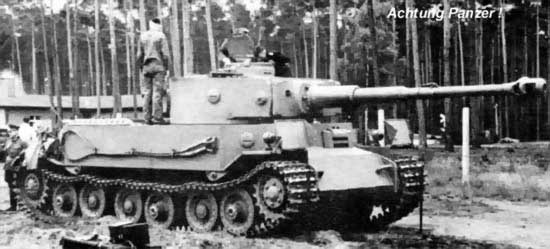
German tank commanders such as the aces Michael Wittmann and Hyazinth von Strachwitz employed the "Tiger" tank of World War Two [WW2] fame with great efficiency.

The Tiger tank was a formidable weapons system when used by able hands.

Possessed very thick and virtually, for it's time, impenetrable frontal armor.

Possessed a very powerful gun that could destroy any existing enemy armor, Soviet or Allied. This gun was of the caliber 88 mm. Based on the famous German 88 mm flak gun. Having found the 88 mm anti-aircraft artillery piece to be eminently suitable for anti-armor warfare when used in a ground role, it was only natural to outfit the latest and most powerful German tank with such a gun as well.

The Tiger tank was a reaction to the realization on the part of the Germans that most of their armor vehicles were INFERIOR in quality to that of their adversaries, at least in the early stages of the war.

Both during the campaigns in France [1940], and in Russia [1941], German armor units fought adversaries whose tanks were both more numerous and of better quality. German success at armored warfare was due to the manner with which the Nazi commanders employed THEIR tanks. Rather than dispersing them to support the infantry, the German CONCENTRATED their tanks and focused their combined energy against enemy WEAK SPOTS. The German objective was to rupture the enemy defenses and create a breakthrough situation. Tanks would then rapidly advance with the intent of destroying enemy rear echelon units, service and service support, a collapse of the entire enemy front being the inevitable result.

"The German tanks that preceded the Tiger balanced mobility, protection, and firepower. They were sometimes outgunned by their opponents (at the time the best tank to put against enemy tanks was the Panzer III with its 50mm gun), but greatly superior German tactics offset this disadvantage."

[concentrated armored formations of German tanks were supported by Luftwaffe ground attack aircraft such as the Stuka which blasted a path through enemy defenses, creating the circumstances favorable for a breakthrough.]

Even when faced with superior Soviet tanks such as the T-34 or the KV tank [Klementi Voroshilov], German tank tactics used in the Russian campaign of 1941 were still successful. By AVOIDING Soviet strength and attacking WEAKNESS, German victories of prodigious proportions via armored assault were still possible.

NONETHELESS, the Germans quickly realized that the Soviet T-34 and the KV tank posed really serious problems for them. Problems for which a counter had to be devised.

"The Tiger had in part been a response to Soviet heavy tanks, namely the KV-1, as well as the medium T-34 which had some notable successes against lighter German tanks of the time."

"There was great consternation when it was discovered that the Soviet tanks were superior to anything available to the Wehrmacht".

That counter was the Tiger tank.

The Tiger tank WAS a successful counter to the Soviet machines. Thicker armor and a more powerful gun meant that the Tiger was more or less impervious to frontal attack while being able to destroy opponents at hitherto unheard of ranges. ONE Tiger was worth TEN opposing tanks??!!

The Tiger, however, was NOT without it's drawbacks. Drawbacks that in some cases were very serious.

* Such a heavy machine as the Tiger WAS ponderous. All that armor and large gun meant that the Tiger was far heavier than existing German tanks. Mobility was sacrificed for protection and killing power. THE TIGER WAS SLOW!! LACKED SPEED AND MOBILITY PERIOD!!

"The Tiger I represented a new approach that emphasized firepower and armor at the expense of mobility."

[tanks since their onset as a military weapon have been an engineering compromise of mobility, protection and firepower. The successful tank is the best engineering compromise of all three aspects.]

* The Tiger was rushed into production and had a lot of teething problems. Mechanical breakdown and a lot of maintenance meant down-time and a lack of availability for combat.

"The Tiger had reliability problems throughout its service life; Tiger units frequently entered combat understrength due to breakdowns. It was rare for any Tiger unit to complete a road march without losing vehicles due to breakdown."

* The Tiger could not be produced in large enough numbers to make a difference. Took a lot of time to build and only a limited number were produced.

"A major problem with the Tiger was its very high production cost. During the Second World War over 40,000 American Sherman and 58,000 Soviet T-34s were produced, compared to 1,350 Tiger I and 500 Tiger II tanks."

The Tiger was formidable. When handled by able crews and commanders, could wreak a lot of destruction. But when faced with overwhelming numbers, as it was, the Tiger did not make the difference the German had hoped it would.

"During the Second World War over 40,000 American Sherman and 58,000 Soviet T-34s were produced"

Simple as that!!

coolbert.

Labels: