Thoughts on the military and military activities of a diverse nature. Free-ranging and eclectic.

Sunday, April 13, 2008

Q.


This is coolbert: Q.

Once again, alarming headlines that capture the attention of the media. Pirates at work again. An age-old menace has again reappeared. Something [the practice of piracy] that the average-everyday-man-on-the-street had thought was banished to the history books along with the cavalry is now enjoying, in certain parts of the world, a resurgence of surprising proportions.

Pirates, attacking merchant vessels or cruise ships, seizing valuable cargo or taking hostages for ransom. Bad folks [the pirates] that need to be taken "care of" through a variety of means. APPEASEMENT NOT BEING ONE OF THEM!!!

[pirates have "enjoyed" in the past the same degree of condemnation that today is directed toward terrorists. Hanging captured pirates "with all due dispatch" historically being the usual punishment!!]

This past week has seen pirates hijack a French luxury cruise ship in the Indian Ocean. Somali pirates operating off the Horn of Africa. An "incident" that lasted a week, only being resolved this last Friday.

"Pirates seize French yacht"

"PARIS, France (AP) -- Pirates seized control of a French luxury yacht carrying 30 crew members Friday in the Gulf of Aden off Somalia's coast, the French government and the ship's owner said."

"Attackers stormed the three-mast Le Ponant as it returned without passengers from the Seychelles, in the Indian Ocean, toward the Mediterranean Sea, said officials with French maritime transport company CMA-CGM."

[no passengers, just crew, an exclusive cruise ship with all the ammenities. Looks very fancy.]

"Sarkozy: Pirates have released hostages"

"PARIS, France (AP) -- The 30 hostages held on a tourist yacht by pirates off the coast of Somalia have been released, French President Nicolas Sarkozy said Friday."

"France sent elite commando troops to the region earlier this week to bolster efforts to free the captives."

"A French frigate was diverted from its NATO duties and tracked the yacht, while a French plane dispatched from a French base in Djibouti flew over the boat, military officials said"

Military force by a special French hostage rescue force was an option. NOT employed, but still an option. The threat of the use of force was enough to guarantee the release of the hostages? It is not clear.

Here is another blast from the past, a weapon of war and a legacy of World War One [WW1] again thought relegated to the history books, that could be useful in combatting pirates, where ever they are found?

The Q-ship.

A merchantman, disguised with hidden arms [and fighting men], designed originally "intended to lure submarines [German U-boats] into surface attacks, in order to sink them".

"Q-ships also known as Q-boats, Decoy Vessels, Special Service Ships or Mystery Ships are heavily armed merchant ships which are intended to lure submarines into surface attacks, in order to sink them."

"the Q-ship, one of the most closely-guarded secrets of the war . . . The Q-ship would pose as an easy target for the U-boat but in fact carry hidden armament."

[submarines of the WW1 era in particular could carry only a limited number of torpedoes. More often than not, a U-boat would generally try to sink a merchant vessel using naval gunfire from a gun mounted on the deck of the submarine than use a valuable torpedo!]

A modern Q-ship, disguised as a slow-moving and "helpless" merchant vessel, lures pirates into an attack. Once the pirates commit themselves, voila', the Q-ship becomes a fighting vessel, much to the detriment of the pirates.

Will this ever transpire? Q-ships being deployed by whoever, designed to lure pirates into attack. Put the fear of GOD into the bad guys. Play a deterrent role that will make the villains think twice before attacking what is apparently a defenseless freighter!

I doubt we will ever see such a thing. But does the idea have merit? I think so.

coolbert.

Labels: ,

Sunday, October 14, 2007

Bugi Men IV. [Conclusion]


This is coolbert:

"Many of the soldiers from the NAOU later went on to join Z Special Unit"

Z Special Unit. Often referred to as Z Special Force. Australian commando unit during World War Two [WW2]. Ranged far and wide during WW2, New Guinea, the Indonesian archipelago, AND AS FAR WEST AS SINGAPORE.

"Z Special Unit, often known as Z Force, was a joint Australian, British and New Zealand commando unit"

"All of its [Z Special Unit] missions were cloaked in ultimate secrecy and even though it's been over 50 years since the end of World War II very little is known of its 182 missions."

[Bill Reynolds for one is NOT EVEN INCLUDED AMONG THE NAMES OF THOSE AUSTRALIANS KILLED IN ACTION DURING WW2. It is known for a fact Bill was killed! Secrecy being what it is, to not even include a hero of the war among the names of the war dead is strange!!??]

Best know for the two commando missions targetting Japanese shipping anchored in Singapore harbor. Missions that used unihabinted islands OF THE RIAU ARCHIPELAGO AS FORWARD STAGING BASES. ONLY SEVEN MILES FROM DOWNTOWN SINGAPORE!

These were the Jaywick and Rimau missions. One very successful, the second not so much so!! Both the Jaywickers and MODERN DAY PIRATES FOUND USING THE ISLANDS OF THE RIAU ARCHIPELAO TO THEIR ADVATAGE!!


"[the] most daring, unbelievable and most sucessfull Australian commando attack in World War II. They sailed with the Japanese fishing boat Kofuku Maru (renamed into Krait) from Australia to Riouw Archipelago, crossing a large portion of Dutch East Indies, to carried out a commando raid with canoes (!!!). Their targets were the anchored Japanese ships in Singapore Harbor. The raid was a huge sucess, as they sank 37,000 tons of shipping and return safely back to Australia."

"Operation Jaywick was one of the most daring and celebrated special operations undertaken in World War II. In September 1943, 15 Allied commandos from Z Force raided Japanese shipping in Singapore Harbour, sinking seven ships."

The Jaywickers employed folding boats [folboats] and limpet mines for their attack on Singapore harbor. Jaywick did not need fancy high technology to achieve the desired goals. Highly trained, daring, motivated soldiers and sailors, two-man kayaks, mines with magnetic hold-fasts to attach to the sides of targets, and that was that!!

"Limpet mines"

"Limpet mines are a special form of contact mine which are attached to the target by magnets and left, and are so named because of the superficial similarity to the mollusk, limpet . . . Usually they are set off by a time fuse."

"Operation Rimau was an attack on Japanese shipping at Singapore Harbour, carried out by the Allied commando unit Z [special] Force, during World War II. It was a follow-up to the successful Operation Jaywick, which had taken place in 1943."

"The second, similar operation, named "Rimau", was not so sucessful. They again managed to sink ca. 30,000 tons of the Japanese merchant fleet anchored in Singapore Harbor, but all 23 men who took part in this operation were lost either killed or captured-beheaded, including Lt-Col Ivan Lyon, who was killed by the Japanese troops on the tiny island of Soreh on 16 October 1944."

Most surprisingly so, for skilled kayakers, you too can follow in the footsteps of the "Rimau" raiders. Adventure type touring and vacationing, follow the exact path taken by the Aussie commando unit in their abortive and unsuccessful raid on Singapore harbor.

To conclude.

The Stait of Malacca and Singapore harbor have been historically major shipping routes for the last five hundred years or more, infested with pirates, then and now, OPERATING PRIMARILY OUT OF THE RIAU ARCHIPELAGO. Pirates quite of then of the Bugi ethnic group. Bugi men that had the ability to sail vast distances to the west [Singapore], and then return to the east [as far as Australia]!

The Jaywick raiders, sailing from northern Australia, following in the path of the Bugi men to Singapore, attacking shipping in Singapore harbor from the Riau archipelago, and retiring to the east, unscathed, as the Bugi men would have done.

The age-old patterns of behavior are the best ways?! What was good for the Bugi men was good for the Jaywickers!!??

coolbert.

Labels:

Bugi Men II.

This is coolbert:

Bugi. A sea-faring culture of the Banda Sea. Noted sailors AND pirates. Feared for their attacks on "western" vessels carrying spices and other valuable goods. The Bugi man is the "boogeyman".

NOT persons of formidable physical stature. But fearless in battle. Much like the Moro of the Philippines in that regard!

"The Bugis are the most numerous of the three major linguistic and ethnic groups of South Sulawesi, the southwestern province of Sulawesi, Indonesia's third largest island"

"Respected as traders and sailors, and feared occasionally as adventurers and pirates"

NO! NOT just occasionally. By their own words, the Bugis WERE pirates and were very good at it too! NOT above attacking "European" vessels heavily laden with spices of all variety. Rich prizes for the Bugi and worth the risk! Sailed as far west as Singapore and as far north as the Philippines. AND as far east as the northern territories of the Australian land-mass! Followed the prevailing seasonal winds.

"the Bugis built elegant, ocean-going schooners in which they plied the trade routes . . . they travelled . . . to northern Australia, where they exchanged shells, birds'-nests and mother-of-pearl for knives and salt with Aboriginal tribes . . . The Bugis sailors left their mark and culture on an area of the northern Australian coast which stretches over two thousand kilometers from the Kimberley to the Gulf of Carpentaria . . . Each year, the Bugis sailors would sail down on the northwestern monsoon . . . They would stay in Australian waters for several months to trade . . . before returning . . . on the dry season off shore winds"

As far west as Singapore, and as far north as the Philippines. AND to Australia too. There has been a movement of people, historically, from the Indonesian archipelago to the northern reaches of Australia. For trade in "shells, birds'-nests and mother-of-pearl for knives and salt" originally. NOW, the trade is in drugs and persons [illegal migrants]!

coolbert.

Labels:

Bugi Men I.

This is coolbert:

Piracy/Malacca/Bugi/Jaywick.

Believe me, it will all come together!

The most recent edition of the National Geographic has an excellent article entitled, "Malacca Strait Pirates".

"Modern pirates have long plagued Southeast Asia’s Strait of Malacca, robbing sailors, kidnapping crews, and stealing entire ships."

Malacca, the strategic choke-point between Malaya and Indonesia, has been the subject of a prior blog entry. A part of the world that has regained a pre-eminent status as a place of maritime trade AND piracy. With regard to the latter, a plague of historic proportions is once again manifesting itself. Piracy has been "popular" in these waters for centuries, perhaps even millenia!

It was once said of the ruler of Malacca:

"it's ruler - - "had his hand on the throat of Venice"!!

"Malacca - - founded around the year 1400 by a refugee Sumatran Prince. A city that controlled to a large extent the spice trade between Asia and Europe. Spices greatly desired by Europeans and for which they [the Europeans] were totally dependent upon Arab and Venetian traders."

Currently, through the Strait of Malacca pass:

* 1/5th of all seaborne trade passes through the Strait of Malacca.

* 1/3rd of the world's crude oil shipments [natural gas too!!].

Pirates taking on three incarnations:

* Multi-National syndicates.

* Gangs.

* Guerrilla groups [Aceh province/Indonesia].

A very large percentage of the pirate attacks emanate from the Riau Archipelago. Located ONLY SEVEN MILES from downtown Singapore. An archipelago traditionally a staging area for pirate miscreants bent on mayhem!! Has the reputation as a "lawless" area NOT fully under the control of the Indonesian authorities.

Riau-Lingga Archipelago

"Two island groups of Riau province, Indonesia, in the South China Sea south of Singapore . . . Riau-Lingga is comprised of 3,214 islands, of which about 700 are uninhabited . . . . For centuries Riau's significance lay in its location immediately south of the major sea route passing Singapore. The Riau Islands were under the Bugis-influenced Johor sultanate in the 16th century, and during the 18th and 19th centuries were a centre of conflict between Muslim rulers and Dutch and British forces."

ONLY SEVEN MILES FROM THE DOWNTOWN AREA OF SINGAPORE, LAWLESSNESS BEGINS WITH ABANDON!!

[My impression is that Singapore is perhaps the most modern, prosperous, and safe big city in the world!! Can anyone name a place the equal of Singapore?]

Piracy yesterday, today, tomorrow. FOREVER! Piracy that falls into that grey area. Is it a problem that requires a law enforcement response or a military response? Pirates were the TERRORISTS of yesteryear. ANYONE fortunate to get their hands on the villains could deal with them summarily, execution being the norm.

coolbert.

Labels:

Monday, April 26, 2004

Malacca.


This is coolbert:

The Straits of Malacca have become a hot topic item among naval circles.

Good program on the way home today on National Public Radio [NPR] about the Straits and the piracy threat.

How this threat may expand to combine the piracy threat with the terrorist threat. Especially from the various Islamic terrorist groups operating out of Indonesia, where most of the pirates come from.

We have seen how the terrorists in Spain obtained their explosives for their bombing campaign from local criminals in trade for drugs. The terrorists supply the drugs and the criminals the explosives.

The Straits of Malacca are a choke point where some outrageous amounts of the world major commodity trade passes through. Something like a third of the world's exportable oil, half of the world's exportable liquefied natural gas [LNG], etc.

Oil and gas from Indonesia to other points in the world and oil and gas from the Persian Gulf region to Japan primarily, but not exclusively. And besides Indonesia, a lot of smaller players here. Brunei, Singapore in particular are very susceptible to disruption of this major sea lane. To read further about the Straits of Malacca click here.

The Straits of Malacca have been since the time of the earliest European colonists and explorers an important transit point.

First the Arabs, then the Portuguese, then the Dutch, and finally the British used Malacca as an important trading point.

Many battles and wars were fought over the fortress at the Straits of Malacca.

Now the strait separates Malaysia and Indonesia.

The former worried about ferment in Indonesia and the threat it poses to the region, the latter in a state of constant upheaval from many quarters. In the 1960's, the Sukarno regime of Indonesia actually launched a mini-war against the newly created nation of Malaysia. And the Al-Qaeda associated Jamaah Islamiyah hopes to one day create a Malay Muslim state out of Malaysia, Indonesia, and the southern Philippines.

Piracy has always been a serious matter in this region of the world for centuries, even before European colonialism came upon the scene.

The infamous Bugi men of the Banda Sea used to range as far west as Singapore and as far north as the Philippines in search of targets for piracy. These are the same Bugi men your parents used to scare you about when you were a kid, "don't let the boogie man get you."

And the famous white Raja of Sarawak, [on the island of Borneo] Brookes Raja obtained a 100 year rule agreement from the locals for himself and his progeny if he was able to defeat and control the pirates that infested the area [he was able to do so]. To read further about Brookes Raja, click here.

The modern day pirates in this part of the world are no better than the pirates of yore.

Board a ship, at best set the crew adrift in life boats or at worst murder the crew [modern ships carry small crews], steal the ship and sell the commodity cargo at some port, and then use the ship for other nefarious deeds. To read about such a boarding, only seven days ago, on 19 April, click here.

The governments in the area are not equipped to handle this threat.

The Indonesian government is not able to stop the pirates from carrying out their piracy from their territory, as they have too much internal strife on their hands.

The navies of Malaysia and Singapore are too small and ill-equipped to deal with the threat other than on a sporadic basis.

The U.S. Navy does have port facilities in Singapore, although as to how extensive they are is not known to me.

It would seem that U.S. Navy vessels are not properly equipped to deal with this threat.

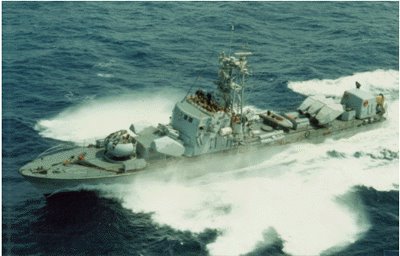
What is required, and I do not know if the U.S. Navy possesses such ships, is gunboats of the Israeli "Reshef" or "Saar" class [click here to see these ships].

Not small, but not big either.

Gunboats have both a good and bad reputation in the world. Gunboat diplomacy leaves a bad taste in the mouths of most modern nations that had a colonial past. But gunboats were also instrumental in ending the African slave trade too. The fight against modern piracy would be an excellent example of how gunboats could be utilized in the modern age.

For surveillance over a large stretch of water, such gunboats could be equipped with radar held aloft by a tethered balloon or could use unattended aerial vehicles [UAV] for a peek over the far horizon. Such capability is already being used and would serve perfectly in this situation.

If real armed boarding force is required, it may be necessary to have Marines or SEALS on standby or actually on board the gun boats, using Zodiac type boats to launching counter-attacks against suspected pirates.

The terrorist/pirate combination here warrants inclusion of the U.S. Navy into the scene.
Economic disruption of such countries as Indonesia, Malaysia, or Singapore would be the goal of the terrorists.

Hijacking an oil tanker of a liquefied natural gas [LNG] tanker would be a disaster if the hijacked ship was used as a floating fire bomb or in the case of the LNG tanker, a floating bomb that would have the destructive effect of a nuclear explosion. Sail one of these ships into Singapore harbor and the disaster would be terrible, even to contemplate. Such a scenario has been proposed as a possible threat for some time now. Has not materialized, but is a definite threat. Read further about this threat by clicking here.

What is needed is a solution now.

Well, as in so many things, it would seem the terrorists and the pirates have the upper hand now and for some time into the future. Let us hope the problem can be properly addressed and solved. This should also be an indication that the terrorist threat is not confined merely to western targets. This is a world-wide scourge.

coolbert.

Labels: