Thoughts on the military and military activities of a diverse nature. Free-ranging and eclectic.

Saturday, December 09, 2006

Live-and-Let-Live.

This is coolbert:

During World War One [WW1], it was not uncommon for certain sectors of the "front" to become known as "quiet sectors".

Places [sectors] where both sides refrained from serious combat.

A modus vivendi, informal, was reached so that the normal vicissitudes of trench warfare came to a basic halt. Neither side would engage in offensive combat action against the other.

"mo·dus vi·ven·di - - 1. manner of living; way of life; lifestyle. 2. a temporary arrangement between persons or parties pending a settlement of matters in debate."

"vi·cis·si·tude - - 1. a change or variation occurring in the course of something. 3. vicissitudes, successive, alternating, or changing phases or conditions, as of life or fortune; ups and downs"

Restraint seems to have foremost in the minds of soldiers on both sides:

"In one section the hour of 8 to 9 A.M. was regarded as consecrated to 'private business,' and certain places indicated by a flag were regarded as out of bounds by the snipers on both sides."

"The quartermaster used to bring the rations up... each night after dark; they were laid out and parties used to come from the front line to fetch them. I suppose the enemy were occupied in the same way; so things were quiet at that hour for a couple of nights, and the ration parties became careless because of it, and laughed and talked on their way back to their companies."

This situation was rarely the result of some sort of high-minded ethical motivation.

Rather, as argued on one particular web site, was the result of mutual cooperation made possible by psychological considerations for survival!!??

This is called the "The Live-and-Let-Live System in Trench Warfare in World War I".

I would offer an alternative reason as to why some sectors became known as "quiet".

The terrain of the area had become so chewed up by trench warfare that above-ground movement had become more or less impossible.

"The real reason for the quietness of some sections of the line was that neither side had any intention of advancing in that particular district."

[the above quote from that same web site as cited linked previously.]

Trench warfare as practiced in WW1 was enormously destructive of the landscape. The two parallel trench systems as dug by both sides usually had:

* "a main trench system of three parallel lines, interconnected by communications trenches"

* "Behind the front system of trenches there were usually at least two more partially prepared trench systems"

* Found within a trench system would be dugouts, listening posts, and strong points [redoubts]. Between the parallel lines would be a maze of barbed wire entanglements of amazing depth.

The entire area on both sides of the trenches to some depth would be pockmarked like the surface of the moon, and then some. Craters from the incessant shelling from all caliber guns of ever increasing caliber as the war continued year after year.

The see-sawing battlefields of WW1 quite often saw movement of only a few miles at a time back and forth. IF EVEN THAT. SOMETIMES THE MOVEMENT WAS MEASURED IN MERE YARDS! EACH MOVEMENT NECESSITATING THAT NEW TRENCHES, DUGOUTS, STRONGPOINTS BE DUG AND MANNED, FURTHER ENTANGLEMENTS OF BARBED WIRE MAZES BE PUT IN PLACE, ETC.

THE LANDSCAPE OF A WW1 BATTLEFIELD HAD BECOME VIRTUALLY IMPASSABLE EVEN FOR FOOT MOVEMENT. THE BREAKTHROUGH OFFENSIVE SO DESIRED BY THE GENERAL STAFFS OF THE VARIOUS COMBATANTS HAD BECOME IMPOSSIBLE.


This is in all likelihood for the REAL REASON SOME SECTORS OF THE WW1 BATTLEFIELD BECAME KNOWN AS "QUIET"!!

coolbert.

Labels:

Sunday, June 13, 2004

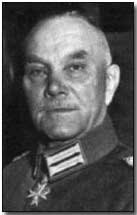
Bruchmuller.


This is coolbert:

In a previous post, I mentioned this defense group [Defense and the National Interest], that categorizes and defines warfare by generations.

According to this defense group, third generation warfare is the blitzkrieg type of warfare as first practiced by the Germans in the latter days of World War One.

Prior to the blitzkrieg style offense of the Germans during this period, the stalemate faced by the combatants in World War One was seemingly unresolvable. All throughout the war, the various combatants had tried offense after offense that eventually ended in failure. The original battles of 1914, the Somme, Verdun, Gallipoli, etc., all began with high hopes on the side of the initiator that this offensive would end the war once and for all. NONE of them did. They all resulted in further stalemate with just horrendous casualties to both the attacker and defender.

It was not until the end of 1917 that the Germans seemed to have solved the problem of the stalemate by introducing new tactics. These tactics incorporated the elements of infiltration tactics [penetrating enemy lines by the use of surprise, and stealth], release of poison gas right on the enemy positions by artillery shell [prior to this poison gas was released from canisters and allowed to drift by the breeze to the enemy position], strafing of ground troops by ground attack aircraft, and a super-intense artillery bombardment of short but extremely intense nature designed to "neutralize" the enemy [not necessarily destroy, but render the enemy capable of coherent action].

"neutralization fire - - (DOD) Fire which is delivered to render the target ineffective or unusable."

"infiltration - - (DOD) 1. The movement through or into an area or territory occupied by either friendly or enemy troops or organizations. The movement is made, either by small groups or by individuals, at extended or irregular intervals. When used in connection with the enemy, it infers that contact is avoided."

"At this early stage of the war [1914?] artillery bombardments tended to span several days (and sometimes a week or more) prior to the actual commencement of infantry action. Artillery was in effect being used as a means of demolishing the opposition, although most available evidence demonstrated its continuing failure as a breakthrough weapon. Furthermore extensive artillery bombardments were taken as a sure sign of a forthcoming infantry offensive by the opposing force.

[Colonel] Bruchmuller conversely recommended short, sharp artillery offensives as a means of neutralizing rather than destroying the enemy while maintaining the crucial element of surprise. Rather than targeting fixed locations and maintaining a steady barrage he ensured the artillery barrage constantly shifted focus, always targeting important strategic and command posts rather than the enemy front line. He also made extensive use of gas shells to aid enemy confusion."

To read more about the German artillery tactics and Colonel Bruchmuller, the commander and architect of the German artillery tactics, click here.

These elements were first used in 1917 at Riga against the Russians and Caporetto against the Italians with great success by the Germans. The German General Staff now believed they had the winning formula for victory on the western front against the British and the French.

In the spring of 1918 the Germans put their new offensive strategy into effect against the British in three offensives, code named "Michael", "Georgette", and "Blucher". All three offensives nearly succeeded and the war was almost won for Germany. Only the determined actions of small groups of untrained British troops prevented a catastrophic defeat,

"the line was held by small numbers of signallers, ambulance drivers, mess waiters, and batmen, who fought as veteran riflemen until overwhelmed". [Batmen are an institution perhaps peculiar to the British army. Valets who are responsible for the uniform, toilet, and general appearance of officers].

To read more about Michael, the first German blitzkrieg offensive, in March 1918, click here, and here.

Here is an interesting statistic from the last referenced web site that illustrates the intensity of the artillery bombardment for "Michael":

Artillery statistics:

It is interesting to compare statistics between the British artillery barrage prior to their 1st July 1916 offensive on the Somme, and the Bruchmuller plan for 21st March 1918.

Somme: 1916 Duration 7 days [1916]' number of guns 1,437 [1916]; number of shells1,500,000 [1916]

Michael: 1918 Duration 5 hours [1918]; number of guns 6,473 [1918]; number of shells1,160,000 [1918]

One very significant factor in the infiltration tactics used by the German infantry in these offensives was the organization of "Storm Troops". Battalions of specially chose, physically fit, proven men of initiative who led the infiltration of British lines and the further penetration and pursuit. These troops performed very well and were a key to the German success. They also suffered inordinate casualties. So much so that when the offensives ended, the remaining troops were of low level and were unable to continue the advance.

These offensives did not only not win the war for Germany, they helped to defeat Germany in the long run!

coolbert.

Labels: