Thoughts on the military and military activities of a diverse nature. Free-ranging and eclectic.

Saturday, December 15, 2007

Crown of Grass.

This is coolbert:

More wiki stuff on the Romans and their legions.

The highest military decoration that could be awarded to a Roman soldier was a CROWN OF GRASS!!!???

"Roman military decorations and punishments"

[the Romans did have a whole range of punishments for soldiers that did not go their duty. This blog entry concerns only the highest award for superlative achievement!!]

Grass Crown.

"Grass Crown- (Latin, corona obsidionalis or corona graminea) was the highest and rarest of all military decorations. It was presented only to a general or commander who broke the blockade of a beleaguered Roman Army"

A Roman legion or army, surrounded and beset by an enemy, in danger of annihilation, is rescued by a relief column of other Roman legions. The general at the head of the relief column, receiving the award, "it was never conferred except at a crisis of extreme desperation, never voted except by the acclamation of the whole army".

[a general would have the soldiers of his own army confer this decoration by acclamation!! AND ONLY THEN!! Whoa!!]

"the highest and rarest of all military decorations in the Roman Republic and early Roman empire. It was presented only to a general or commander who broke the blockade around a beleaguered Roman army, thus saving a legion or the entire army."

"The Grass Crown can be compared the the contemporary Medal of Honor [OR Victoria Cross], which is awarded for valor 'beyond the call of duty',"

"Pliny also lists the persons who by their deeds won the grass crown":

* Lucius Siccius Dentatus.
* Publius Decius Mus. (received two grass crowns—one from his own army, and another from the troops which he had rescued when surrounded)
* Fabius Maximus.
* Marcus Calpurnius Flamma.
* Scipio Aemilianus Africanus.
* Gneius Petreius Atinas.
* Lucius Cornelius Sulla.
* Quintus Sertorius.

Traditionally, according to military historians of the U.S. Army, military units besieged and blockaded normally ONLY survive BY RELIEF FROM OVERLAND COLUMN. Such military operations by their very nature are fraught with great danger and are difficult to perform!!?? Alesia, Kut, Khe Sanh!!

Augustus also was award a Crown of Grass, but as a political, symbolic award, NOT for rescuing a beleaguered Roman military force. Think Wainwright and Mac Arthur in modern times??!!

coolbert.

Labels:

Engineers!

This coolbert:

Read this amazing wiki entry on the Roman military engineering expertise.

Way far ahead of Roman contemporaries??!! Was a very institutionalized, integral, and important aspect of the Roman legion and Roman military conquest.

My comments on the wiki entry [in BOLD as usual!!]"

"The military engineering of Ancient Rome's armed forces was of a scale and frequency far beyond that of any of its contemporaries . . . each Roman legionary had as part of his equipment a shovel"

The Romans were hardly the first to employ military engineers, but it was the scale, and institutionalized aspect of their engineering that made them unique in this respect.

"when on the march, particularly in enemy territory, the legion would, after a day's marching, construct a fortified camp or castra, requiring as raw materials only earth, turf and timber . . . A legion could throw up a camp under enemy attack in as little as a few hours."

We have to be clear here. EACH AND EVERY DAY DURING THE MARCH OF A LEGION, A NEW CAMP WOULD BE CONSTRUCTED. A FORTIFIED CAMP, COMPLETE WITH MOAT [A DITCH BY MODERN PARLANCE, NOT WATER FILLED!] AND STOCKADE, TENTS AND INTERIOR BUILDINGS ALSO ERECTED WITHIN THE BOUNDARIES OF THE STOCKADE. EACH AND EVERY DAY WHILE ON THE MARCH - - A NEW CAMP - - FORTIFIED!!

"One of the most notable examples of military bridge-building in the Roman Empire was Julius Caesar's Bridge over the Rhine River. This bridge was completed in only ten days and is conservatively estimated to be more than 300 feet long. The construction was deliberately over-engineered for Caesar's stated purpose of impressing the Germanic tribes"

Roman roads of course required bridges! As I have said in a previous blog entry, Roman roads were generally constructed in as straight a line as possible. NOT necessarily conforming to the terrain as would be a modern road. This WAS DONE IN LARGE MEASURE FOR PSYCHOLOGICAL PURPOSES??!! The Romans are saying to the locals, "we even defy the forces of nature itself and are victorious - - what chance - - do you have against us!!??"

In World War Two [WW2], the Rhine river WAS SEEN as a major obstacle for the allied forces prior to the invasion of Germany proper. A formidable obstacle. CAPTURING THE BRIDGE AT REMAGEN WAS A MAJOR COUP DE MAIN OF SIGNIFICANT PROPORTIONS!! The British Army when crossing the Rhine [1945] did so only with an effort that in magnitude closely resembled the Normandy invasion [D-Day].

In his book, "The Liberators", Suvorov speaks of Operation 'Bridge'. The construction of a railroad bridge designed to impress foreign observers!! The Soviets were trying to say, "even the Rhine is not an obstacle to us!!" Big Red moving from east to west will NOT be stopped by an insignificant obstacle as the Rhine. NATO BEWARE!!

[the bridge was a sham, according to Suvorov, but must have been impressive to some. I recall seeing a U.S. Army booklet from the era of the Cold War that DID describe this bridge as a "done deal"!]


[personal comment! Do you find that to be spooky? Caesar builds a great bridge across the Rhine to impress the Germanii locals. Two thousand years later the Soviets build a bridge [albeit a sham one!] to again impress the Germanii and their NATO allies!]

"The Roman army also took part in building projects for civilian use . . . the involvement of the soldiers in building works, kept them not only well accustomed to hard physical labour, but also kept them busy"

Good training. Any sergeant will tell you that. Hard physical labor, work as a team, learn skills that will be useful while on the march, etc.!!

"the scale of Roman military engineering exceeded that of any of its contemporaries in both imagination and scope."

"extra-ordinary constructions [by the Roman military engineers] . . . the walling in of the entire city of Alesia . . . within a massive length of double-wall - one inward-facing to prevent escape or offensive sallies from the city, and one outward-facing to prevent attack by Celtic reinforcements. This wall is estimated to be over 13 miles long"

That is an impressive figure. Thirteen miles. Is this the combined length of the inner and outer wall is not clear. And moat too, with watch towers, further impediments, etc.!

Romans - - can do!!

coolbert.

Labels:

Tuesday, January 17, 2006

Commands.

This is coolbert:

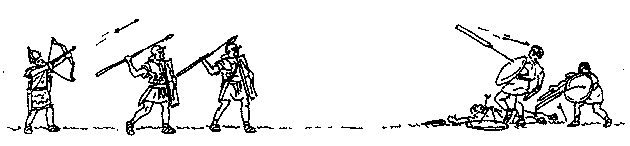
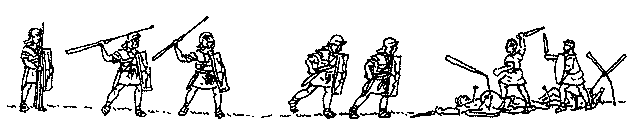
Here is an extract from a web site that illustrates HOW the Romans employed their missile firing troops as part of the combined arms concept.

[missile firing troops in this instance consists of archers, sling and javelin throwers!!]

Keep in mind that those sling throwers [peltists] are heaving at you a solid lead projectile the size of a human kidney. This is a glandes.

The missile firing troops supporting the men-a-foot [infantry] in combat.

It has been noted in a previous blog entry that the Assyrians of old also arrayed THEIR missile firing troops in a similar manner as part of THEIR combined arms concept.

Perhaps the Romans brought the combined arms concept to a much more higher degree of development than did the Assyrians!!??

At any rate, we DO HAVE more info on the subject from Roman times.

From the web site:

"ROMAN BATTLE TACTICS
The following description is just one typical battle tactic that could be employed against the enemy.

The Signifer sounds the call for Battle Formation as the order is shouted, "Form Battle Lines! Battle!" Ad aciem - Pugna! The Centurio gives the order to follow the standard and march towards the enemy, Signo sequate - Moveo! A halt is ordered when the front line reaches a distance of about 100 yards from the enemy's front. Consiste! The Archers and Slingers are ordered forward about 25 yards. The Archers fire a high arcing shower of arrows. The Slingers fire a lower trajectory aimed at the enemy's waist and head.


After a period of time, the Slingers are ordered to the rear. The Archers will continue to fire their arrows while the Legion's front advances past them to a distance that is about 100 feet from the enemy. The front two ranks will now receive the order to plant their pila [javelin]. Pila infige! The Optio marks the front line. The Centurio now gives the order to throw the pilum. Pila iace! This is quickly followed by the order to throw their second pilum. Swords are now drawn and the advance is made to engage the enemy. Gladium stringe! Parati - Oppugnare! - Impetus!


The next two rows advance to the Optio's mark. Now they, in turn, repeat the action of throwing their two pila. Swords are drawn and held at the ready as they slowly move forward to back up the front ranks, now engaging the enemy. The archers have ceased firing. The fifth row is stationed nearby as a reserve line."


Several things to note here:

The archers are firing in a manner for their arrows to descend from a high arc [plunging], while the slingers are throwing in a manner so that their glandes have a "lower trajectory"!! The targets must contend with missiles coming from two directions at once!!

The commands for the Roman missile firing troops are standardized and SIMPLE!! Roman soldiers from all corners of the realm would NOT need be THAT conversant in Latin to be useful and efficient soldiers. Knowing only a few simple commands would be ADEQUATE!! Recall my previous blog entry where Suvorov states that the Soviet soldier, regardless of nationality, regardless of proficiency in Russian, KNEW ten simple commands that would suffice in combat!!

Roman cavalry would of course be waiting in the wings, ready to exploit gaps in the enemy defenses created by the infantry advance.

Such combined arms tactics show a very marked and high degree of military knowledge honed and developed over centuries!! Tactics that served the Romans and the Assyrians before them very well!!

coolbert.

Labels: